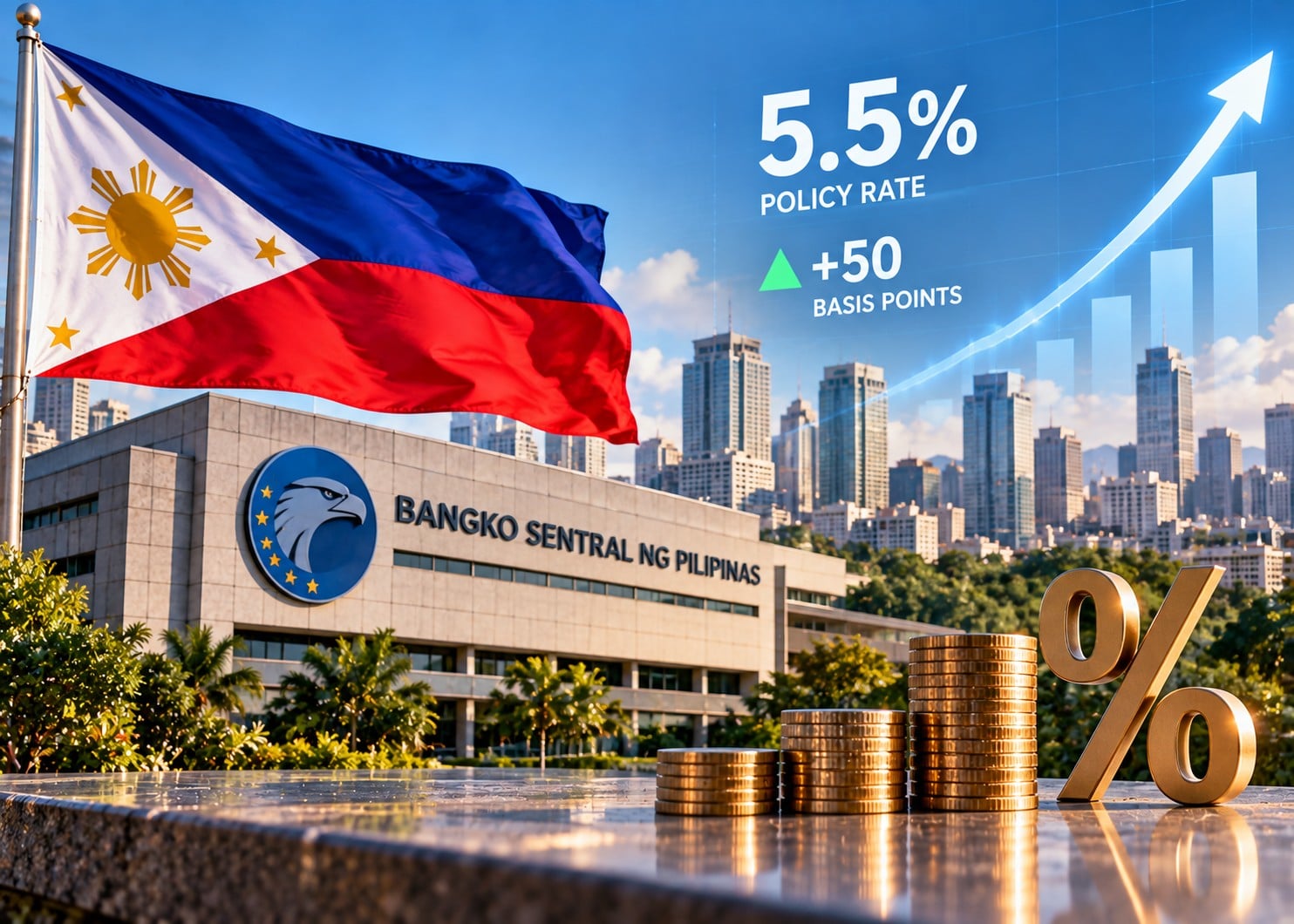
The Philippine central bank raised its benchmark interest rate by 50 basis points to 5.5% Thursday, delivering twice the increase economists expected as policymakers respond to persistent inflation.
All 27 economists surveyed by Reuters had expected a quarter-point increase.
The move marks the central bank’s fourth consecutive rate increase and represents a more aggressive attempt to prevent elevated prices from becoming embedded in inflation expectations.
The Bangko Sentral ng Pilipinas described the larger move as necessary to contain second-round inflation effects.
Energy costs remain an important risk as elevated oil prices feed into transportation, electricity and other domestic prices.
Weather conditions associated with El Niño are creating additional uncertainty around food inflation.
The central bank maintained its 2026 inflation forecast at approximately 6.1% and increased its 2027 projection to 6.0%.
Both figures remain well above the central bank’s normal inflation target.
The Philippine peso initially strengthened following the decision before giving back much of the move, illustrating the difficult policy environment.
Higher interest rates can support the currency and restrain inflation, but they also increase borrowing costs at a time when economic growth has been relatively weak.
Governor Eli Remolona indicated that additional increases remain possible depending on the inflation outlook.
That keeps the policy path open rather than establishing Thursday’s move as the end of the tightening cycle.
The decision is also notable within the broader Asian monetary-policy landscape.
South Korea’s central bank held rates at 3% earlier Thursday while leaving the door open to additional tightening.
The Philippines has chosen a considerably more aggressive response.
Markets will watch core inflation, the peso, oil prices and the next policy meeting for evidence of whether the 50-basis-point increase was sufficient to stabilize inflation expectations.