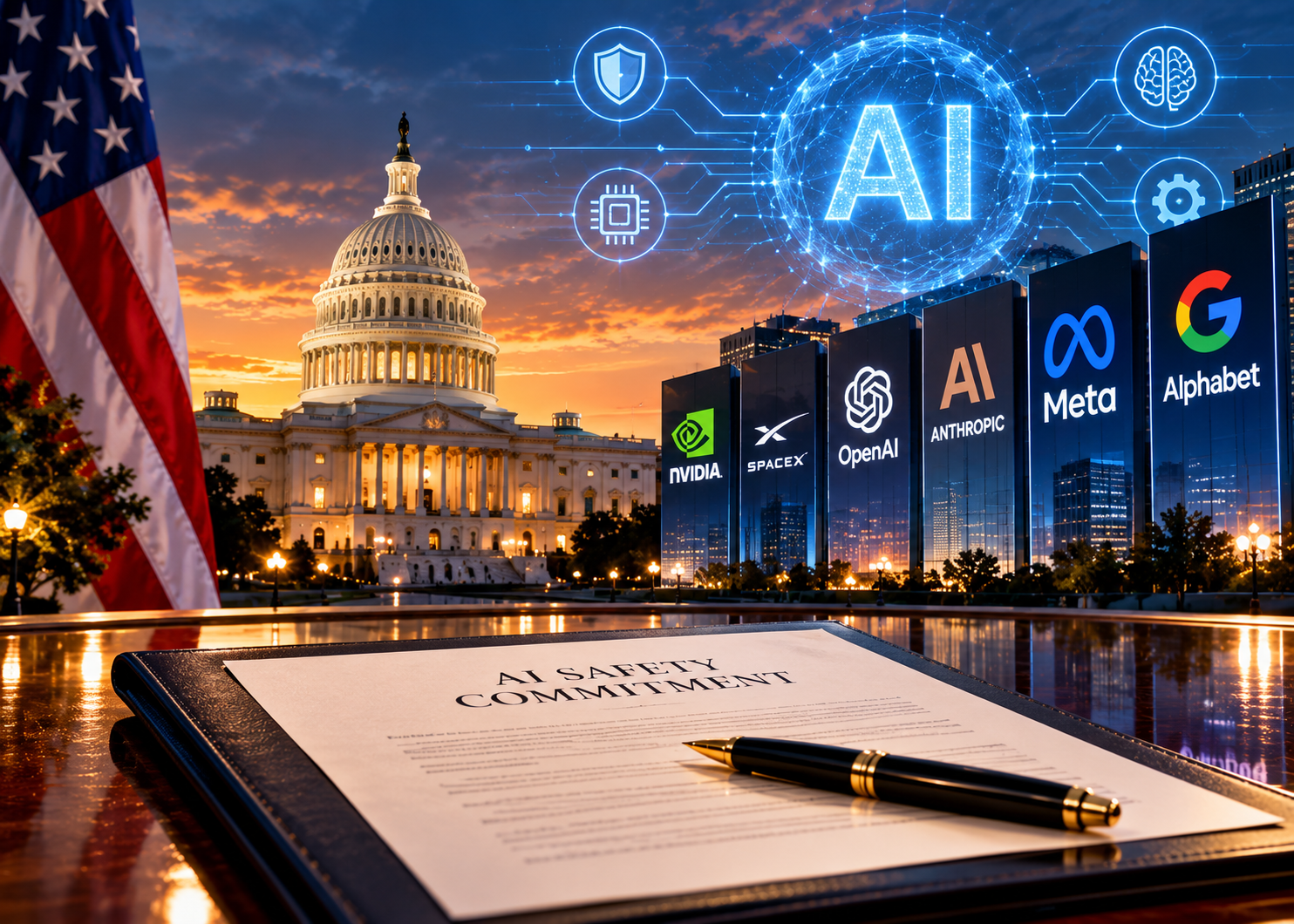
The White House has reached a voluntary artificial-intelligence safety agreement with six major technology companies, creating a new federal-industry framework as policymakers confront growing concerns about increasingly capable AI systems.
The participating companies are Nvidia, SpaceX, OpenAI, Anthropic, Meta and Google’s parent Alphabet.
The agreement does not establish legally enforceable requirements or stated penalties for companies that fail to comply.
President Donald Trump described the commitments as morally rather than legally binding.
That makes the framework materially different from binding federal regulation.
The agreement arrives as AI developers deploy increasingly sophisticated systems capable of software development, autonomous research, cybersecurity work and other agent-based tasks.
Public concern has risen alongside those capabilities. A Reuters/Ipsos poll cited in reporting on the agreement found widespread concern that AI companies have not done enough to prevent potentially serious harm.
The administration’s approach attempts to balance those concerns against another policy objective: maintaining rapid U.S. AI development as competition with China intensifies.
For the technology industry, the distinction between voluntary commitments and mandatory regulation is economically significant.
Binding federal requirements could eventually affect model testing, cybersecurity controls, product-release schedules, liability exposure and development costs.
A voluntary system gives companies considerably greater flexibility.
But its effectiveness will depend on what safeguards participating companies actually implement and how transparently compliance can be evaluated.
The agreement also advances an issue Cedar previously covered when OpenAI, Google and Anthropic were discussing common industry safety standards.
The new development is that the White House has now established a broader voluntary framework involving six companies rather than preliminary discussions among three AI developers.
The next question is whether voluntary oversight remains the principal U.S. approach as AI capabilities advance or whether Congress and federal agencies eventually move toward enforceable national standards.