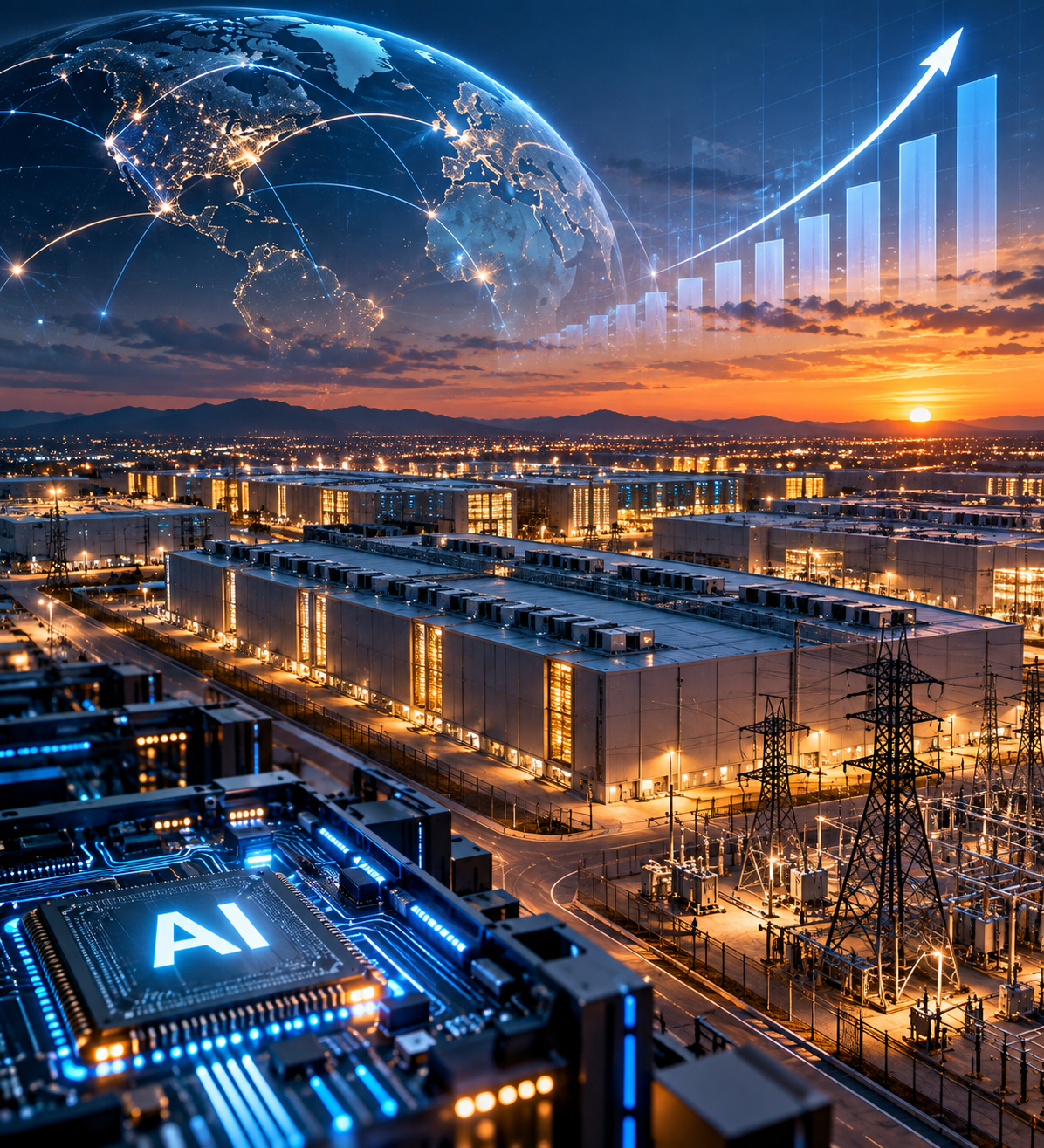
The global artificial-intelligence investment boom is moving into territory unmatched by previous technology revolutions, with cumulative spending on data centers alone potentially exceeding $30 trillion by 2050, according to a projection from PwC reported by Reuters.
That figure approaches the current value of the entire outstanding U.S. Treasury market and illustrates the extraordinary amount of capital being committed to the infrastructure required to develop and operate increasingly powerful AI systems.
The spending extends far beyond semiconductor chips.
AI development requires enormous investments in data centers, electricity generation, transmission networks, cooling systems, networking equipment and specialized computing hardware. Technology companies are simultaneously competing to build larger models and expand the infrastructure needed to serve those models to businesses and consumers.
The scale creates an increasingly important question for investors: whether AI can generate enough economic value to justify the capital being deployed.
The current investment cycle differs from the dot-com boom in one important respect. Many of the companies financing the largest AI projects are highly profitable technology groups with substantial cash generation and access to capital.
That financial strength allows the buildout to continue even before the ultimate economics of AI applications have been established.
But capital requirements are accelerating.
As models become more computationally demanding and AI usage expands, companies must continually add processing capacity and electricity supply. That has pushed the AI investment cycle into industries that previously sat outside the center of technology markets.
Utilities, nuclear generators, natural-gas producers, electrical-equipment manufacturers and data-center developers are increasingly becoming part of the AI investment story.
The consequences are also reaching global capital markets.
Large-scale AI infrastructure projects compete for financing alongside governments, corporations and other industries. At a time when sovereign borrowing requirements are already elevated, trillions of dollars of additional private infrastructure spending could influence borrowing costs and capital allocation for years.
There is also execution risk.
History shows that transformative technologies can create enormous long-term economic value while still producing periods of excessive investment, overcapacity and investor losses.
Artificial intelligence could ultimately increase productivity across software, medicine, manufacturing, finance and other industries. But the scale of today’s investment means companies will increasingly be judged not simply on their ability to build AI systems, but on their ability to monetize them.
For markets, that is becoming the defining question of the AI cycle.
The infrastructure race is no longer simply about who can build the largest model. It is increasingly about whether the economic returns generated by artificial intelligence can justify one of the largest capital-investment waves in modern history.