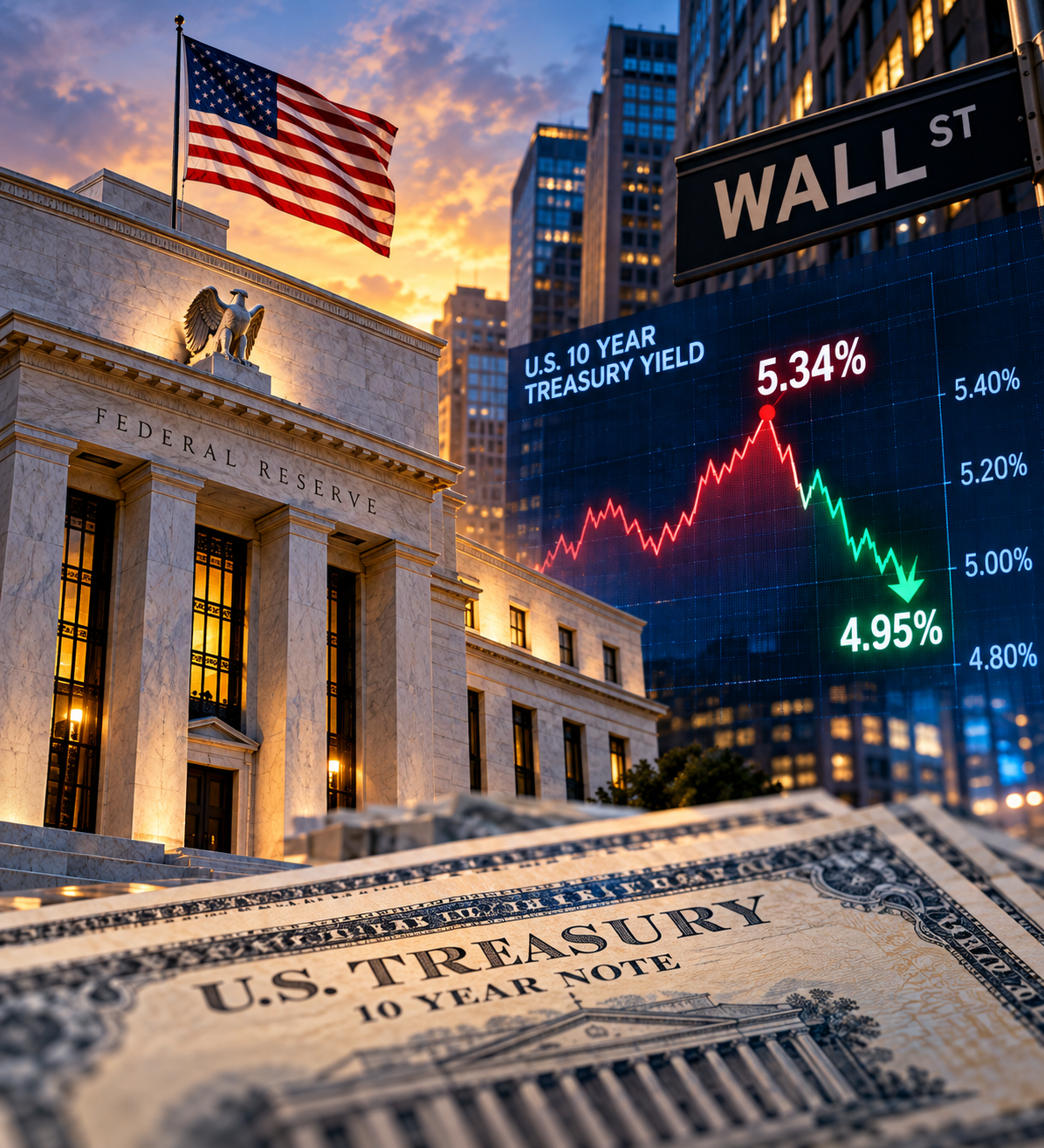
The global bond shock that drove the U.S. 10-year Treasury yield to its highest level since 2002 reversed sharply later Thursday, allowing Wall Street to recover from early losses as Federal Reserve officials pushed back against expectations for another immediate interest-rate increase.
The 10-year yield had climbed to roughly 5.34% earlier in the session, extending a selloff that pushed borrowing costs across several major economies to multi-decade highs.
By the afternoon, the direction had changed.
Treasury buyers returned and yields moved lower after Federal Reserve Vice Chair Philip Jefferson indicated policymakers may need more time and additional economic data before determining the next adjustment in monetary policy.
The two-year Treasury yield dropped roughly 10 basis points and was headed for its largest one-day decline since August 2025.
Jefferson’s remarks reinforced the more patient policy message delivered earlier in the week by New York Fed President John Williams, who said there was no urgency to change interest rates.
Markets responded by substantially reducing expectations for another increase at the Federal Reserve’s October 27-28 meeting.
Fed-funds futures implied approximately a 28.2% probability of at least a 25-basis-point October increase, down from 68.6% one week earlier.
That repricing helped equities recover.
The S&P 500 gained 0.20% to close at 7,666.48. The Dow Jones Industrial Average rose 0.04% to 50,926.74, while the Nasdaq Composite added 0.04% to finish at 26,871.60 after all three indexes faced pressure earlier in the session.
The rebound did not eliminate the underlying inflation concern.
Weekly initial jobless claims fell to 197,000, below the 200,000 consensus estimate, while the Institute for Supply Management’s manufacturing index registered 54.5 in September and showed higher input prices.
Oil added another source of inflation pressure, with Brent crude rising more than $4 a barrel as tighter fuel supplies supported energy markets.
Thursday therefore left investors with competing signals.
Long-term borrowing costs remain historically high, but Federal Reserve officials are signaling that policymakers do not necessarily intend to validate the bond market’s earlier aggressive tightening expectations with an immediate October rate increase.
Attention now turns to the next U.S. employment report.
A stronger-than-expected labor-market reading could revive pressure on Treasury yields and interest-rate expectations. A softer report could reinforce the argument for the Fed to wait while already-tight financial conditions work through the economy.
Thursday ultimately became less about the 5.34% Treasury peak than what happened afterward: the bond market tested an extreme level, Fed officials resisted the implied policy path, yields reversed and U.S. equities recovered.