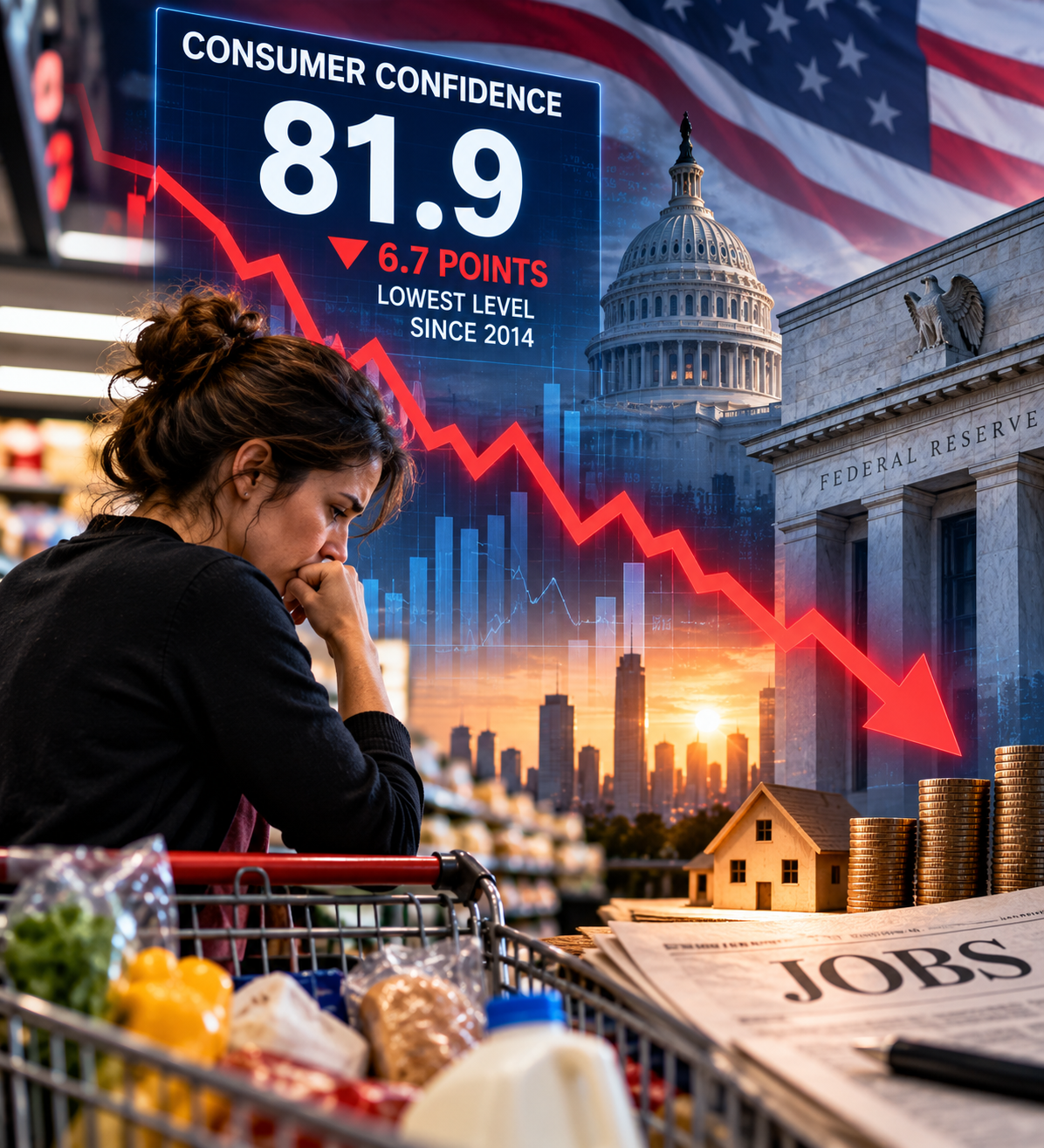
U.S. consumer confidence fell sharply in September to its lowest level in more than 12 years as households became increasingly concerned about employment, rising interest rates and the cost of living.
The Conference Board’s consumer confidence index dropped 6.7 points to 81.9, its lowest reading since April 2014.
Economists surveyed by Reuters had expected a reading of 89.2, making the deterioration substantially larger than anticipated.
The weakness was broad, appearing across political affiliations, age groups and income levels.
Consumers became notably more pessimistic about employment.
The share saying jobs were plentiful fell to 23.6%, the lowest since February 2021, from 24.5% in August.
At the same time, the share describing jobs as difficult to obtain climbed to 21.9%, its highest since January 2021.
The Conference Board’s labor-market differential — the gap between consumers saying jobs are plentiful and those saying they are hard to obtain — narrowed sharply to 1.7% from 4.2%.
That measure is watched because it has historically correlated with movements in the U.S. unemployment rate.
Separate Labor Department data reinforced the softer labor-demand picture.
U.S. job openings declined by 256,000 to 7.079 million at the end of August, below economists’ expectation of 7.225 million. There were approximately 1.01 available jobs for every unemployed worker, down from 1.06 in July.
The weakness was not accompanied by a major increase in layoffs.
Layoffs and discharges declined by 61,000 to a 17-month low of 1.641 million, suggesting companies remain reluctant to dismiss workers even as hiring demand cools.
That creates a complicated picture for the Federal Reserve.
A weakening labor market normally strengthens the argument for easier monetary policy. But inflation pressures associated with elevated energy prices have moved in the opposite direction.
The Fed increased its benchmark rate by 25 basis points earlier this month to a 3.75%–4.00% range, while interest-rate markets were assigning roughly a 68% probability to another increase in October when the latest data were reported.
Housing is adding to household pressure.
Separate FHFA data showed U.S. single-family home prices increased 0.3% in July and 2.6% from a year earlier, even as the average 30-year fixed mortgage rate reached 7.03%, its highest since January 2025.
The combination of weaker confidence, fewer job openings, high borrowing costs and persistent inflation creates a difficult backdrop for consumer spending.
Markets will now focus on Friday’s employment report. Economists surveyed by Reuters expect approximately 90,000 jobs were added in September, with unemployment holding at 4.1%.
A significantly weaker employment report would strengthen evidence that higher interest rates are beginning to materially cool labor demand.