McDonald’s is increasingly using artificial intelligence to guide menu pricing across its nearly 14,000 U.S. restaurants, bringing sophisticated algorithmic pricing into one of the world’s largest consumer businesses.
The system analyzes millions of transactions and recommends what McDonald’s describes as an optimal price for individual menu items at individual restaurants. One of the factors incorporated into the system is an estimate of customers’ willingness to pay in a particular market, according to a Reuters investigation published Tuesday.
The technology represents a significant expansion of AI beyond the data centers, software development and automation applications that have dominated the investment narrative.
It is increasingly being used to influence everyday commercial decisions — including what consumers pay.
McDonald’s pricing engine uses machine-learning algorithms to evaluate transaction data and local market conditions. Reuters also reviewed company materials showing that the platform incorporates publicly available menu-price information from nearby competitors.
McDonald’s says individual franchisees remain responsible for setting their final prices and describes the system as an advisory tool rather than a mandate.
Some franchisees interviewed by Reuters said they have faced pressure from the company to follow its pricing recommendations. McDonald’s disputed the characterization of its practices as controversial and said the system helps franchisees make informed pricing decisions.
The system can produce substantially different prices between nearby restaurants.
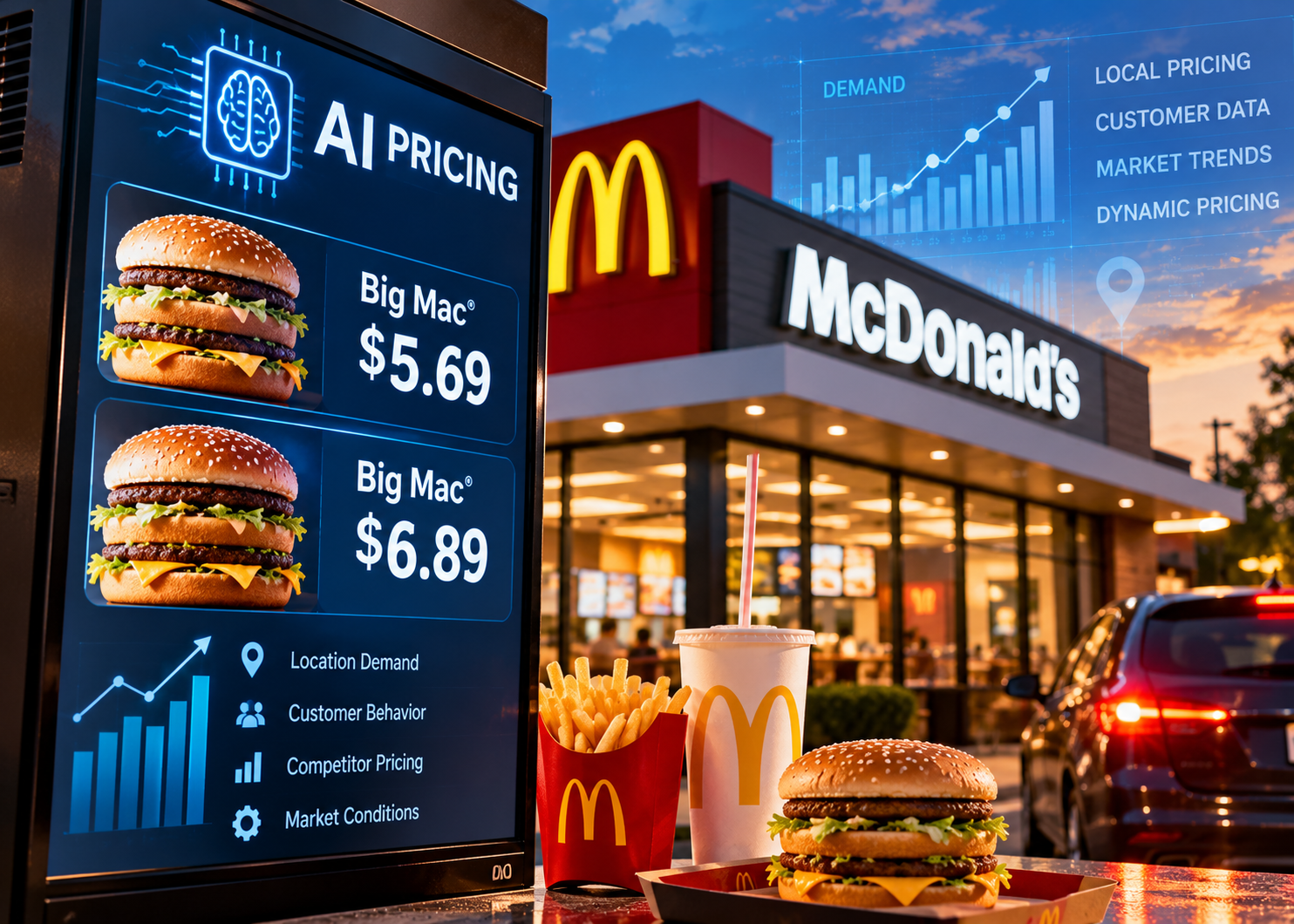
Reuters found one company-operated McDonald’s in Fresno, California, selling a Big Mac for $5.69, while another company-operated restaurant about two miles away charged $6.89 — a difference of roughly 21%.
Reuters could not establish whether the AI pricing system itself caused that particular difference, an important distinction because restaurant operating costs and local market conditions can also vary.
The technology also creates regulatory questions.
McDonald’s pricing portal warns franchisees about compliance with antitrust and competition laws because individual restaurant owners may be considered competitors. U.S. regulators and courts have increasingly examined whether certain algorithmic-pricing systems can facilitate unlawful coordination.
McDonald’s says it takes antitrust compliance seriously and that the warning does not indicate anticompetitive conduct.
The economic incentives between McDonald’s and its franchisees are not always identical.
Corporate revenue depends heavily on a percentage of franchisee sales, while individual restaurant operators must absorb wages, rent and other operating expenses. The National Restaurant Association estimates restaurant operating costs have increased 36% since 2019.
That can create tension over whether restaurants should lower prices to increase customer traffic or raise them to protect individual-store margins.
For investors, McDonald’s provides a large-scale test of how AI can move from operational automation into revenue management and consumer pricing.
The broader question is whether algorithmic pricing becomes standard across retail, restaurants, travel and other consumer industries — and how regulators respond if increasingly sophisticated systems begin influencing prices across competing businesses.