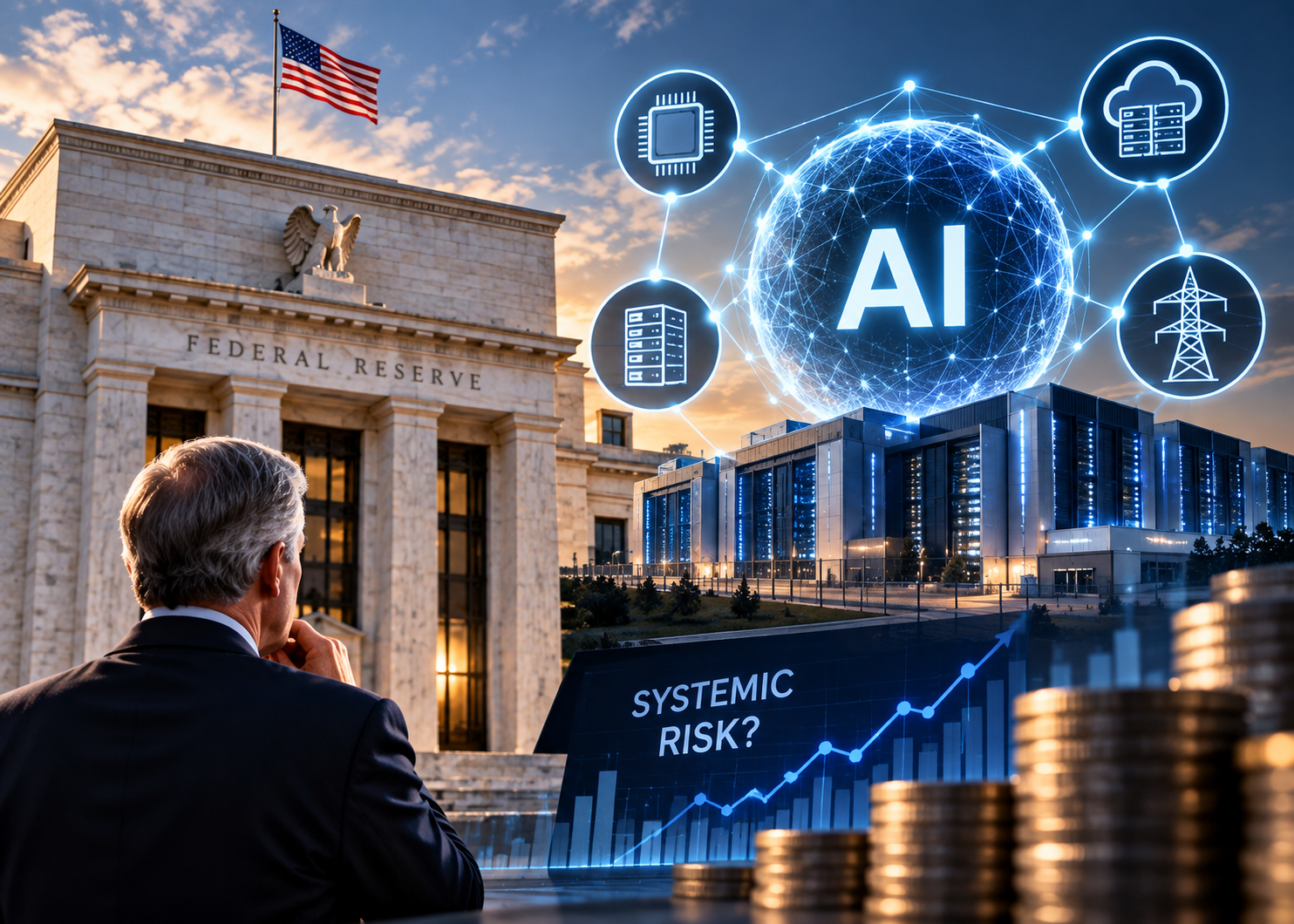
Kansas City Federal Reserve President Jeff Schmid said policymakers need to examine whether the rapidly expanding artificial-intelligence ecosystem is becoming sufficiently interconnected and economically important to create systemic financial risks.
Schmid focused on the growing network of companies and contracts supporting AI and data-center construction, questioning whether the industry could eventually develop characteristics associated with institutions considered “too big to fail.”
The concern is significant because investment in AI infrastructure has expanded rapidly across semiconductor manufacturing, cloud computing, power generation, data centers and related financing.
Schmid did not say that the AI industry currently represents a systemic threat or that government intervention is necessary. Instead, he raised the question of whether policymakers adequately understand the relationships developing inside the sector and whether vulnerabilities could eventually spread through the broader economy or financial system.
The comparison invokes one of the central lessons of the 2007–2009 financial crisis, when the failure of highly interconnected financial institutions threatened broader financial stability and prompted extraordinary government intervention.
For markets, the comments introduce another dimension to the AI investment debate.
Investor attention has largely centered on whether enormous capital expenditures on AI infrastructure will ultimately generate sufficient revenue and productivity gains. Schmid’s remarks raise a separate question: whether the network of companies, contracts and financing supporting that expansion could eventually become important enough to warrant financial-stability scrutiny.
That does not mean the Federal Reserve has determined that an AI bubble or systemic problem exists. The comments instead signal that at least one senior Fed policymaker believes the structure of the AI investment ecosystem deserves closer examination as it expands.
Markets should watch whether other Federal Reserve officials begin discussing AI infrastructure through a financial-stability lens and whether future Fed assessments examine data-center financing, corporate leverage or interconnected exposure among technology companies and financial institutions.