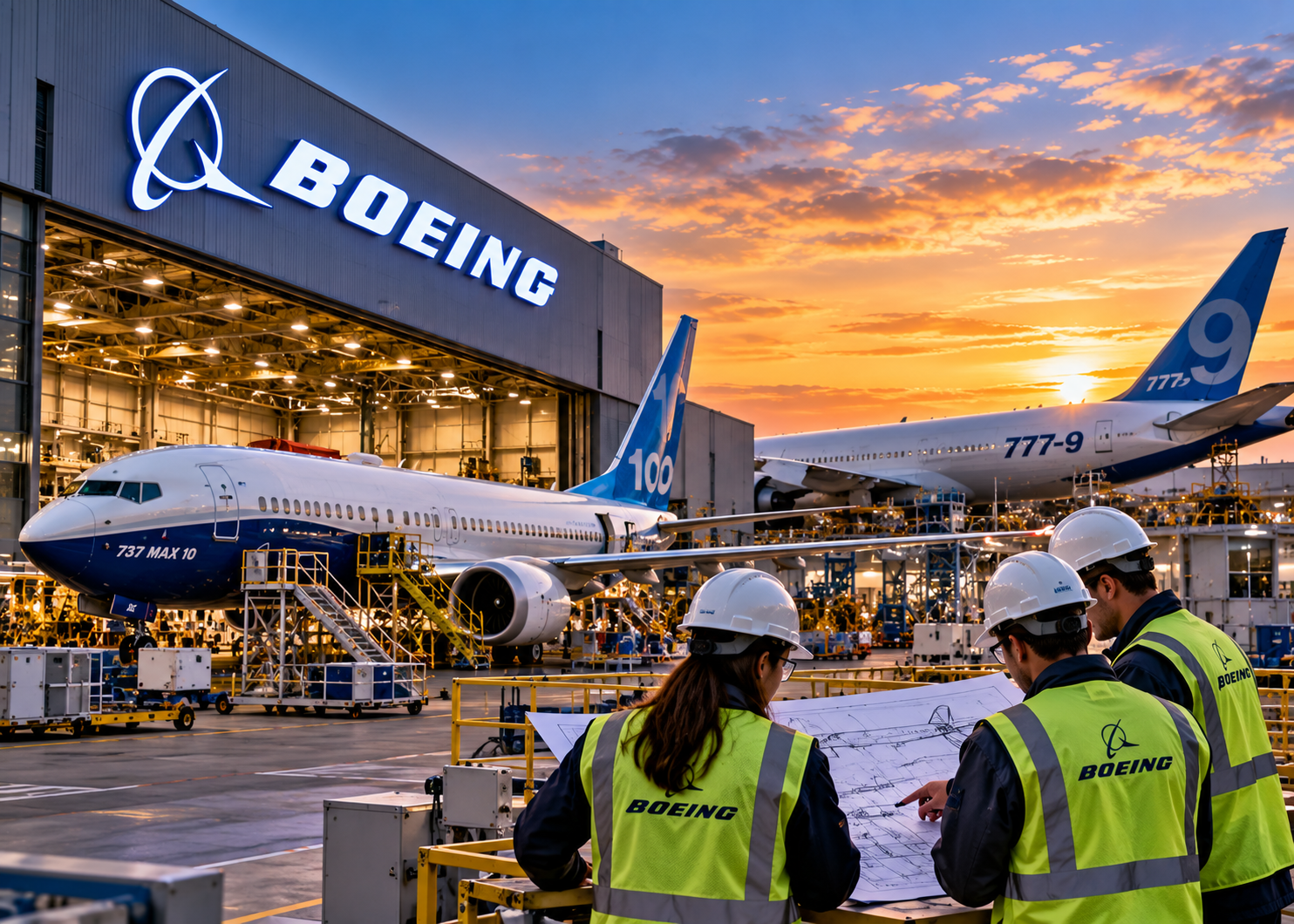
Boeing’s largest white-collar union has approved a new four-year labor contract, removing the threat of an October strike that could have disrupted certification work on the 737 MAX 10 and 777-9 and complicated the aircraft manufacturer’s broader production recovery.
The Society of Professional Engineering Employees in Aerospace, or SPEEA, represents approximately 17,000 Boeing engineers and technical workers.
Both bargaining units approved Boeing’s revised offer Thursday. About 68% of the professional unit voted in favor, while approximately 53% of the technical unit supported the agreement.
The vote removes a significant near-term operational risk for Boeing.
The existing contracts were scheduled to expire October 6, and workers could have begun a strike as early as October 7 if the revised agreement had been rejected.
That potential work stoppage carried broader consequences because SPEEA members perform engineering and technical work central to Boeing’s aircraft-development and certification programs.
The 737 MAX 10 and 777-9 are particularly important.
Both aircraft have faced lengthy certification delays, and Boeing is attempting to move the programs toward regulatory approval while simultaneously increasing commercial-aircraft deliveries and improving its financial performance.
A strike involving engineering personnel could have interrupted certification work and potentially created additional delays.
The revised agreement includes an immediate 10% guaranteed wage increase, followed by annual guaranteed increases of 4%, with additional performance-based increases possible.
For the average SPEEA employee, the union estimates the contract will produce approximately a 32% wage increase over four years.
The agreement follows months of difficult negotiations.
Union members overwhelmingly rejected Boeing’s earlier proposal in August and authorized their negotiating team to call a strike. Boeing subsequently began preparing contingency measures before presenting an improved offer in September.
Thursday’s ratification eliminates that immediate labor uncertainty, but Boeing still faces significant execution challenges.
Separately, the Federal Aviation Administration is scheduled to conduct a safety review Friday concerning a software issue affecting the 737 MAX family. The FAA has delayed certification of the MAX 10 while it completes its analysis.
The software issue can increase pilot workload during a specific aborted-landing procedure known as a go-around. Boeing is developing a software update, and U.S. officials have said they currently see no reason to ground the existing MAX fleet over the issue.
That makes regulatory progress the next major milestone.
With the labor threat removed, investors can refocus on whether Boeing can complete MAX 10 and 777-9 certification, increase aircraft deliveries and convert its large commercial backlog into stronger cash generation.