Seven years after Lebanon’s financial system collapsed, the country’s depositors remain trapped in an extraordinary position: their money exists on bank statements, yet billions of dollars remain inaccessible under normal banking conditions.
Lebanon has made more progress toward resolving that crisis in 2026 than it did during several preceding years. But the most consequential question remains unanswered:
Who ultimately absorbs the losses, and how much of their money will depositors actually recover?
The International Monetary Fund’s September 15–18 mission to Beirut brought that question back to the center of Lebanon’s economic negotiations.
The IMF welcomed Parliament’s amendments to the Bank Resolution Law, describing the framework as an important step toward restructuring failed or insolvent banks. But the Fund made equally clear that passing a bank resolution framework is not the same thing as resolving Lebanon’s financial losses.
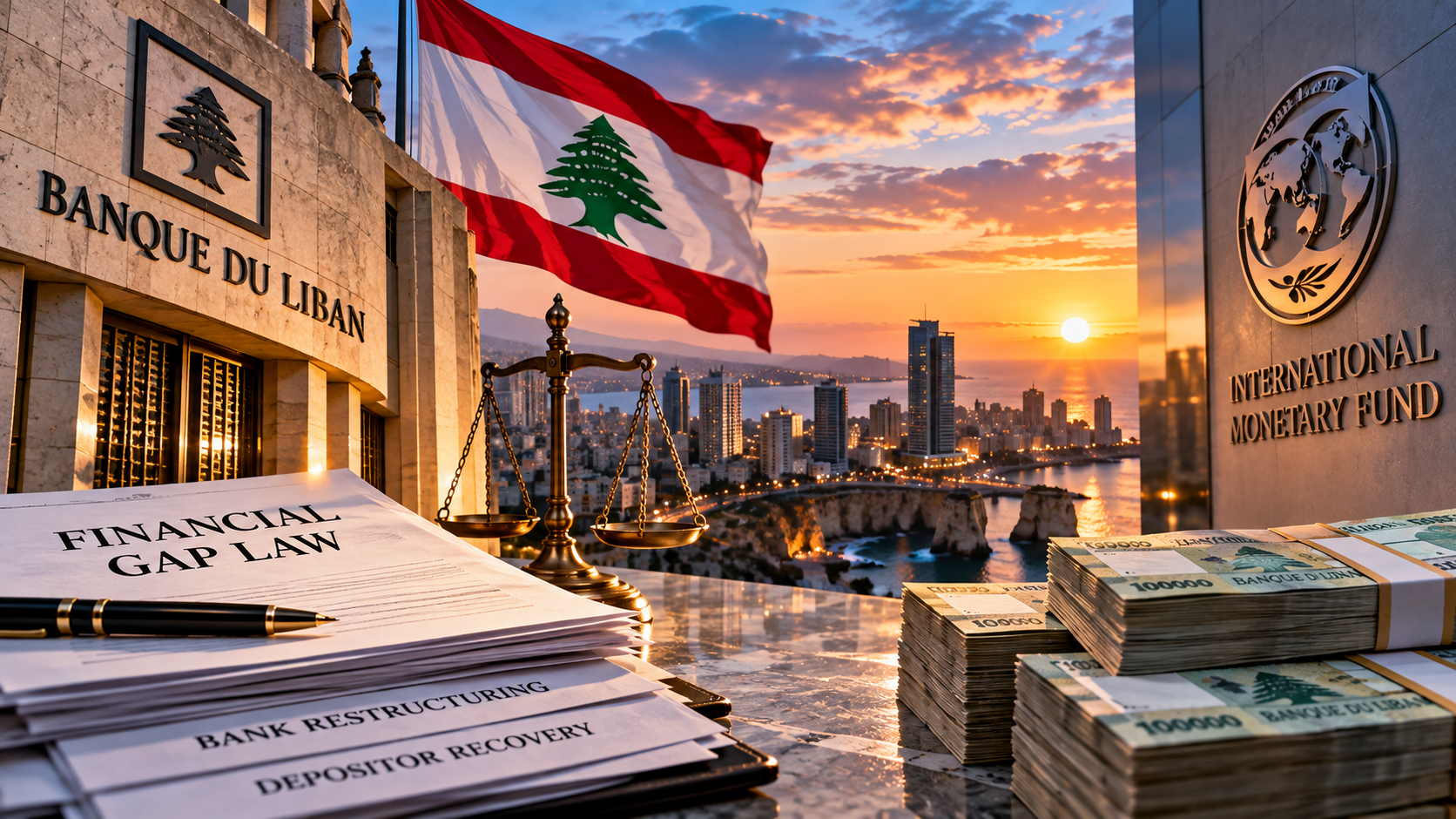
The decisive legislation remains the Financial Stabilization and Deposits Recovery Law, commonly known as the Financial Gap Law.
That law must determine how the enormous losses accumulated across Lebanon’s financial system are recognized and distributed among the state, Banque du Liban, commercial banks, bank shareholders, creditors and depositors.
For depositors, the IMF’s position contains an important principle.
The Fund said in September that Lebanon must respect the established hierarchy of claims and that depositors should not absorb losses before bank shareholders and junior creditors. It also called for maximizing depositor protection while ensuring that the resulting banking system remains viable and that repayment obligations do not make Lebanon’s public debt unsustainable.
That sounds straightforward. Implementing it is anything but.
Lebanon must somehow reconcile three competing realities: depositors have legitimate claims on money trapped since the 2019 collapse; many banks cannot simply return all those deposits from available assets; and transferring the entire financial hole to the Lebanese state could create obligations the government itself cannot sustainably finance.
That is why the Financial Gap Law matters so much.
Earlier proposals have contemplated gradual repayment of deposits, differentiated treatment of larger accounts and various mechanisms for dealing with balances that cannot immediately be paid in cash. Banque du Liban proposed revisions this summer that included extending repayment periods and broadening potential bail in mechanisms. Those proposals remain part of an evolving negotiation rather than a final settlement.
There has nevertheless been some movement of money. Banque du Liban Governor Karim Souaid said during the September negotiations that $8.1 billion would have been returned to depositors by the end of 2026 through Circulars 158 and 166. That is significant, but it does not constitute a comprehensive resolution of the frozen deposit problem.
The IMF left Beirut. The negotiations did not stop.
Finance Minister Yassine Jaber said on September 28 that Lebanon is seeking a new staff level agreement with the IMF. But he acknowledged that a full IMF program still depends on resolving the legislation dealing with the financial system’s losses.
Prime Minister Nawaf Salam subsequently met IMF Managing Director Kristalina Georgieva in Washington.
The IMF says Georgieva reaffirmed its willingness to support a comprehensive Lebanese reform program, while the discussions addressed both the progress already achieved and the reforms still required.
Then another complication emerged.
President Joseph Aoun referred part of the amended Bank Resolution Law to Lebanon’s Constitutional Council, involving provisions concerning Banque du Liban’s independence and powers.
That matters because the IMF had already concluded that the legislation approved by Parliament was consistent with international standards.
On October 1, IMF communications director Julie Kozack said the Fund would examine any changes resulting from the Constitutional Council process and determine whether the revised legislation remained consistent with those standards.
The referral therefore does not mean Lebanon’s negotiations with the IMF have collapsed. But it introduces another variable into a process that already contains plenty of them.
What happens now?
The IMF has now provided a remarkably clear roadmap.
For Lebanon to reach a new staff level agreement, the Fund says progress is required on the entry into force of an acceptable Bank Resolution Law; an appropriate Financial Gap Law consistent with international standards; a 2027 budget and medium term fiscal framework consistent with debt sustainability; and structural reforms focused particularly on public financial management and governance.
For ordinary depositors, however, all of that ultimately reduces to something much more personal.
When will I get my money, how much will I get, and in what form?
Lebanon still cannot provide a definitive answer.
There is no final IMF supported depositor settlement today. There is no final schedule governing every frozen account. And proposals discussed during negotiations should not be mistaken for guaranteed repayment terms.
That distinction is essential.
But something has changed.
The debate is increasingly moving away from whether Lebanon must recognize and restructure the losses and toward how those losses will be allocated and how depositors will be treated when that restructuring occurs.
The IMF has drawn an important line: shareholders and junior creditors cannot simply be protected while depositors are pushed ahead of them to absorb losses.
Now Lebanon’s political leadership, Banque du Liban, Parliament and the banking sector have to translate that principle into an implementable law.
For depositors who have already waited seven years, another promise means very little.
The real test will be the final Financial Gap Law: who pays first, how much depositors recover, how quickly they receive it, and whether Lebanon finally replaces years of improvised restrictions with a credible banking system governed by enforceable rules.
Until those questions are answered in law, Lebanon may be approaching an IMF agreement, but its depositor crisis is not yet resolved.