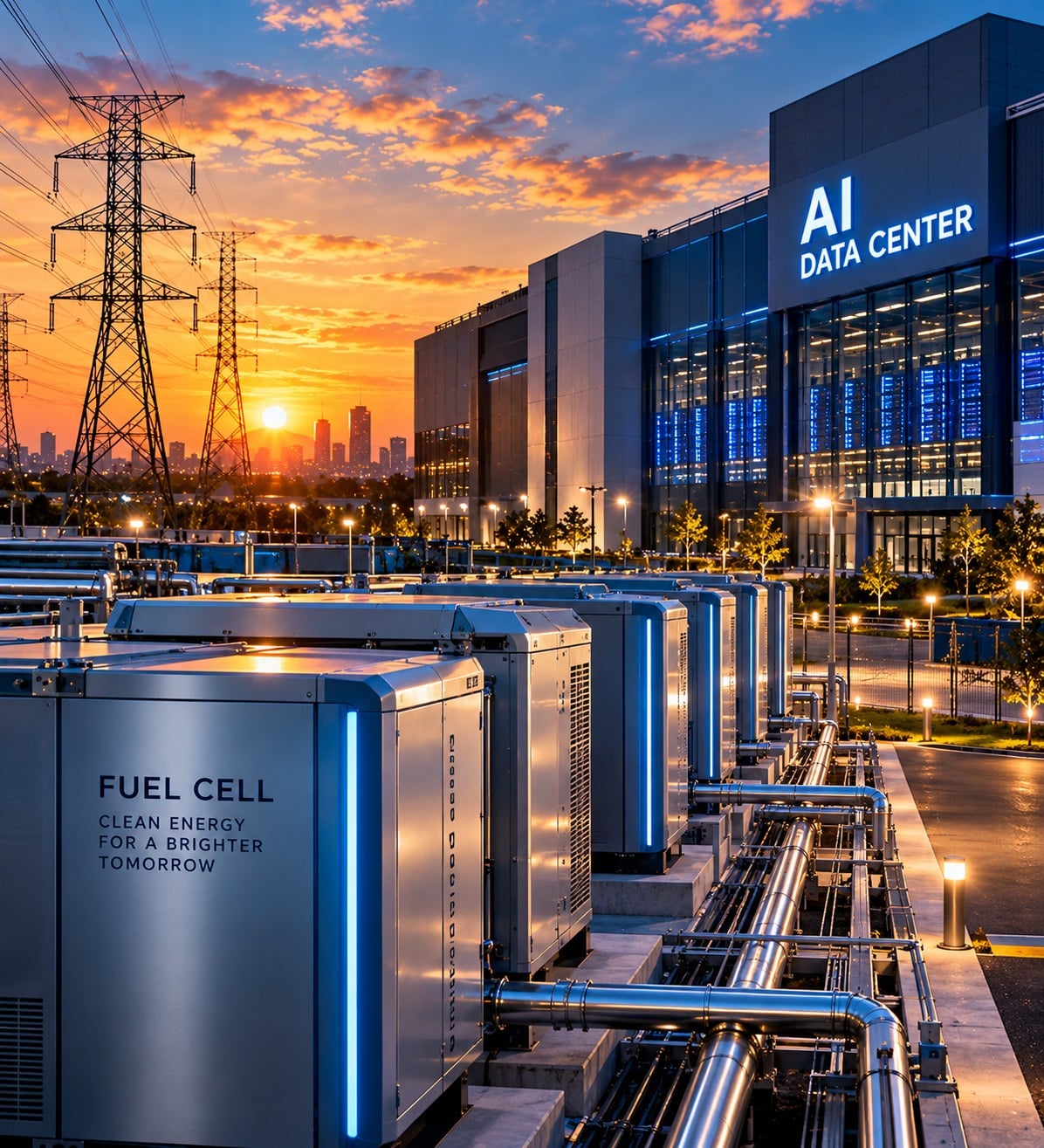
Artificial-intelligence infrastructure is creating a rapidly expanding market for onsite fuel cells as data-center developers look for ways around increasingly severe U.S. electricity-grid bottlenecks.
Rystad Energy projects investment in fuel cells serving data centers will increase from approximately $2.8 billion in 2025 to about $30 billion by 2030.
The shift reflects a fundamental constraint facing the AI buildout: electricity infrastructure is not expanding as quickly as computing demand.
Connecting large new loads to the U.S. grid can take three to six years. Rystad estimates roughly 40% of projected U.S. data-center capacity in 2030 could pursue dedicated onsite power.
Fuel cells convert the chemical energy contained in fuels such as natural gas or hydrogen directly into electricity. For data centers, their attraction is less about replacing the entire electricity system than gaining dependable generation without waiting years for conventional transmission and grid connections.
The commercial impact is already becoming visible.
Bloom Energy reported third-quarter revenue of $1.236 billion, up 138.1% from a year earlier, and raised its 2026 revenue forecast to between $4.4 billion and $4.6 billion. Product revenue increased 179.4%.
Oracle plans to procure as much as 2.8 gigawatts of Bloom systems, with 1.2 gigawatts contracted, while industry orders and framework agreements for fuel-cell capacity have reached approximately 9 gigawatts.
The expansion still faces constraints.
Rystad estimates annual fuel-cell manufacturing capacity could reach about 4 gigawatts by 2030, up from approximately 1.8 gigawatts currently. Developers also need suitable sites, fuel connections, permitting and supporting electrical infrastructure.
That means fuel cells do not eliminate the physical constraints surrounding AI infrastructure. They change where some of those constraints appear.
For markets, the development broadens the list of potential beneficiaries from the AI capital-spending cycle. Chips and servers remain central, but electricity generation and equipment capable of bringing power online quickly are becoming increasingly valuable.
The next test will be whether manufacturers can scale quickly enough to turn the projected $30 billion market into deployed capacity rather than another AI infrastructure bottleneck.