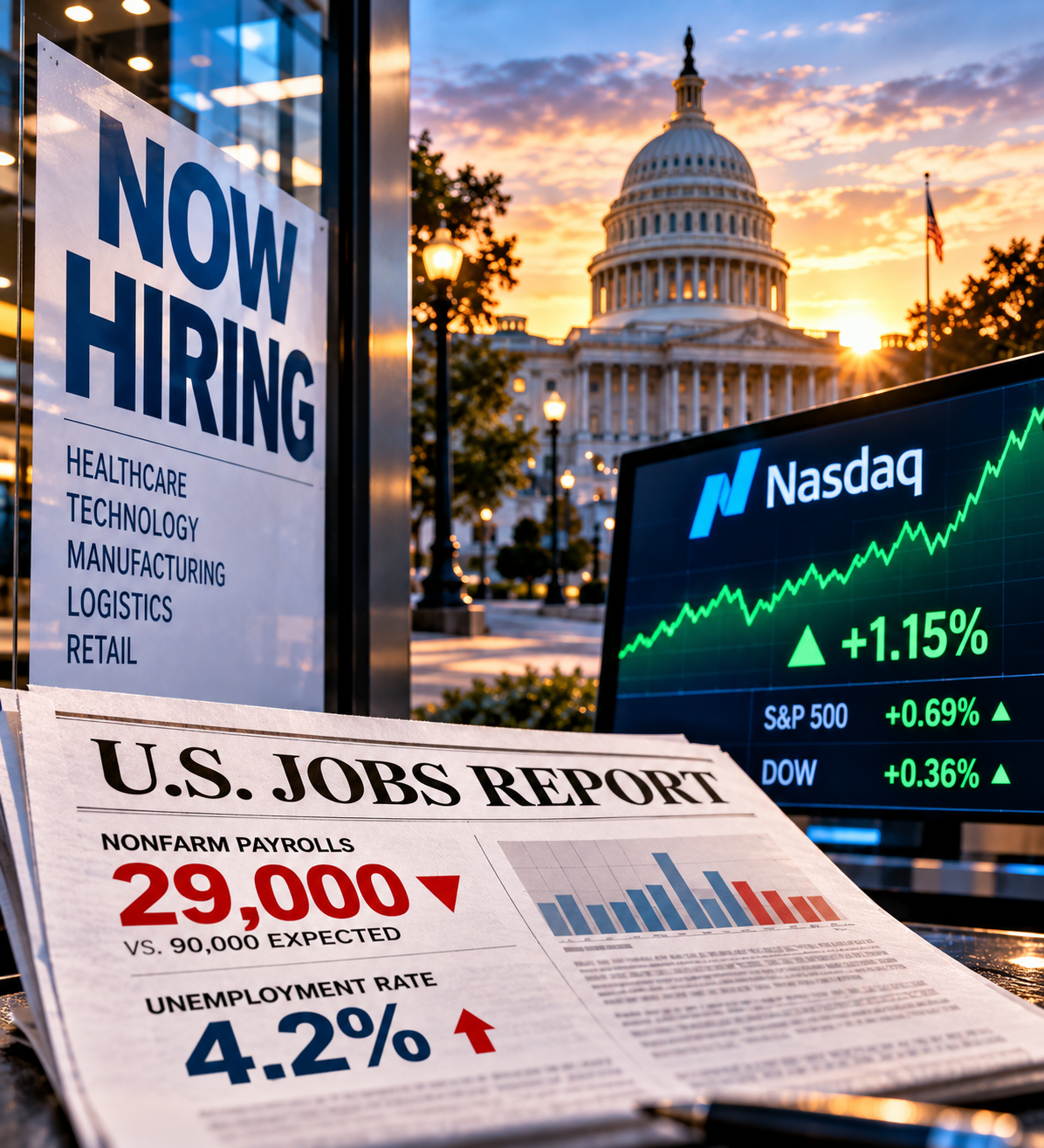
U.S. employers added just 29,000 jobs in September, substantially below expectations, while the unemployment rate increased to 4.2%, delivering fresh evidence that the labor market has lost momentum and sharply reducing pressure on the Federal Reserve to raise interest rates again this month.
Economists surveyed by Reuters had expected approximately 90,000 new jobs. August payroll growth was revised down to 133,000 from 162,000, while July was revised from a gain of 21,000 to a loss of 10,000 jobs. Combined employment for July and August was therefore 60,000 lower than previously reported.
Wage pressure also moderated. Average hourly earnings increased 0.1% in September and 3.0% from a year earlier. Labor-force participation edged up to 61.8%. Health care added 17,000 jobs, but employment across most major industries changed little.
The immediate market response was substantial.
The Nasdaq Composite reached a record high as investors reduced the probability of another Federal Reserve increase this month. By late morning, the Nasdaq was up about 1.15%, the S&P 500 gained roughly 0.69% and the Dow Jones Industrial Average was approximately 0.36% higher. Semiconductor shares were among the strongest performers.
Market pricing for an October quarter-point Fed increase fell to roughly 20%-21%, compared with about 26% before the employment report. That represents an important shift after investors began the week substantially more concerned that persistent inflation could force additional monetary tightening.
The bond-market reaction was more complicated.
Treasury yields initially fell after the employment data but subsequently reversed. Around midday, the 10-year yield was about 2 basis points higher at 5.256%, while the two-year yield was approximately 3 basis points higher at 4.821%. That reversal suggests investors are distinguishing between weaker employment growth and the broader inflation problem created by elevated energy costs.
The dollar weakened against both the euro and yen, while lower oil prices provided another boost to risk sentiment. Brent crude fell toward $101 a barrel as governments moved toward additional emergency energy-stock releases.
The jobs report therefore changes the balance of risks facing the Fed without eliminating its inflation problem.
Payroll growth is weak, prior employment estimates have been revised lower and wage growth is moderating. At the same time, energy costs and broader inflation remain sufficiently elevated that policymakers may be reluctant to declare the tightening cycle complete.
For markets, the immediate result is a lower probability of an October rate increase and renewed support for growth-sensitive equities.
The next question is whether subsequent inflation and labor-market data confirm that the economy is moving toward a softer but stable employment environment — or whether September’s weak payroll number proves temporary.