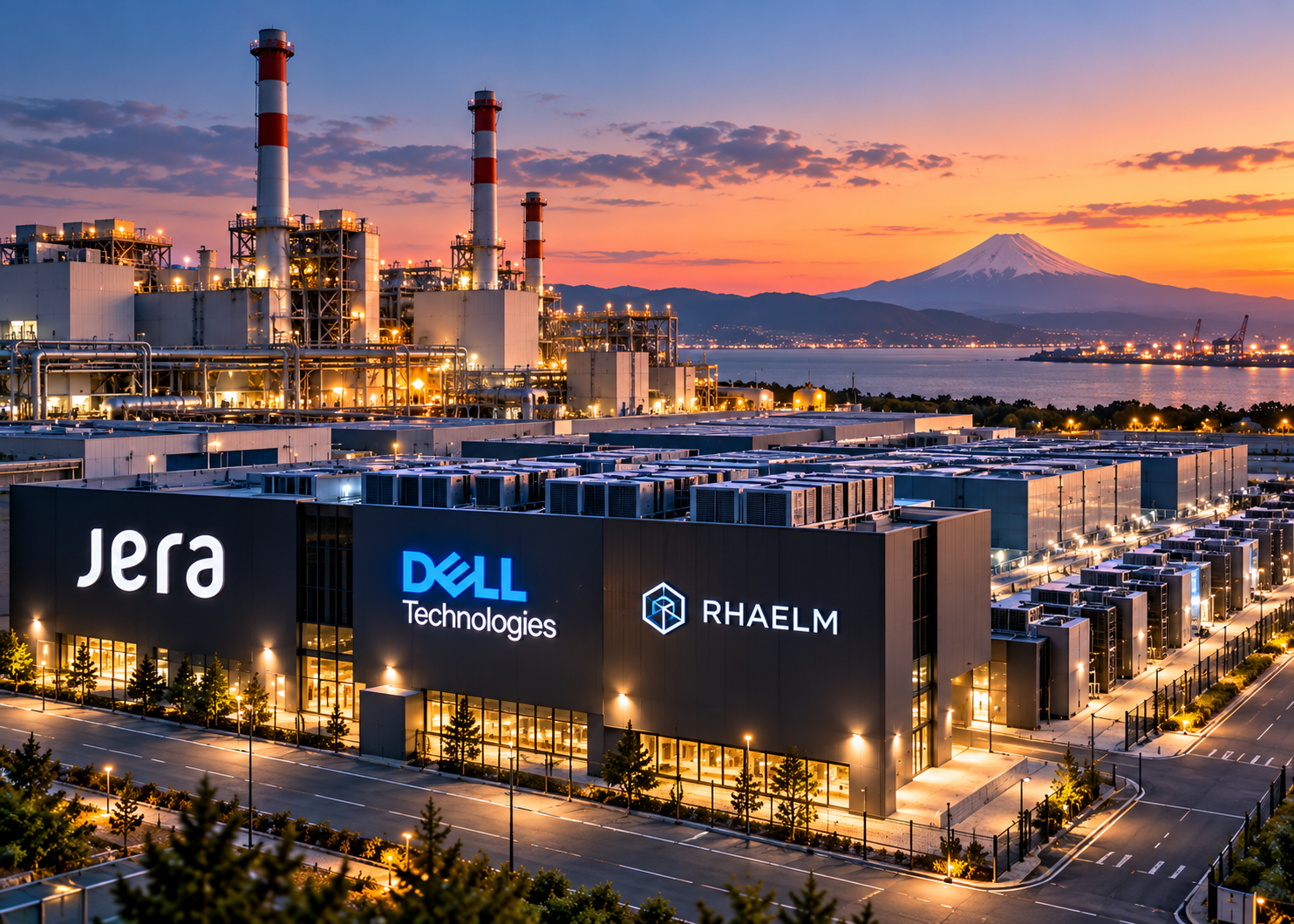
Japan’s JERA, Dell Technologies and British infrastructure developer RHAELM have agreed to develop a standardized model for large-scale artificial-intelligence infrastructure, beginning with a project worth more than $15 billion in Chiba.
The planned facility would provide approximately 400 megawatts of AI computing capacity on land adjacent to JERA’s existing Chiba power station.
The location is central to the project’s strategy.
Rather than waiting for a conventional grid connection, the development is intended to use behind-the-meter electricity supplied from JERA’s existing generation assets.
The companies believe that structure could bring computing capacity online significantly faster than a conventional grid-connected development.
RHAELM would develop, construct, operate and finance the facility, while Dell would supply standardized rack-scale AI infrastructure.
Apollo Global Management intends to participate as a strategic investment and financing partner for RHAELM.
Phased operations are targeted to begin around 2028, with the site expected to reach its full 400-megawatt scale in 2029.
The partners ultimately want to replicate the model at additional JERA locations and potentially develop multi-gigawatt AI infrastructure across Japan during the 2030s.
The project illustrates a structural change taking place across the AI industry.
Access to advanced processors is no longer the only major infrastructure constraint.
Developers increasingly need locations where large amounts of reliable electricity, cooling, networking infrastructure and financing can be assembled on predictable schedules.
JERA’s participation places a major electricity producer directly inside that infrastructure chain.
For Japan, where land and energy constraints can complicate hyperscale data-center development, locating computing infrastructure alongside existing power assets could shorten deployment timelines.
The project remains at the memorandum-of-understanding stage, however.
Investors should therefore watch financing, customer commitments, construction milestones and the final power-supply structure before treating the entire $15 billion investment as committed capital.