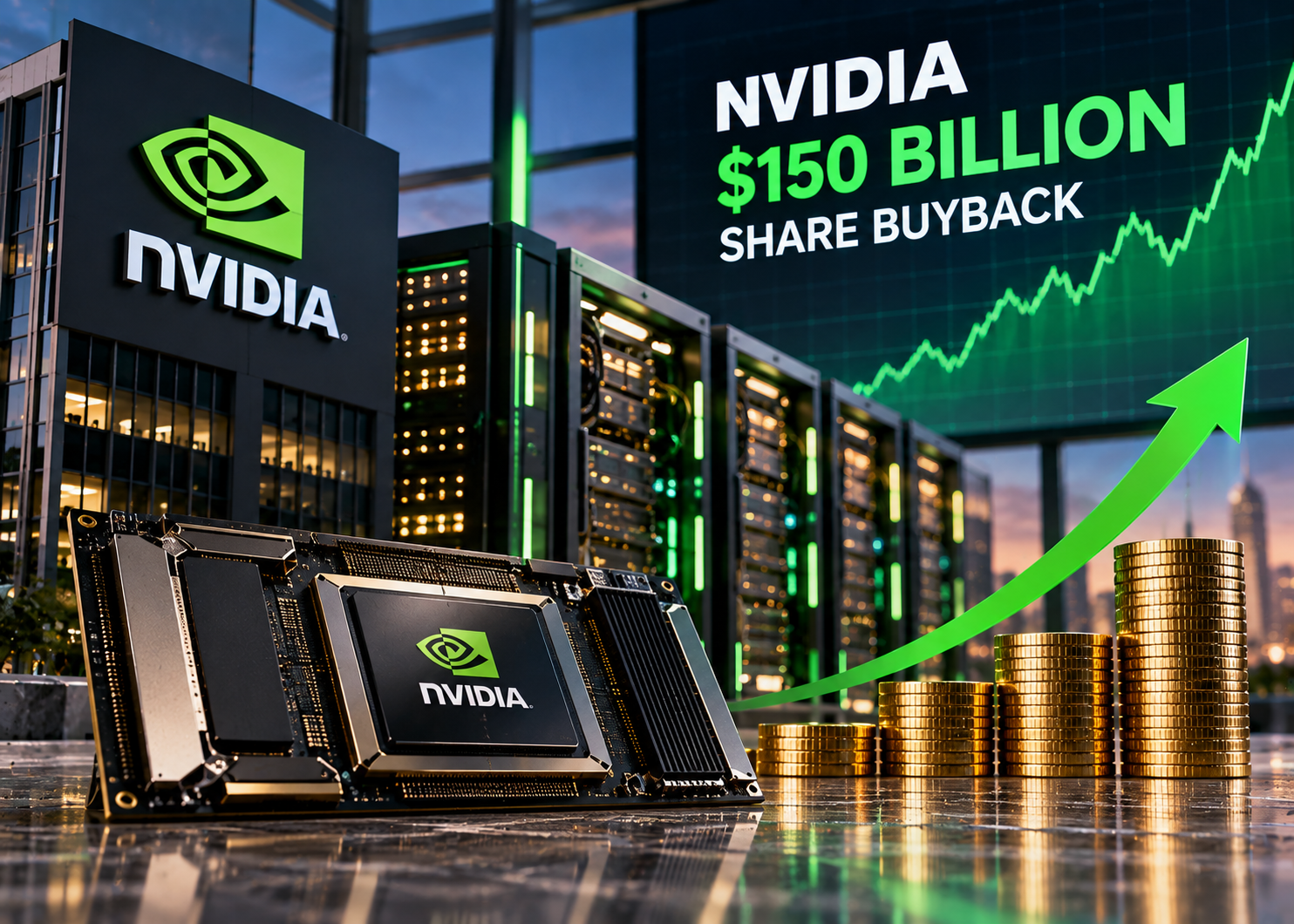
Nvidia has increased its share-repurchase authorization by a record $150 billion, lifting its remaining buyback capacity to $235 billion as the world’s most valuable chipmaker uses its enormous AI-driven cash generation to return more capital to shareholders.
The authorization is the largest increase in Nvidia’s history and exceeds Apple’s $110 billion authorization announced in 2024. Nvidia expects to use its remaining $235 billion capacity through fiscal 2028.
Shares rose more than 2% Monday, outperforming a broader technology market pressured by rising Treasury yields and oil prices.
The scale is significant. Nvidia’s $150 billion increase alone exceeds the market capitalization of roughly 84% of S&P 500 companies, according to LSEG data cited by Reuters.
Nvidia ended its July quarter with $22.44 billion in cash and cash equivalents. Its most recently reported fiscal second-quarter revenue reached $96.22 billion, more than double the year-earlier level, while the company returned approximately $26 billion to shareholders through repurchases and dividends during that quarter.
The buyback arrives as Nvidia’s stock performance has become less dominant relative to some semiconductor rivals. Through Friday, Nvidia was up just over 20% in 2026, while AMD had more than doubled and Intel had more than tripled.
Nvidia’s forward earnings multiple has fallen to roughly 16.5 times expected earnings, its lowest since January 2015, according to LSEG data.
That compression reflects a changing question around the AI trade. Investors are no longer debating whether AI infrastructure demand is large; they are increasingly assessing how long extraordinary growth rates can persist as competitors expand and hyperscalers commit enormous capital to computing infrastructure.
The repurchase authorization signals that Nvidia believes it can fund both continued technology investment and substantially larger shareholder returns.
Investors will now watch the pace at which Nvidia deploys the authorization, future AI infrastructure spending by major customers and whether revenue growth remains strong enough to justify the company’s aggressive capital-return program.