The artificial intelligence boom is usually described in trillions of dollars of market value and billions of dollars of new chips. For most American families, it is more likely to show up somewhere far less glamorous: the monthly electric bill.
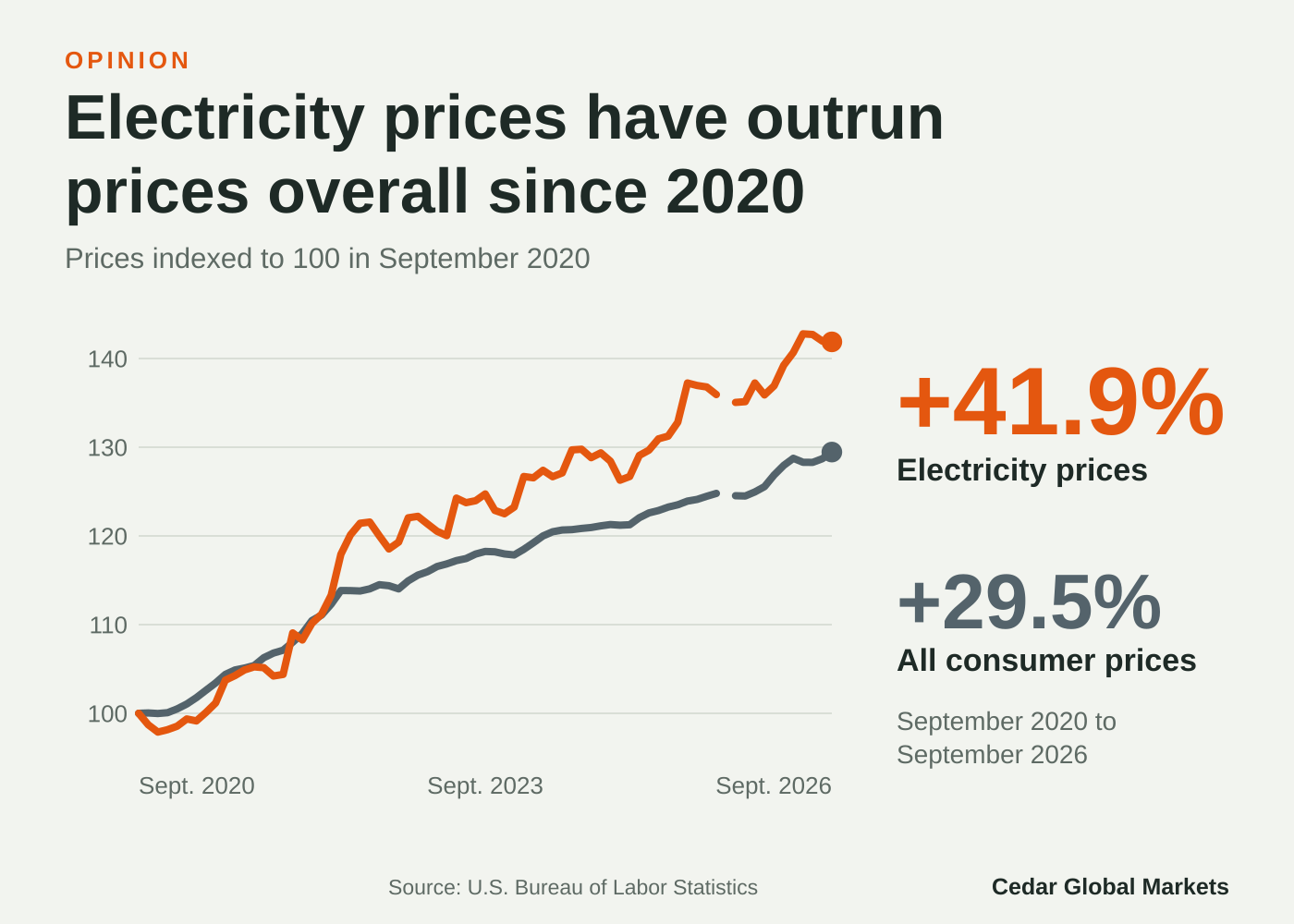
Electricity has been climbing faster than prices overall. Federal data show electricity prices rose 41.9% from September 2020 to September 2026, while consumer prices as a whole rose 29.5%. Over the most recent 12 months, electricity rose 4.4%, compared with 3.7% for all items. A household can put off buying a car or skip a vacation. It cannot skip keeping the lights on, and most families have little say over who delivers their power.
The honest answer to why bills are rising is that there is more than one reason. Aging equipment, storms and fuel costs all play a part, and researchers do not agree on how much of the increase so far belongs to data centers. A Rutgers University study published in June, using data through 2024, found no reliable evidence that data center openings had pushed up local residential bills.
That finding should be taken seriously, and so should its limits. The study’s lead writer, Kiran Garimella of Rutgers, noted that most of the facilities it covered were built before the current AI wave. Some of the campuses now planned would draw hundreds of megawatts, or close to a gigawatt, and can need new substations and transmission lines, whose costs may take years to show up on bills. “The future could look very different,” the author wrote.
On the nation’s largest power grid, the warning signs are already here. PJM Interconnection, which serves all or part of 13 states and Washington, D.C., runs an auction to ensure there will be enough power plants in future years. Its independent market monitor put data centers’ share of capacity charges over the last four auctions at $29.4 billion, or 46% of the total, Utility Dive reported in July. Those charges flow through utilities and power suppliers to their customers.
The companies driving this demand are among the most valuable in history, and they can pay for what they use. Constellation Energy, in quarterly results today, pointed to 20-year power agreements it announced this fall with Amazon and Google, tied to more than $7 billion of planned investment at its nuclear plants. Those are the kinds of deals that show what this electricity is worth to the buyers. The question is who pays for the rest of the system built around them.
Some regulators have started to answer. Ohio approved rules requiring new data centers above 25 megawatts served by AEP Ohio to pay for most of the capacity they contract for, up to 85%, for as long as 12 years, even if they use less. Virginia created a separate rate class for very large customers and, in August, directed Dominion Energy to develop a way to assign more transmission costs directly to them. More than 20 states have now approved special rates for large electricity users.
That approach should be the national standard. Every large data center should be placed in its own rate class, sign a long contract with a minimum bill, and cover the cost of equipment built for it even if the project is delayed or canceled. Regulators should also publish the estimated effect on an average household before approving major new connections. PJM’s market monitor has proposed going further, with a separate auction for data centers, and that idea deserves a serious hearing.
The urgency is not theoretical. The National Energy Assistance Directors Association estimated in February that one in six U.S. households, about 21.5 million, had fallen behind on energy bills. Those families have no lobbyists at the state utility commission and no 20-year contract to protect them.
None of this is an argument against artificial intelligence or against building data centers. The country can pursue both and still insist on a simple principle: the companies profiting from the buildout should carry its cost. A family’s electric bill should not be how America finances the AI boom.