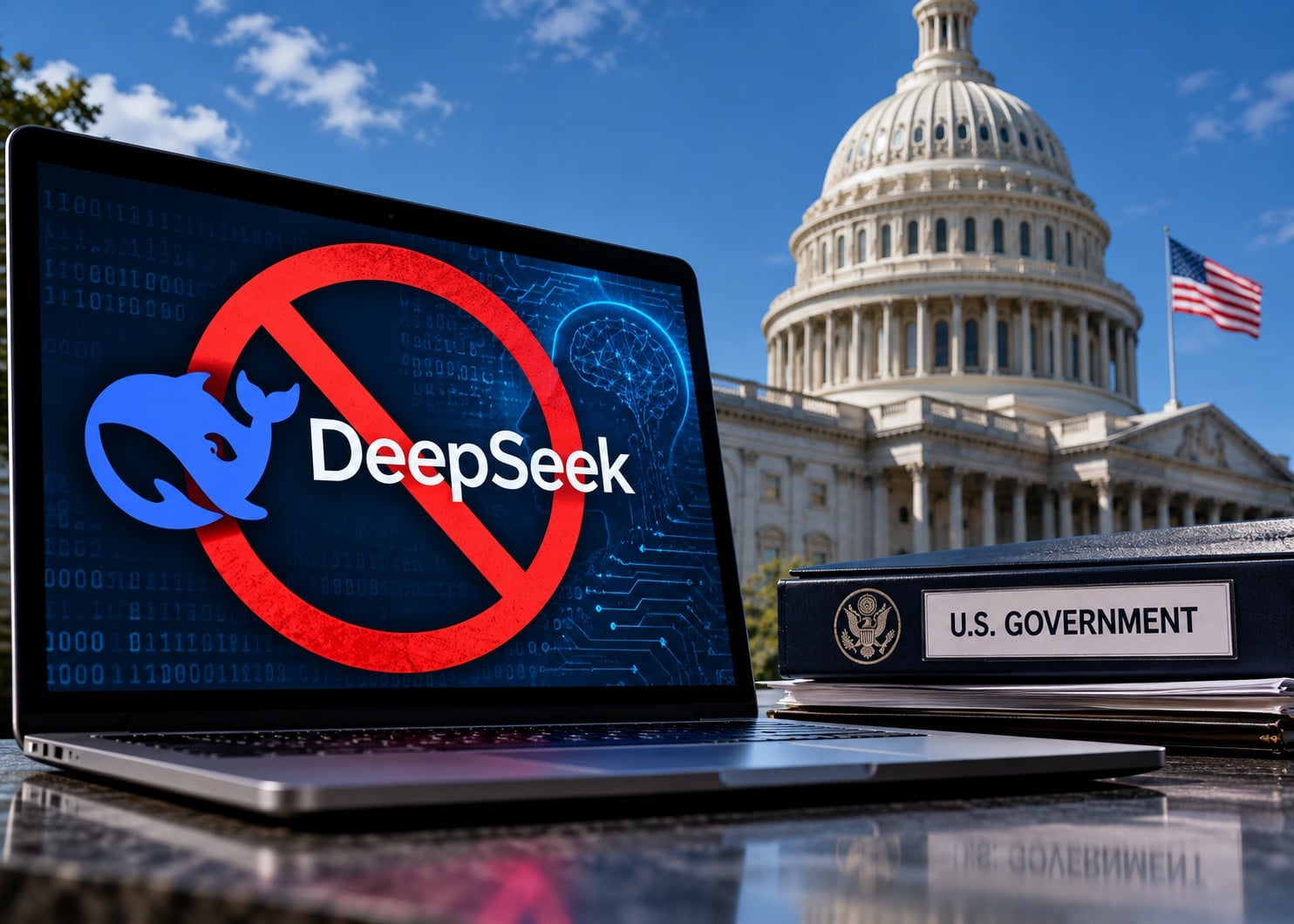
The U.S. government has ordered civilian federal agencies to remove DeepSeek products from their information-technology systems, escalating Washington’s restrictions on Chinese artificial-intelligence technology.
The Department of Homeland Security directive also blocks agencies from acquiring new DeepSeek products or third-party services incorporating DeepSeek technology.
The government cited security concerns surrounding the potential transfer of sensitive information to China when DeepSeek models are used by federal employees, contractors or technology vendors.
The decision expands the U.S.-China technology conflict beyond semiconductor export controls and into the software and AI-model layer.
That distinction matters.
Governments have traditionally focused on restricting access to advanced computing hardware. Artificial-intelligence models introduce another potential security channel because users may transmit documents, prompts, data or system information while interacting with cloud-based models.
The federal action could therefore influence corporate technology policies outside government.
Large companies operating in regulated industries may reassess whether employees should be permitted to use foreign-developed AI systems when handling sensitive internal data.
The decision also creates additional pressure on Chinese AI developers seeking international customers.
DeepSeek and other Chinese companies have gained attention by offering highly capable models at lower costs than many Western competitors. But security restrictions imposed by governments could limit adoption even where the technology itself remains competitive.
The next issue for markets is whether similar restrictions spread to federal contractors, state governments or allied countries.