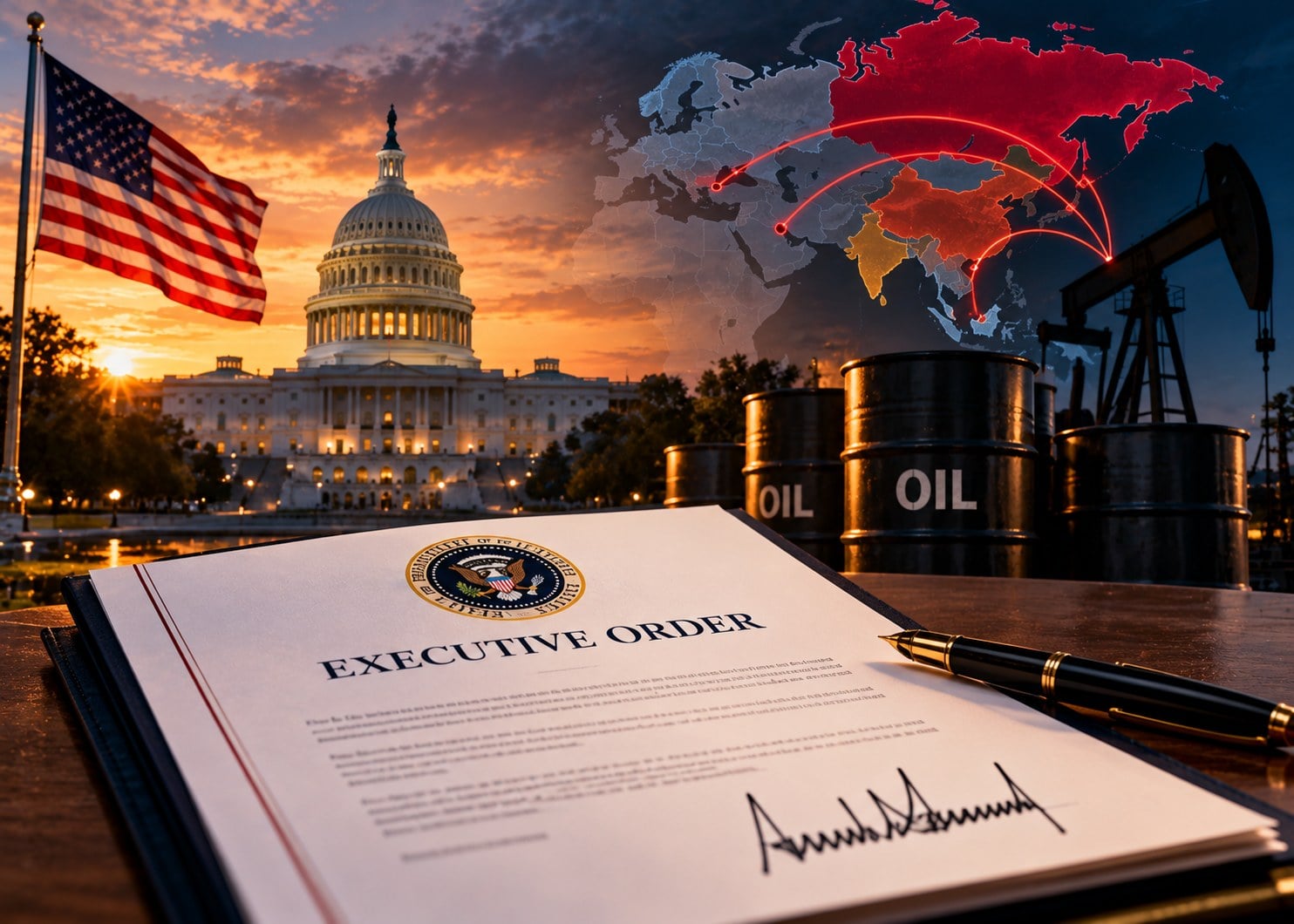
President Donald Trump has waived major sanctions and tariffs contained in the newly enacted Lindsey O. Graham Sanctioning Russia and Iran Act, suspending measures that could have imposed enormous new trade penalties on Russia and countries purchasing Russian energy.
The White House issued the executive order October 16, immediately invoking the president’s authority under the law to waive the measures on national-interest grounds.
The underlying legislation provides for a 500% tariff on goods imported from Russia.
It also provides for 100% tariffs on goods from the five largest countries making new purchases of Russian crude oil or natural gas beginning October 18, as well as 100% tariffs targeting the five largest facilitators of Russian oil-sanctions evasion.
But those duties have now been waived before taking effect.
Trump certified to Congress that issuing the waiver is currently in the national interest of the United States. The executive order also waives numerous additional sanctions and restrictions contained in the Graham Act.
The decision substantially changes the immediate economic consequences of legislation Trump signed into law September 18.
Without the waiver, major purchasers of Russian energy could have faced severe U.S. trade penalties.
That could have affected existing Russian oil flows and potentially tightened global energy markets at a time when fuel prices are already politically and economically sensitive.
The waiver avoids that immediate disruption while preserving the administration’s ability to reconsider the measures.
Importantly, the executive order does not eliminate the broader U.S. sanctions regime against Russia.
The White House specifically states that sanctions imposed under earlier executive orders addressing Russian government activities remain in effect. The waiver concerns measures established under the new Graham Act.
Washington has therefore created a powerful new sanctions and tariff mechanism without immediately activating much of it.
The administration instructed the U.S. Trade Representative, State Department, Treasury Department and Energy Department to continue monitoring Russian energy purchases and sanctions evasion.
That keeps the threat of future penalties available.
For markets, the immediate implications center on oil prices, global trade and countries that remain major purchasers of Russian energy.
The next question is whether the waiver remains in place or whether Washington eventually activates some of the penalties if geopolitical conditions change.