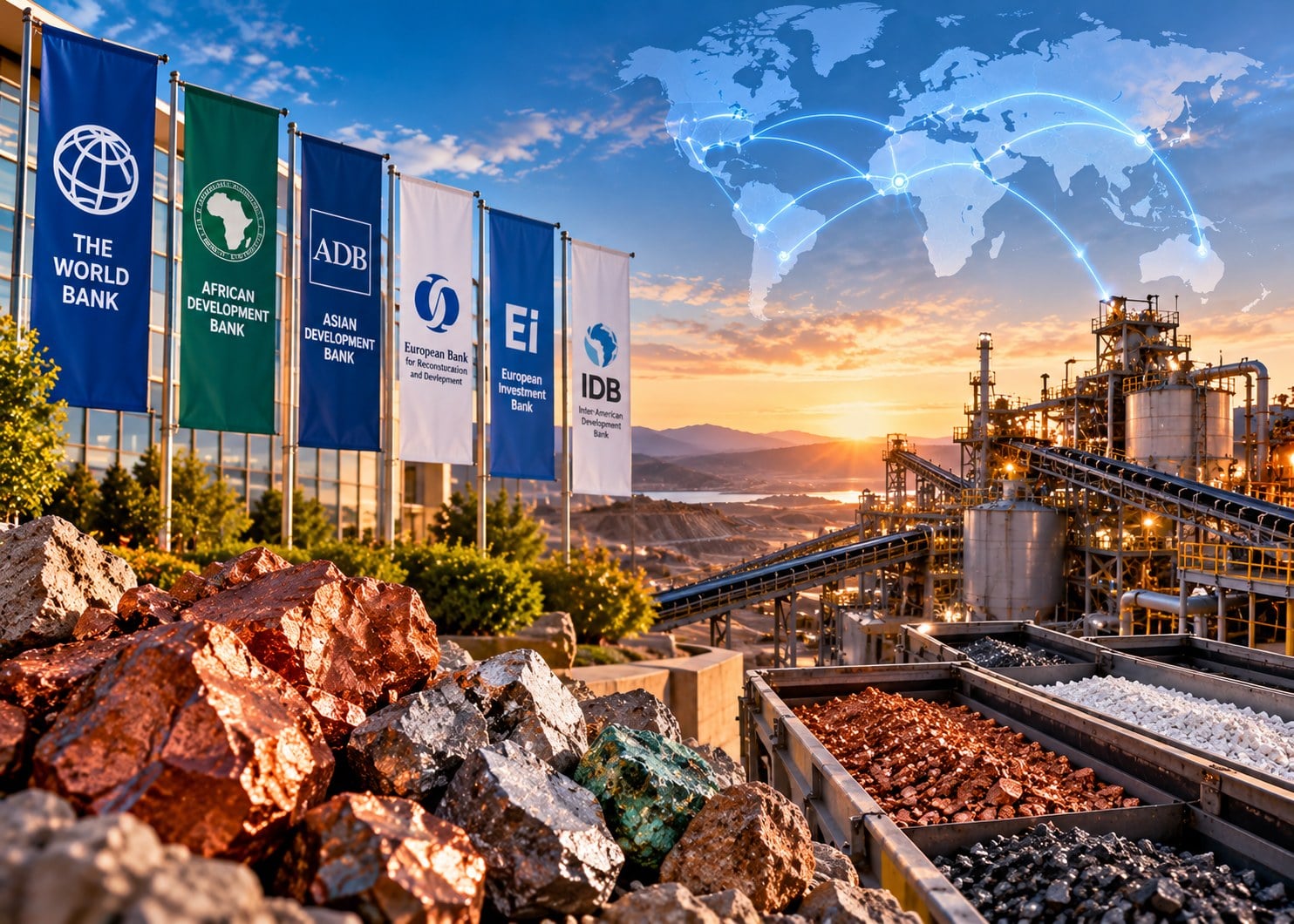
Major multilateral development banks are strengthening a coordinated strategy designed to help mineral-rich developing countries capture more economic value from their natural resources rather than remaining primarily exporters of raw materials.
The framework focuses on moving participating economies further along critical-mineral supply chains — from extraction into processing, refining and eventually manufacturing.
Institutions involved include the World Bank, African Development Bank, Asian Development Bank, European Bank for Reconstruction and Development, European Investment Bank and Inter-American Development Bank.
The strategy addresses one of the central weaknesses in today’s critical-minerals economy.
Countries possessing large deposits of copper, lithium, nickel, cobalt and other strategically important materials frequently export raw or minimally processed resources while much of the higher-value refining and manufacturing occurs elsewhere.
Development banks want to help change that structure.
The institutions plan to coordinate financing, infrastructure development, government policy support and project preparation while using co-financing and guarantees to attract additional private investment.
Infrastructure will be particularly important.
The framework calls for development of mineral corridors incorporating electricity, transportation, logistics, water and digital infrastructure — investments frequently required before large mining and processing projects become commercially viable.
The strategy also has major geopolitical implications.
Critical minerals are increasingly important for electric vehicles, batteries, electricity grids, renewable-energy systems, electronics, defense equipment and advanced manufacturing.
China maintains dominant positions in processing several strategically important minerals, prompting the United States and other governments to seek more diversified supply chains.
Development-bank financing could simultaneously help emerging economies industrialize and create alternative processing centers for global manufacturers.
An MDB working group will coordinate implementation and report annually on progress.
The economic question is whether mineral-producing countries can convert their geological advantages into durable industrial capacity rather than simply increasing extraction.
Investors should watch which countries receive the first significant financing packages, how much private capital the institutions mobilize and whether new refining and manufacturing projects materially diversify global supply chains.