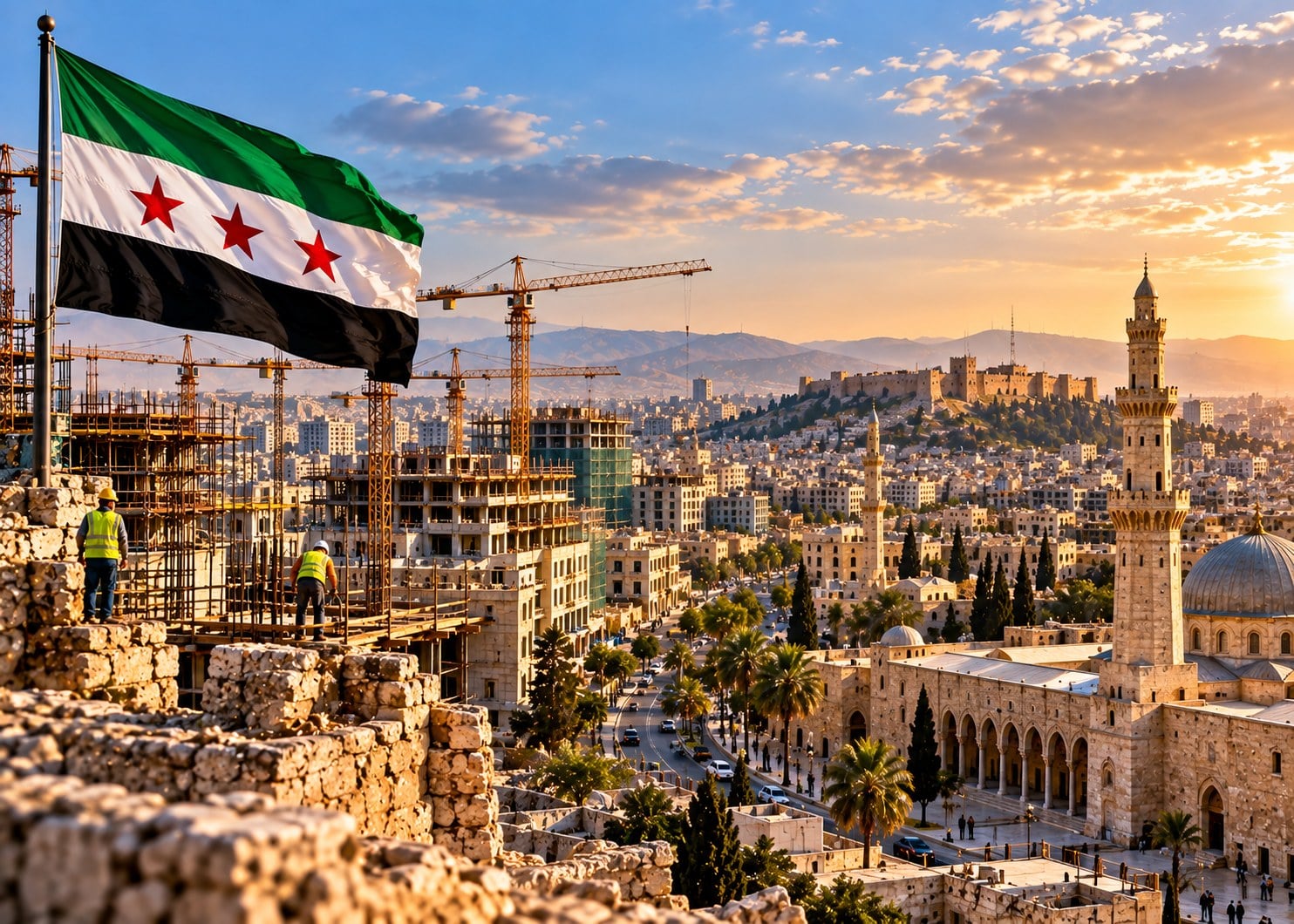
A planned investment of as much as $17 billion by Emirati developer Eagle Hills is putting a remarkable number behind Syria’s attempt to move from postwar stabilization to economic reconstruction.
Eagle Hills founder and chairman Mohamed Alabbar said Wednesday that the company plans to invest between $16 billion and $17 billion in Syria, centered on two large developments in Damascus and the Mediterranean coastal city of Latakia.
The announcement is significant not simply because of its size.
It represents something Syria has struggled to attract for more than a decade: large-scale private foreign capital willing to make a long-term bet on the country’s economic future.
But $17 billion also raises a much larger question.
Can massive Gulf investment actually help rebuild a functioning Syrian economy — or will reconstruction produce impressive real-estate developments surrounded by an economy that still lacks the infrastructure, financial system and institutional stability required for sustained growth?
From Reconstruction Plans to Real Money
Earlier this month, Eagle Hills signed a framework agreement with Syrian authorities covering two major developments.
The Damascus project, known as Damascus Heights, is planned as a large mixed-use community incorporating housing, retail, hospitality, offices, schools, healthcare facilities and public spaces.
On Syria’s Mediterranean coast, Latakia Yachts & Marina is envisioned as a waterfront development combining residential properties, hotels, leisure facilities and a marina.
The projects are expected to generate substantial employment during construction and eventually across tourism, hospitality and other services.
Eagle Hills has also said Syrian contractors, suppliers and businesses will participate in development, potentially allowing part of the investment to flow through the domestic economy rather than remaining concentrated among foreign developers.
That distinction matters.
Syria does not simply need new buildings.
It needs jobs, functioning businesses, tax revenue, reliable utilities, transportation, banking services and a private sector capable of surviving after construction crews leave.
The Scale of Syria’s Problem
Even $17 billion is small compared with the destruction accumulated during more than a decade of war.
The World Bank has estimated Syria’s reconstruction requirements at approximately $216 billion, with a potential range considerably higher depending on how reconstruction is defined.
Residential buildings alone account for tens of billions of dollars in estimated rebuilding requirements.
Non-residential structures represent tens of billions more.
Then comes the infrastructure underneath the buildings: electricity, water, roads, telecommunications, sanitation, hospitals and schools.
Entire communities continue to struggle with damaged or inadequate basic services.
That means Syria’s reconstruction challenge cannot be solved by luxury housing developments, hotels or tourism projects alone.
Private capital can help restart economic activity, but functioning cities require infrastructure that often produces much lower financial returns than luxury real estate.
The real test will therefore be whether projects such as Eagle Hills’ developments become anchors for broader economic rebuilding rather than isolated islands of investment.
Why Gulf Investors Are Moving
The Eagle Hills commitment is part of a wider shift.
Gulf investors increasingly appear willing to examine opportunities that would have been politically or financially difficult to consider only a few years ago.
Syria’s international economic isolation has eased significantly.
The United States no longer maintains the comprehensive sanctions regime that once broadly restricted transactions involving Syria and its government, although targeted sanctions remain against designated individuals and organizations.
That change fundamentally alters the investment calculation.
Capital that previously faced enormous legal, banking and compliance barriers now has more room to enter the country.
Other Gulf-backed projects have already begun emerging across real estate, ports, infrastructure, tourism and related industries.
For investors, Syria offers something unusual: an economy with enormous rebuilding requirements, valuable urban land, Mediterranean access and potentially significant pent-up demand.
But enormous opportunity and enormous risk can exist at the same time.
The Banking Problem
One of Syria’s biggest obstacles is financial infrastructure.
Large reconstruction projects require far more than investors willing to write checks.
Developers need banks capable of processing international transactions. Contractors need credit. Businesses need working capital. Consumers need mortgages and payment systems. Foreign investors need reliable mechanisms for moving money into and eventually out of the country.
Those systems remain underdeveloped.
International payment networks have begun moving back toward Syria, but electronic-payment availability remains limited.
Without a deeper rehabilitation of the banking system, large foreign investments could remain disconnected from much of the domestic economy.
That would reduce the multiplier effect Syria desperately needs.
A $17 billion construction program has much greater economic value if Syrian suppliers can obtain financing, employees can participate in modern payment systems and local entrepreneurs can build businesses around new developments.
Without those mechanisms, much of the economic activity risks remaining concentrated around the projects themselves.
Who Owns the Land?
There is another issue that cannot be separated from reconstruction: property rights.
Years of war displaced millions of Syrians.
Homes were destroyed. Families fled. Ownership records were disrupted. Properties changed hands under extraordinary circumstances.
Large redevelopment projects therefore raise difficult questions about who owns affected land, how previous owners establish claims and how displaced residents are compensated.
Human Rights Watch has warned that Syria’s emerging reconstruction framework does not yet provide sufficient protections for affected communities and property owners.
That creates both a social problem and an investment risk.
A development may look financially attractive on paper, but unresolved ownership disputes can produce litigation, political opposition and long-term instability.
For Gulf investors considering commitments measured in billions of dollars, credible property rights are not merely a humanitarian issue.
They are part of the investment infrastructure.
Reconstruction Cannot Stop at Damascus
Another danger is geographic concentration.
Large investors naturally prefer Damascus, Latakia and other commercially attractive locations.
Those cities offer tourism potential, valuable land and greater prospects for financial returns.
But much of Syria’s destruction extends far beyond prime urban and coastal development zones.
If reconstruction capital flows primarily toward luxury residential districts, tourism destinations and commercial centers while heavily damaged communities remain without reliable electricity, water, schools and healthcare, economic recovery could become deeply uneven.
That could create two Syrias.
One would contain newly developed neighborhoods, hotels, marinas and commercial districts financed by international capital.
The other would remain trapped in the physical and economic aftermath of war.
Successful reconstruction requires narrowing that divide rather than institutionalizing it.
Why the $17 Billion Still Matters
None of those risks make the Eagle Hills investment insignificant.
Quite the opposite.
A private developer discussing an investment approaching $17 billion would have been almost unimaginable during Syria’s years of war and international isolation.
The commitment suggests that at least some major regional investors believe Syria has crossed an important threshold.
If construction proceeds, thousands of workers could find employment.
Syrian contractors and suppliers could receive new business.
Tourism infrastructure could expand.
Housing supply could increase.
Foreign capital could encourage additional investors to examine the market.
Perhaps most importantly, successful projects could demonstrate that investment in Syria can move beyond announcements and memorandums into actual construction and operating businesses.
That credibility is essential.
Syria does not need another decade of reconstruction promises.
It needs projects that actually get built.
The Real Test
The $17 billion figure will attract attention.
But the number alone will not determine whether Syria’s reconstruction succeeds.
The real measures will be different.
How much capital actually enters the country?
How many projects move from agreements to construction?
How many Syrians receive sustainable employment?
How much business goes to local companies?
Can banks reconnect Syria with international finance?
Can investors operate under predictable laws?
Can displaced property owners protect legitimate claims?
And can investment reach beyond high-value developments into the infrastructure ordinary Syrians need?
If those conditions improve, Eagle Hills’ investment could become part of something much larger: the beginning of Syria’s reintegration into the regional economy.
If they do not, Syria could attract billions of dollars while still failing to build the foundations of a functioning postwar economy.
That is why the Eagle Hills announcement matters.
The question is no longer whether investors are interested in rebuilding Syria.
Some clearly are.
The question now is whether Syria can build an economy capable of making those investments work.