The artificial-intelligence selloff is spreading beyond stocks into corporate credit markets, raising a more consequential question about the enormous amount of debt financing supporting the AI infrastructure boom.
The cost of insuring against defaults by U.S. technology companies reached record levels Thursday as investors reassessed whether heavily financed data-center and cloud projects can generate returns fast enough to support their debt.
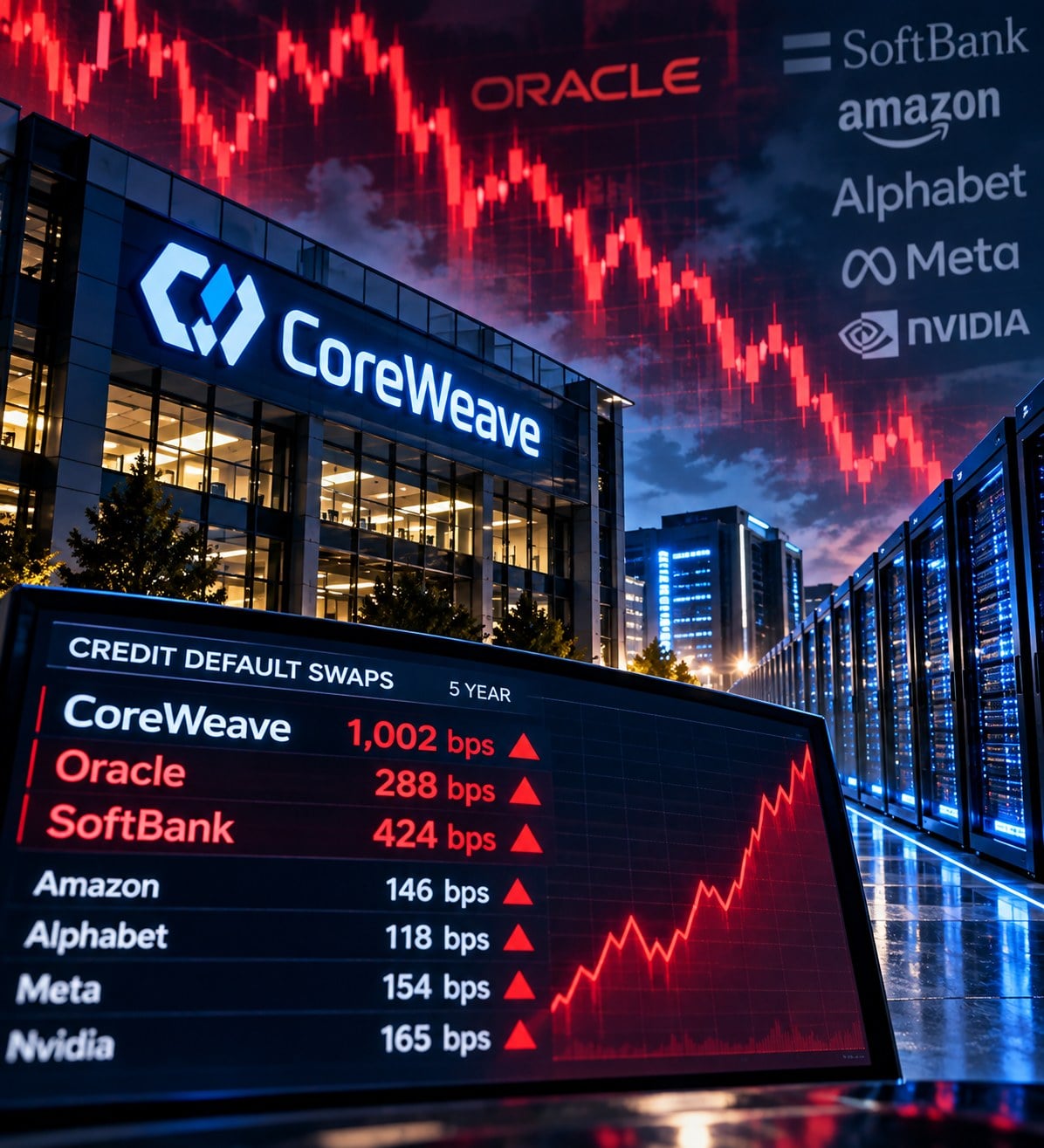
Five-year credit-default swap spreads on CoreWeave moved above 1,000 basis points, according to LSEG data. Oracle’s five-year CDS widened to a record 288 basis points, while SoftBank’s reached 424 basis points.
The deterioration matters because credit markets can provide an earlier signal of financing stress than equity prices alone.
CoreWeave has become one of the most closely watched companies in the AI infrastructure trade because of the large amounts of capital required to build and operate computing capacity. Its bonds have also come under pressure, with yields climbing above 15%.
The pressure is no longer isolated to one company.
Default-protection costs have risen across major technology companies as investors scrutinize the financing behind the enormous expansion of AI data centers, chips and cloud infrastructure.
Higher interest rates make that financing equation more difficult.
Companies investing heavily in infrastructure must generate sufficient future cash flow to justify both the original capital expenditure and increasingly expensive borrowing.
That creates a potential feedback loop: higher financing costs weaken project economics, weaker economics increase perceived credit risk, and worsening credit conditions make future AI infrastructure more expensive to finance.
The development represents an important evolution of the AI-market correction.
Until recently, much of the concern centered on equity valuations and whether the enormous spending commitments by technology companies would generate sufficient returns.
Credit markets are now beginning to price that uncertainty directly.
The next test is whether the deterioration remains concentrated among highly leveraged AI infrastructure companies or spreads further across investment-grade technology debt and the broader corporate-credit market.