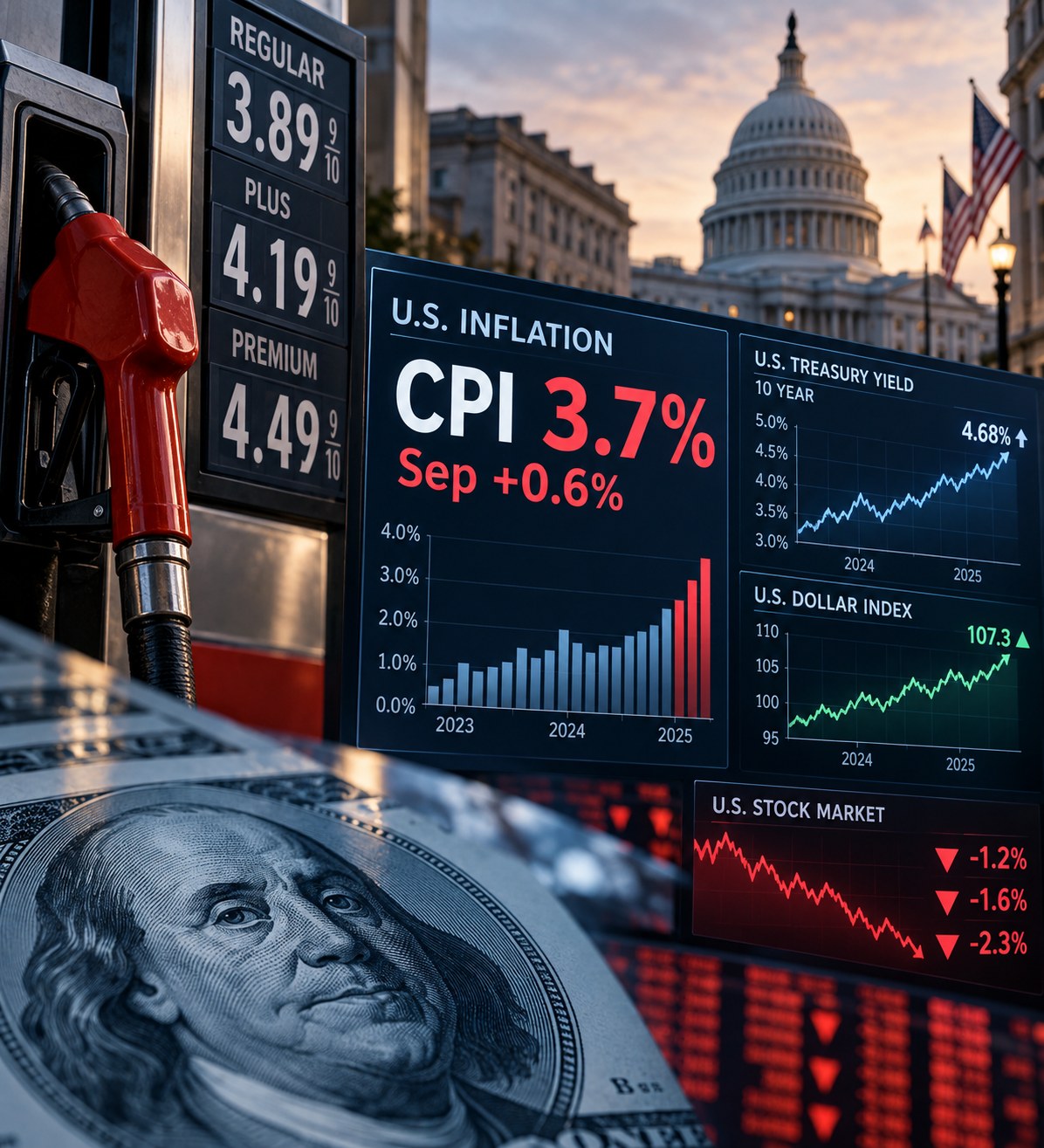
U.S. inflation accelerated sharply in September, delivering a hotter-than-expected reading that pushed Treasury yields and the dollar higher while pressuring stocks and increasing expectations that the Federal Reserve may need to tighten monetary policy again.
The Consumer Price Index rose 0.6% in September after increasing 0.4% in August. Over the previous 12 months, headline CPI increased 3.7%.
Energy was the dominant force behind the monthly increase. The gasoline index jumped 9.1%, accounting for more than half of the overall CPI increase, while the broader energy index rose 5.2%.
Inflation was not confined to energy. Shelter increased 0.4% during the month.
Core CPI, which excludes food and energy, rose 0.3% month over month and 2.6% from a year earlier.
Markets reacted quickly.
The U.S. two-year Treasury yield climbed roughly 7 basis points to about 4.87%, while the dollar index advanced about 0.7%. The S&P 500 fell roughly 0.9% and the Nasdaq about 1.3% as technology shares came under pressure.
Interest-rate expectations shifted as well. Traders substantially increased the probability of another Federal Reserve increase following the inflation report, while Citigroup changed its forecast and now expects a 25-basis-point increase in December.
The report complicates the Fed’s policy outlook because September’s increase combined a large energy shock with continued underlying price pressure.
That distinction will determine whether policymakers view the acceleration as primarily temporary or evidence that inflation is becoming harder to contain.
For markets, the immediate focus shifts from the headline CPI number to Federal Reserve communication and the Producer Price Index.
If additional inflation data confirm persistent price pressure, expectations for further monetary tightening could keep upward pressure on short-term Treasury yields and the dollar while challenging rate-sensitive equities.