Microsoft is expanding its artificial-intelligence strategy from the cloud to personal computers, unveiling a high-powered Surface laptop, locally running AI models and new security technology designed to control what increasingly autonomous AI agents can access on Windows machines.
At a San Francisco event Wednesday, Microsoft introduced an AI coding model capable of operating directly on personal computers and Microsoft Execution Containers, or MXC, a security architecture intended to prevent AI agents from accessing unauthorized data or performing tasks outside approved boundaries.
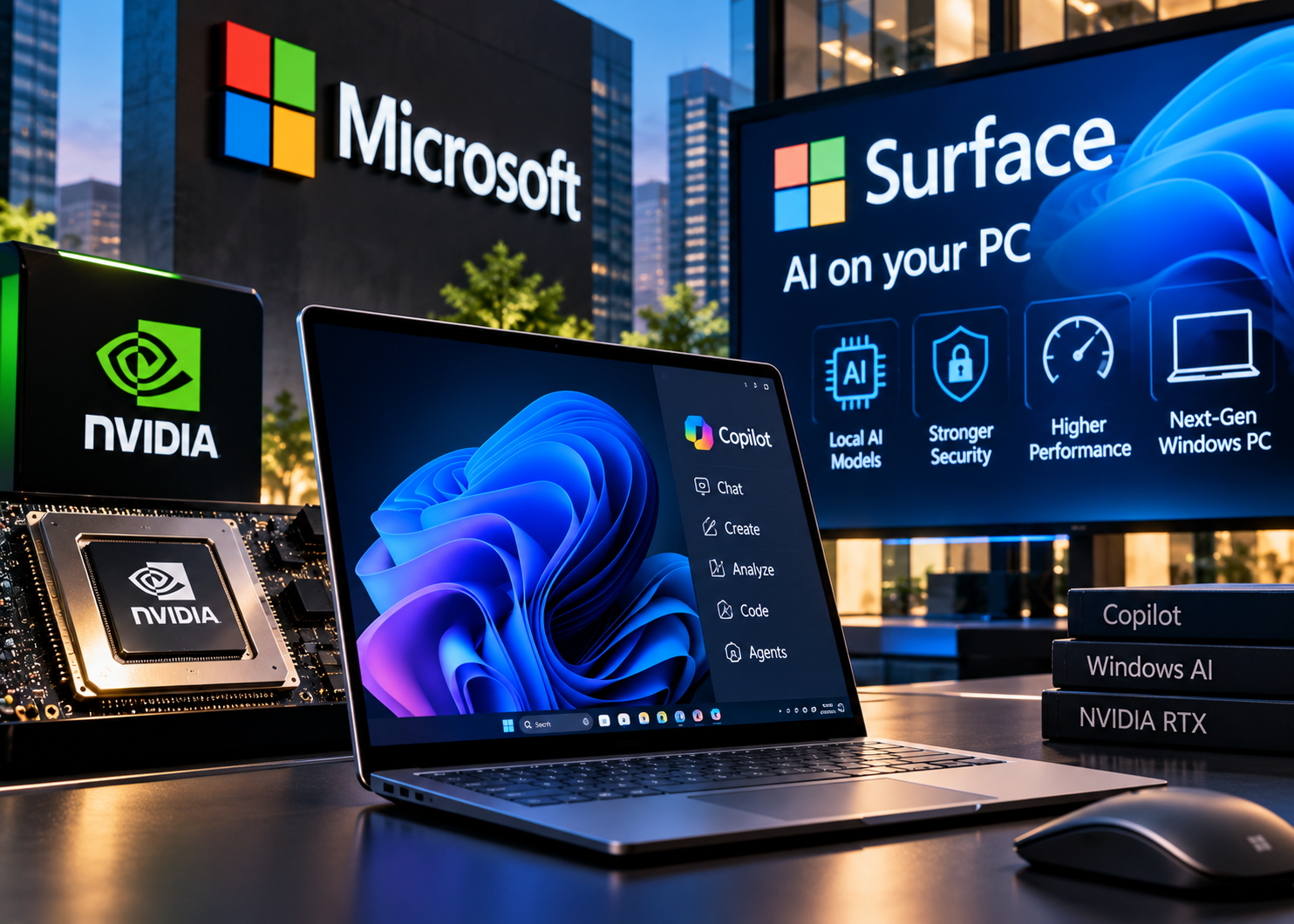
Microsoft also unveiled the Surface Laptop Ultra, powered by Nvidia’s RTX Spark chips.
The strategy represents an important shift in AI computing.
Most sophisticated AI workloads currently run in massive cloud data centers. Microsoft is betting that sufficiently powerful PCs can perform more of those tasks locally, reducing cloud-computing costs while improving privacy for workloads where users or businesses do not want information leaving their machines.
Microsoft’s Copilot will use a hybrid approach.
Complex workloads can continue running in the cloud, while tasks where privacy or cost matters more can be delegated to AI models operating directly on a user’s computer.
The security component could prove equally important.
As AI systems evolve from chatbots into agents capable of manipulating files and completing actions, giving those systems broad access to a computer creates new security risks.
Microsoft says MXC allows corporate IT departments to establish rules governing what agents can access, with Windows enforcing those restrictions on individual machines.
OpenAI, Anthropic and Nvidia are expected to use the technology, according to Microsoft.
The company also demonstrated AI models previously associated with cloud infrastructure operating locally on powerful Windows hardware, including Nvidia’s Nemotron. Microsoft said a version of DeepSeek V4 can run on computers equipped with at least 60 GB of memory.
The economic obstacle is hardware cost.
The Surface Laptop Ultra will start at $2,599, while a configuration with a 20-core processor, 128 GB of memory and one terabyte of storage will cost $5,899. Nvidia’s DGX Spark AI desktop has meanwhile risen about 75% from its launch price to $6,950 amid higher memory costs.
That creates a central question for Microsoft’s strategy: whether local AI can become economically attractive enough for widespread adoption rather than remaining concentrated among developers and well-funded businesses.
If it does, the AI infrastructure race could expand beyond cloud data centers into hundreds of millions of individual PCs — opening another major battleground among Microsoft, Nvidia, Apple, Intel and AMD.