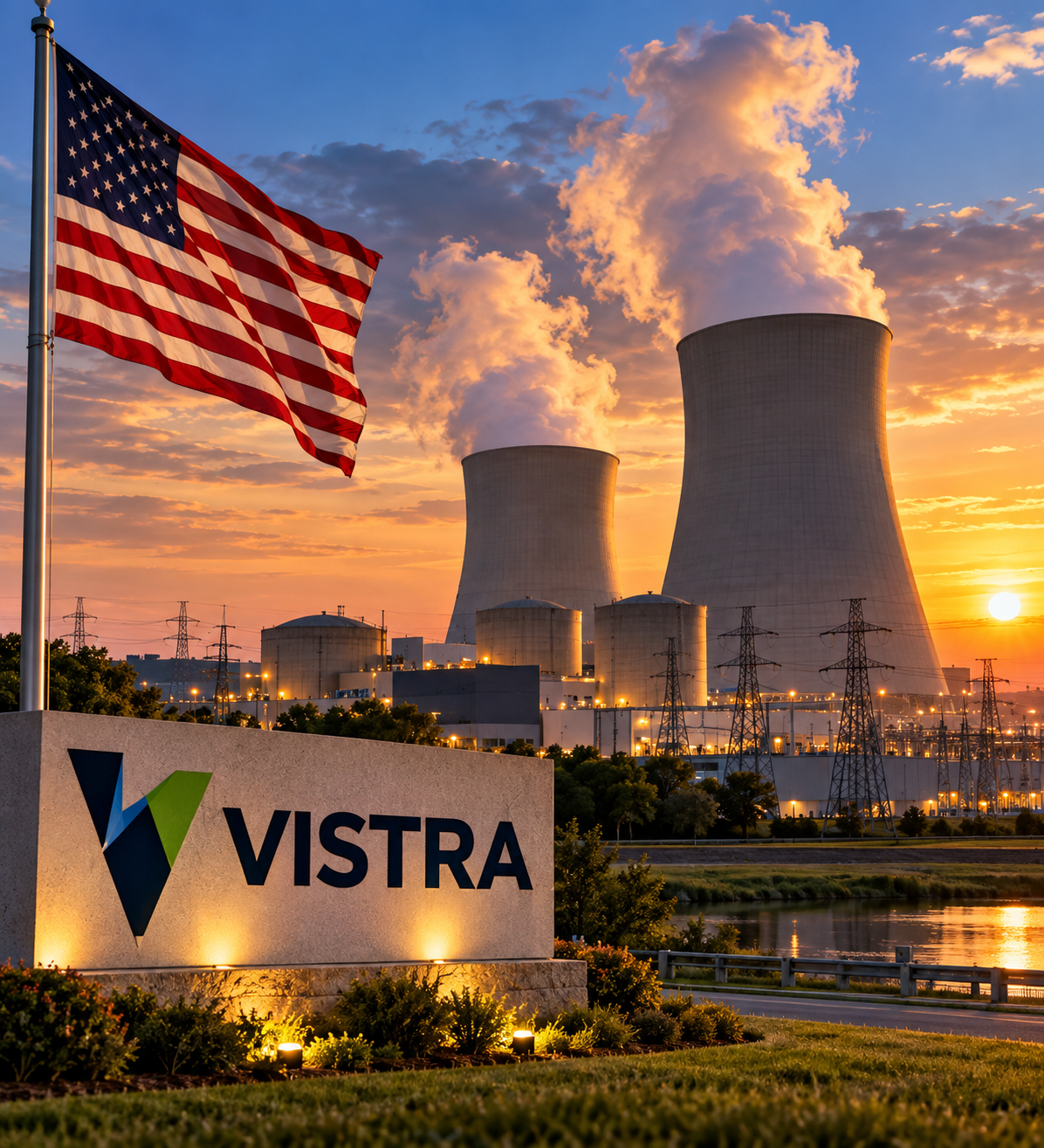
The U.S. government plans to lend power producer Vistra about $4.2 billion to increase electricity output from its nuclear fleet, marking another major commitment to U.S. power infrastructure as artificial-intelligence computing drives electricity demand higher.
The financing is expected to support upgrades at at least three of Vistra’s four nuclear stations. The planned work would increase generation through plant uprates — improvements that allow existing reactors to produce more electricity without constructing entirely new nuclear facilities.
Vistra operates six reactors across four nuclear plants with combined generating capacity exceeding 6.5 gigawatts, enough to supply roughly 3.25 million homes.
Energy Secretary Chris Wright is expected to announce the financing at Vistra’s Perry nuclear facility in Ohio, according to Reuters, which cited a person familiar with the matter. The financing should therefore be treated as a reported government plan until its final terms are formally announced.
The investment illustrates a significant shift taking place across the U.S. electricity industry.
Power demand is accelerating after years of relatively modest growth as technology companies construct increasingly large data centers for artificial intelligence and cloud computing. Electric vehicles, advanced manufacturing and other power-intensive industries are adding further pressure.
Nuclear generation has become particularly valuable in that environment because existing reactors can provide large quantities of continuous electricity. Rather than relying exclusively on new reactors — projects that can require many years of permitting and construction — uprating existing plants can provide additional nuclear output from infrastructure already connected to the grid.
For markets, the implications extend beyond Vistra.
The AI infrastructure boom increasingly depends on electricity generation, transmission equipment, natural gas, nuclear fuel and grid investment. That is pushing the investment consequences of artificial intelligence far beyond semiconductor companies and data-center operators.
Vistra is positioned directly at that intersection.
The next questions are the final loan terms, precisely which reactors receive upgrades, how much additional generating capacity the projects create and how quickly that power can enter the grid.
If the financing proceeds as reported, it would represent another large-scale example of U.S. energy investment being reshaped by the extraordinary electricity requirements of the AI investment cycle.