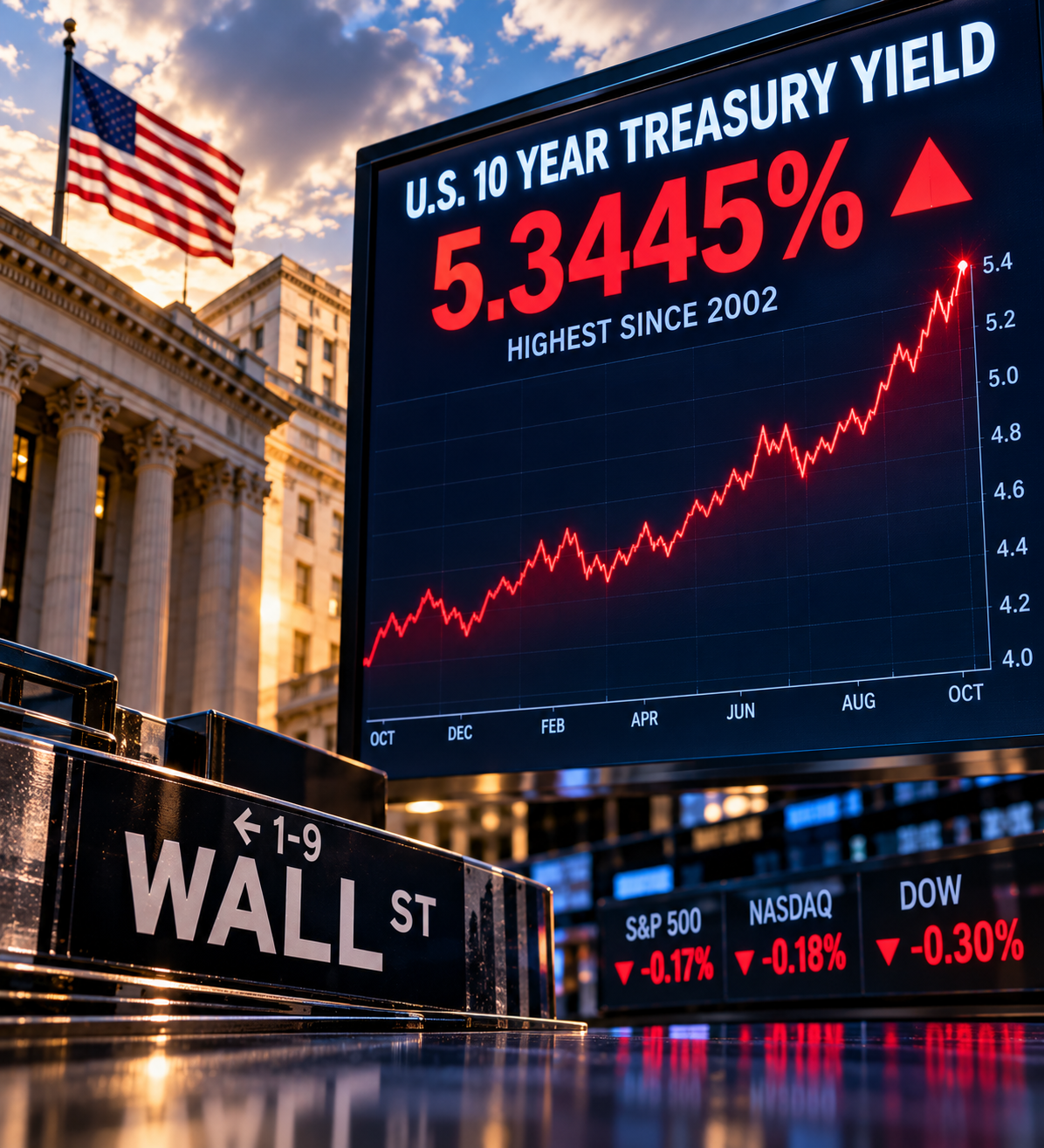
The global bond selloff intensified Thursday, briefly driving the benchmark U.S. 10-year Treasury yield to 5.3445%, its highest level since April 2002, before buyers returned and pulled yields back from the session peak.
The move is increasingly affecting markets beyond government bonds.
By 12:11 p.m. Eastern time, the Dow Jones Industrial Average was down 0.30%, the S&P 500 had fallen 0.17% and the Nasdaq Composite was lower by 0.18%. The S&P 500 had earlier touched a two-week low.
Fresh U.S. manufacturing data added another inflation concern. The Institute for Supply Management’s September manufacturing index showed continued expansion, while its prices component strengthened, contributing to another push higher in Treasury yields.
Energy prices amplified that pressure. Brent crude climbed above $100 a barrel during the session as fuel-market concerns remained elevated.
The combination matters because the Treasury market sits at the center of global asset pricing. Higher government yields raise financing costs for companies and households, pressure rate-sensitive sectors and increase the return investors can obtain from comparatively low-risk government debt.
Housing shares were down about 1.1% around midday, while the S&P bank index lost approximately 1.3%. Real estate, utilities and consumer staples — sectors often treated as bond proxies because of their dividend characteristics — were also lower. The VIX rose to a two-week high and was around 17.07.
The pressure extends well beyond the United States.
Britain’s 30-year government yield crossed 6%, its highest level since 1998. French 10-year borrowing costs approached 5%, while Japanese sovereign yields continued their prolonged climb. The U.S. 10-year yield had posted its largest quarterly increase this century during the three months through September.
There was some stabilization later in the U.S. morning. The 10-year yield retreated toward 5.26% as bargain hunters entered the Treasury market, showing that the session was not a one-directional collapse.
That reversal is important, but it does not remove the broader pressure.
Persistent energy-driven inflation, resilient economic growth, enormous capital requirements associated with AI and data-center construction, government borrowing needs and expectations that policy rates could remain elevated are all increasing competition for capital.
The dollar strengthened as yields climbed, adding another cross-asset consequence to the bond move.
For Wall Street, the central question is whether Treasury yields stabilize near current levels or resume their climb. A sustained 10-year yield above 5% increases the hurdle equities must clear to justify valuations and places particular pressure on highly leveraged companies, housing and other rate-sensitive areas.
Third-quarter corporate earnings beginning in mid-October will provide the next major test of whether profit growth can offset the tightening in financial conditions.