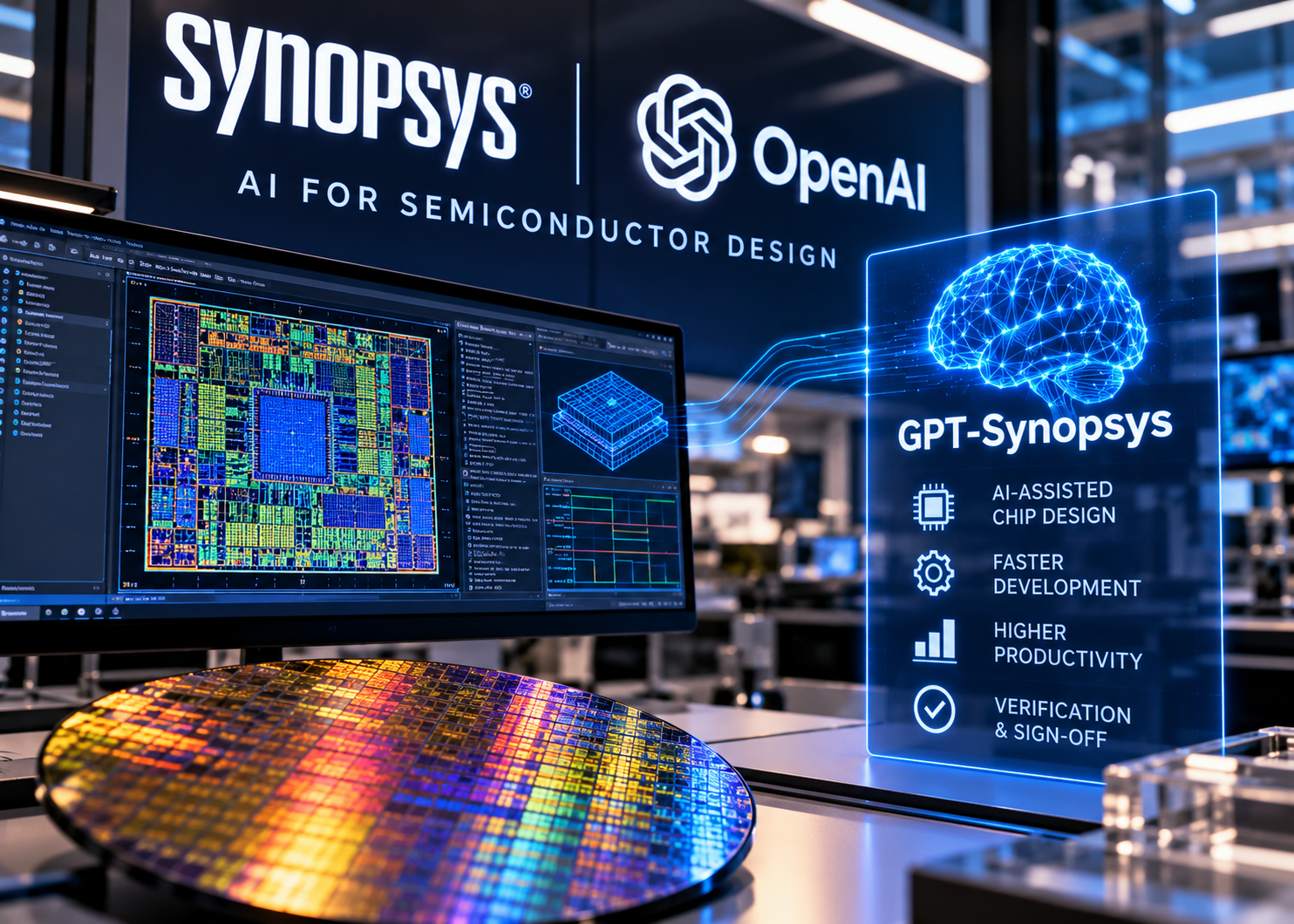
Synopsys and OpenAI have struck a partnership to develop a specialized artificial-intelligence model for semiconductor design, extending generative AI deeper into one of the technology industry’s most technically demanding engineering processes.
The planned model, called GPT-Synopsys, will be trained to work with Synopsys’ electronic-design-automation tools, which semiconductor engineers use to transform chip concepts into detailed physical designs.
Under the agreement, OpenAI will pay Synopsys a training subscription fee. Once the system enters commercial use, the companies will share revenue based on its contribution to chip-design improvements, according to Reuters.
The partnership matters because designing advanced semiconductors involves enormous numbers of engineering decisions spanning circuit architecture, verification, physical layout and manufacturing constraints.
AI systems capable of automating portions of that process could shorten development cycles and allow engineers to explore more potential designs before committing them to manufacturing.
Synopsys said output generated through the AI system will continue to undergo conventional computational verification, known in the semiconductor industry as sign-off, before a design is considered physically valid.
That verification layer is important because errors in semiconductor design can become extraordinarily expensive once a chip reaches manufacturing.
The announcement came as Synopsys raised its fiscal 2027 revenue-growth forecast to approximately 15%, above analysts’ expectations. Shares rose about 7% following the company’s investor event, according to Reuters.
Synopsys separately announced a multiyear agreement worth more than $1 billion under which Amazon Web Services will license semiconductor-design intellectual property from the company. AWS develops its own processors, including Graviton CPUs and Trainium AI accelerators.
Together, the agreements illustrate how AI competition is spreading beyond the companies manufacturing processors.
Electronic-design software and reusable semiconductor intellectual property are becoming increasingly strategic as cloud providers and technology companies develop more customized chips for artificial-intelligence workloads.
For Synopsys, the OpenAI partnership also creates an opportunity to incorporate AI directly into the engineering workflow rather than simply supplying conventional design software.
The key question will be whether GPT-Synopsys can produce measurable improvements in design productivity while maintaining the rigorous verification standards required before advanced chips enter manufacturing.