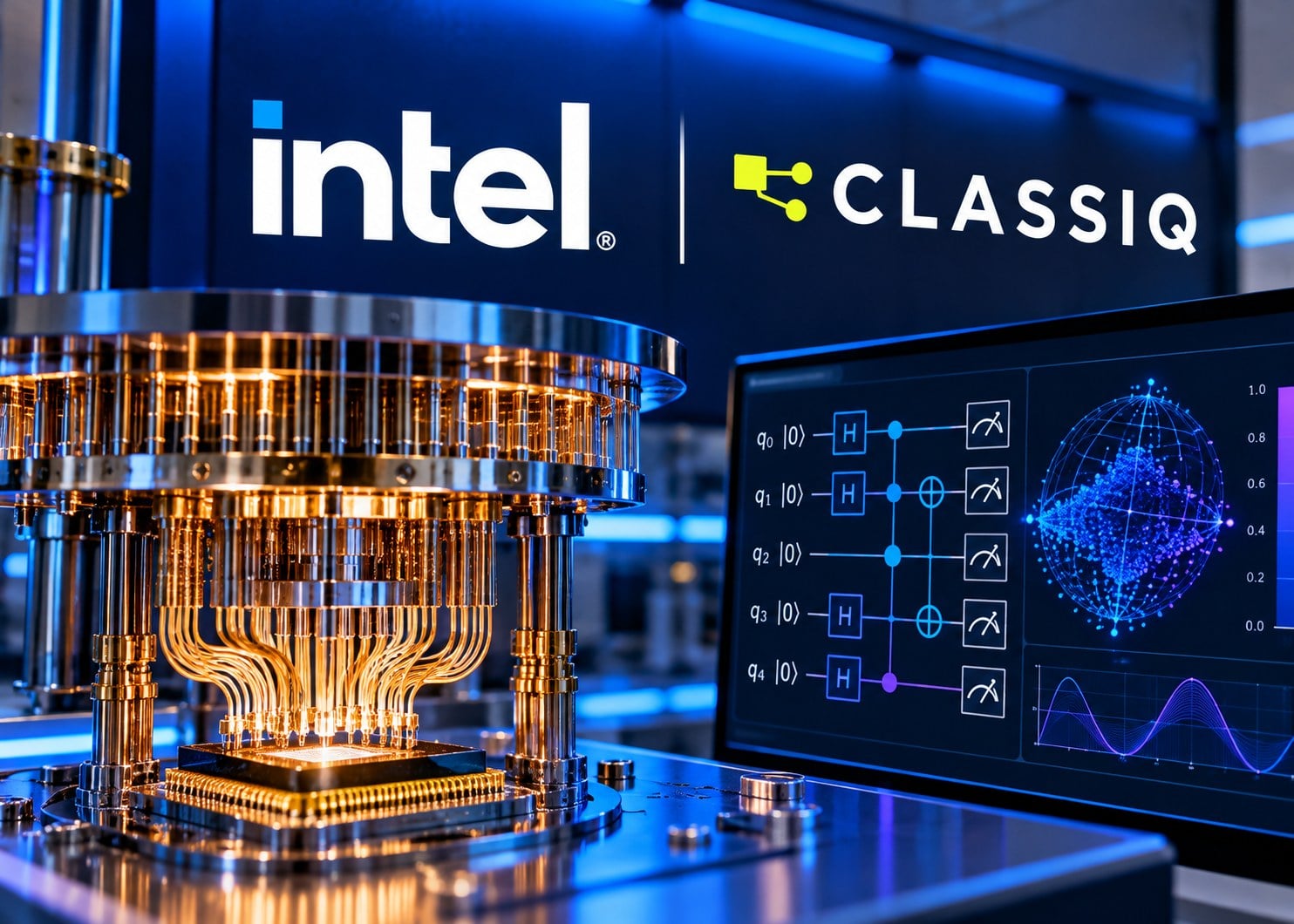
Intel has agreed to acquire quantum-computing software company Classiq, combining Intel’s developing quantum hardware with a software platform designed to make increasingly complex quantum systems easier for developers and businesses to use.
Intel announced the definitive agreement Monday. Financial terms were not disclosed, and the transaction is expected to close during the first half of 2027, subject to regulatory approvals and customary closing conditions.
Classiq develops software that allows users to design quantum algorithms at a higher level of abstraction rather than manually programming individual quantum operations. Intel plans to combine that technology with its own spin-qubit research, semiconductor-manufacturing capabilities and existing quantum software.
The strategy is aimed at creating a full-stack quantum computing platform spanning hardware and software rather than competing only at the processor level.
Intel’s approach relies on silicon spin qubits, which are particularly significant because they could potentially be manufactured using techniques related to the semiconductor processes already used to produce conventional chips. Scaling quantum systems from experimental devices to commercially useful machines remains a major technical challenge, however.
Classiq will continue supporting integrations with multiple quantum-computing platforms after the acquisition, according to Intel. The company says it intends to maintain an open, hardware-agnostic software ecosystem rather than restricting Classiq exclusively to Intel hardware.
The acquisition comes as major technology companies compete to establish positions in quantum computing before the technology reaches broad commercial adoption. Unlike today’s AI accelerator market, commercially useful fault-tolerant quantum computing remains an emerging technology, and the timing of widespread adoption remains uncertain.
For Intel, acquiring Classiq provides the software layer needed to complement its quantum hardware research and potentially gives developers a path from designing quantum applications to eventually running them on Intel processors.
The next test will be whether Intel can translate its semiconductor manufacturing expertise into scalable quantum hardware while Classiq’s software makes those systems practical enough for broader commercial use.