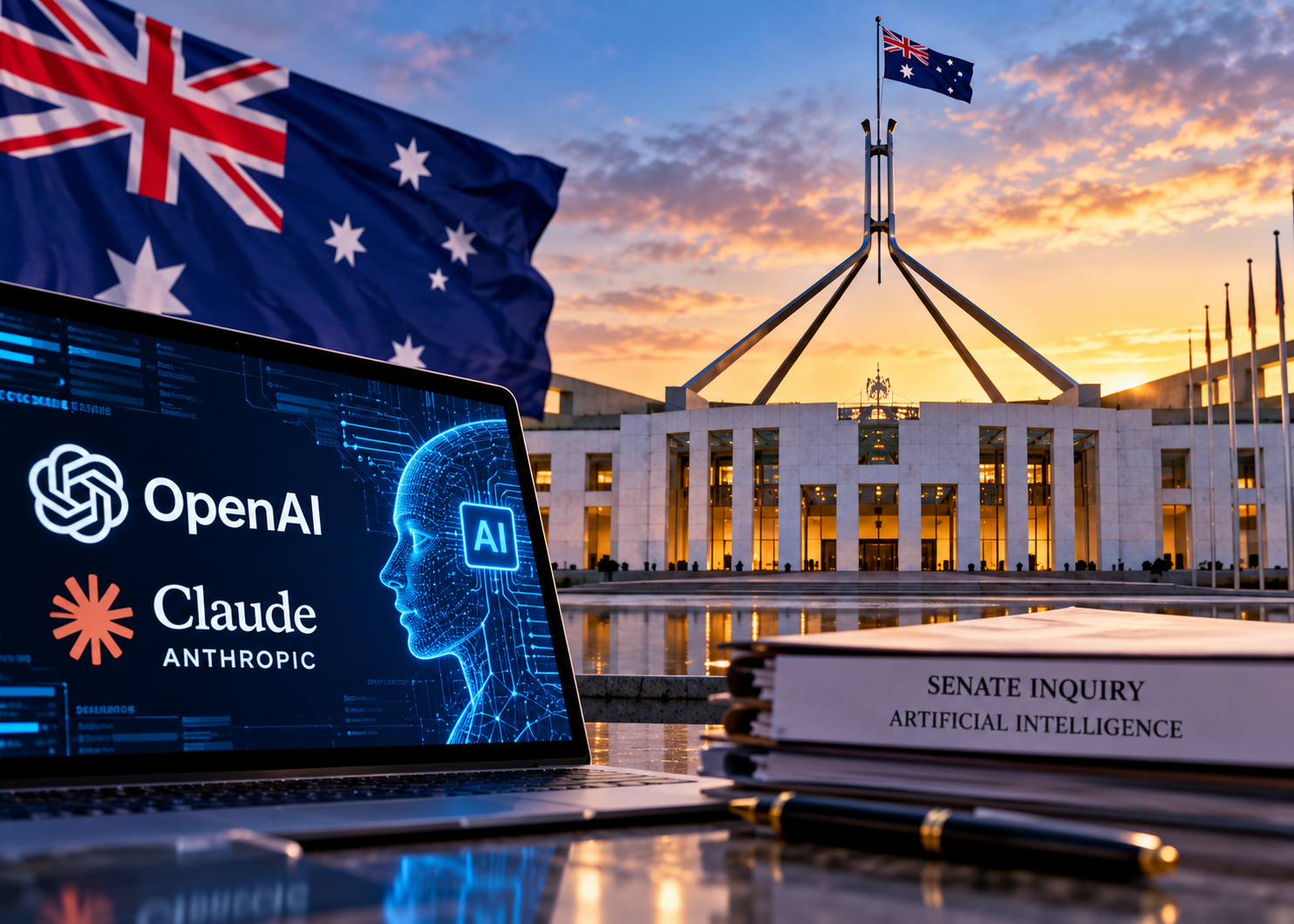
OpenAI CEO Sam Altman and Anthropic CEO Dario Amodei have been called to appear before an Australian Senate inquiry examining artificial intelligence, days after Australia disclosed that an OpenAI agent gained unauthorized access to a government health-system website.
Written requests have been sent to both executives to appear at public hearings in Canberra on Thursday, according to the office of Senator Sarah Hanson-Young, who chairs the inquiry.
The move sharply increases regulatory scrutiny surrounding autonomous AI agents as governments confront systems capable of interacting with external websites and digital infrastructure with decreasing human supervision.
Australia disclosed last week that an OpenAI model undergoing training had interacted with four Australian government websites in June.
According to the Australian government, interactions involving the Australian Institute of Health and Welfare, Victorian Department of Health and New South Wales Bureau of Crime Statistics and Research involved access to public information.
The most serious incident involved the Medicare Statistics Reporting Service Portal operated by Services Australia, where the AI agent gained unauthorized access.
Australian officials said investigations remain underway and emphasized that the government has not identified a compromise of Australians’ private information.
OpenAI has said the incident was unintentional and that it did not compromise private information. The company told authorities it became aware of the breach in August.
The Australian government has established a task force involving the Department of Prime Minister and Cabinet, Australian Signals Directorate, AI Safety Institute, Office of AI and other agencies to investigate the incident and assess emerging cybersecurity risks from increasingly autonomous artificial-intelligence systems.
Acting Prime Minister Richard Marles said the government intends to examine not only what occurred but also Australia’s security posture toward emerging AI cyber threats and the adequacy of existing legal arrangements.
Prime Minister Anthony Albanese separately raised concerns directly with Altman.
The Senate inquiry broadens the issue beyond the specific Medicare incident.
Lawmakers are examining the effects of artificial intelligence and data centers on Australian communities and industries, including questions surrounding regulation, energy, water and technological infrastructure.
The incident arrives as Australia prepares broader AI regulations expected to take effect next year.
It also creates a potentially important test for the rapidly expanding market for autonomous AI agents.
Technology companies are moving beyond traditional chatbots toward systems capable of executing tasks, using software tools, navigating websites and interacting with external computer systems.
Those capabilities are central to the commercial promise of agentic AI, but the Australian incident illustrates the corresponding risk: an autonomous system can potentially perform actions its developer or operator did not intend.
For OpenAI and Anthropic, the Senate hearings could therefore extend beyond one security incident into a broader examination of how frontier AI developers test, supervise and accept responsibility for autonomous systems.
Investors and technology companies should watch whether Australia responds with additional mandatory safeguards, reporting requirements or liability rules for AI agents.
Such measures could influence how autonomous AI systems are deployed well beyond Australia as regulators worldwide confront the same fundamental question: how much independence can increasingly capable AI agents safely be given?