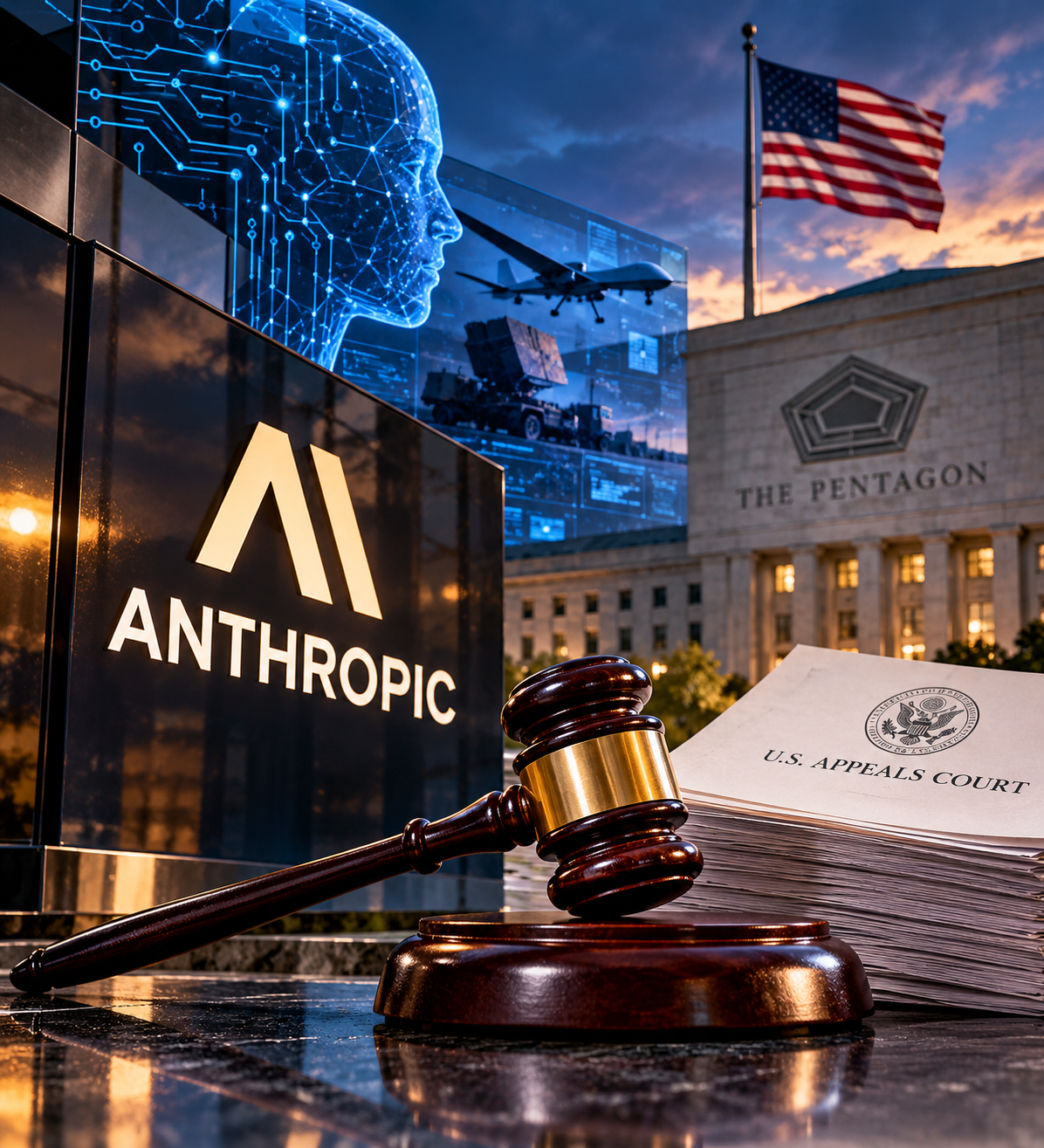
A U.S. federal appeals court has upheld the Pentagon’s blacklisting of Anthropic from military contracts, delivering a major legal setback to the artificial-intelligence company in its dispute with the U.S. government over restrictions on how its technology can be used.
The U.S. Court of Appeals for the District of Columbia Circuit ruled 2-1 that the Pentagon acted reasonably when it designated Anthropic a national-security supply-chain risk.
The dispute centers on Anthropic’s refusal to remove restrictions preventing its AI systems from being used for autonomous weapons and mass domestic surveillance.
The appeals-court majority accepted the Pentagon’s argument that restrictions embedded in AI systems could create operational risks in military environments. The judges rejected Anthropic’s argument that the designation constituted unlawful retaliation for the company’s positions on AI safety and ethics.
The ruling matters well beyond a single government contract.
Artificial-intelligence companies are increasingly competing for defense and national-security work as governments incorporate advanced models into intelligence analysis, logistics, cybersecurity and battlefield systems.
That creates a fundamental commercial question: how much control can an AI developer retain over the downstream use of its technology after supplying it to a government customer?
Anthropic has said its restrictions reflect concerns that current AI technology is not sufficiently reliable for autonomous weapons and that mass domestic surveillance raises fundamental rights concerns.
The company said it disagreed with the appellate ruling and was considering its options, including requesting review by the full appeals court.
The legal picture remains complicated. A federal judge in California previously struck down a parallel designation under a different law and blocked broader government restrictions affecting Anthropic.
The latest appellate ruling therefore does not resolve every legal dispute between the company and the federal government.
The commercial stakes are substantial. Anthropic has said the Pentagon designation has cost it billions of dollars in business and damaged its reputation as the company moves toward a potential public offering.
For investors, the dispute illustrates a growing risk surrounding the AI industry: government customers can become enormously important sources of revenue while simultaneously demanding capabilities or operational freedom that conflict with developers’ own safety policies.
Markets should watch whether Anthropic seeks full appellate review, whether the dispute reaches the Supreme Court, and how other AI developers structure safeguards when pursuing U.S. defense contracts.