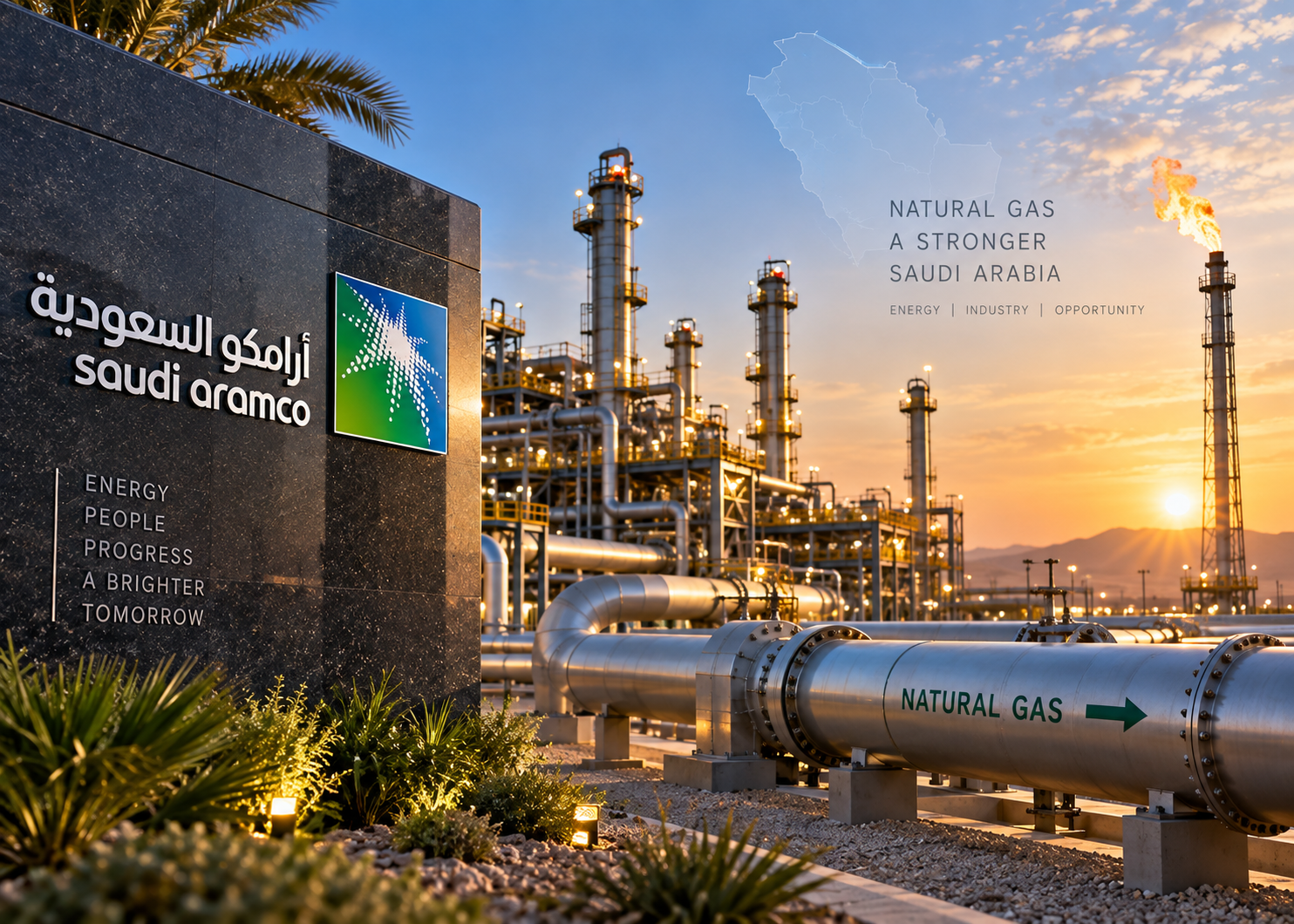
Saudi Aramco is planning a major corporate reorganization that would establish natural gas as a standalone business division, underscoring the increasingly important role gas plays in the company’s growth strategy.
The proposed restructuring would change Aramco’s current upstream-and-downstream structure into three principal businesses: upstream, downstream and gas, with each led by its own president.
The new division would oversee Aramco’s domestic and international natural-gas activities, including its expanding exposure to liquefied natural gas.
The restructuring remains a plan rather than a completed corporate change.
Aramco is also considering options that could eventually include selling a minority interest in the gas business and pursuing additional transactions to raise capital. Those possibilities have not been announced as completed transactions and should therefore be treated as options under consideration.
The centerpiece of Aramco’s gas strategy is the Jafurah field.
Jafurah contains enormous unconventional gas resources and is central to Saudi Arabia’s plan to substantially increase domestic gas production by the end of the decade.
The expansion serves several strategic objectives for the kingdom.
Greater domestic gas availability can replace crude oil currently used in electricity generation, potentially freeing additional barrels for export. Gas can also supply petrochemical operations and power-intensive industries as Saudi Arabia expands its industrial and technology infrastructure.
Aramco has already demonstrated that it can attract outside capital into its gas infrastructure, including through multibillion-dollar investment arrangements connected with Jafurah.
Creating a dedicated gas division would therefore formalize a shift already underway operationally: natural gas is moving from a supporting component of Aramco’s traditional oil business toward a distinct strategic growth platform.
For energy markets, the development reinforces Saudi Arabia’s effort to diversify its energy portfolio without abandoning its position as one of the world’s dominant crude-oil producers.