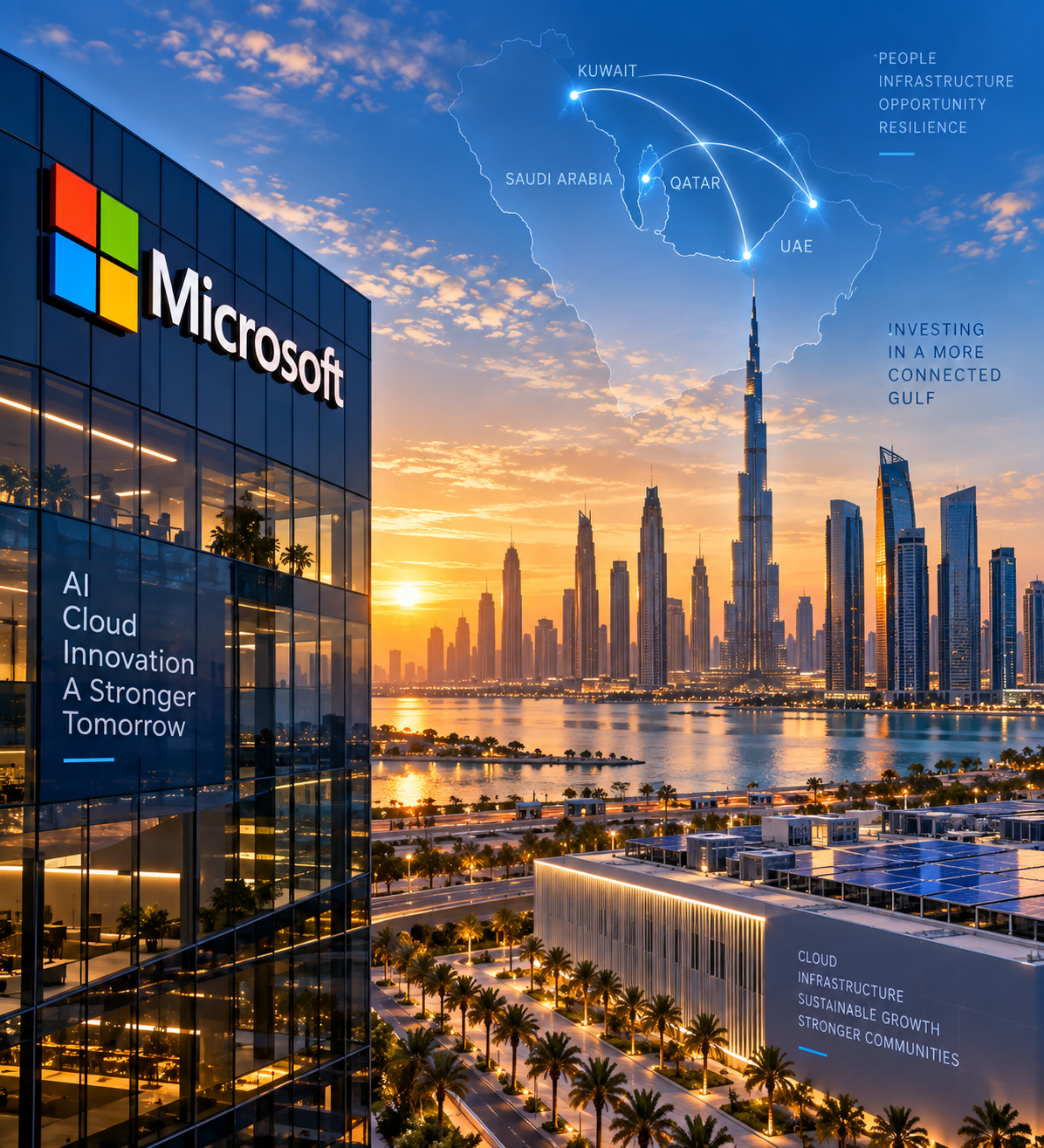
Microsoft plans to invest more than $10 billion across the Gulf through 2030, expanding artificial-intelligence infrastructure, cloud capacity and regional connectivity as the company strengthens its presence in one of the world’s fastest-growing technology markets.
The investment will span the United Arab Emirates, Saudi Arabia, Qatar and Kuwait, according to Microsoft Vice Chair and President Brad Smith. Microsoft has not disclosed how the planned spending will be divided among the four countries or individual projects.
The company said the investment includes continued infrastructure construction and expansion of its regional operations. Microsoft is also planning more than $400 million of additional investment in subsea and terrestrial connectivity across the Middle East by 2030.
The expansion comes as Gulf governments commit substantial capital to artificial intelligence and data-center infrastructure as part of broader efforts to diversify their economies beyond oil and gas.
Access to relatively inexpensive energy and available land has made the region increasingly attractive to hyperscale cloud providers. At the same time, regional security risks are increasing the importance of resilient digital infrastructure.
Microsoft said digital resilience has consequently become a larger component of its Gulf strategy, including assessments designed to strengthen critical infrastructure and operational readiness.
The company said regional conflict has not caused it to reduce previously planned investment. Smith told Reuters that Microsoft is maintaining those commitments while adding further spending.
Microsoft already has significant strategic relationships across the region. It invested $1.5 billion in Abu Dhabi-based artificial-intelligence company G42 in 2024 and has relationships with other regional technology groups.
The Gulf expansion therefore represents more than another data-center construction cycle.
AI infrastructure increasingly sits at the intersection of economic diversification, energy availability, data sovereignty and national resilience.
For Microsoft, that makes the Gulf an increasingly important market in the global competition to build the infrastructure required for artificial intelligence.