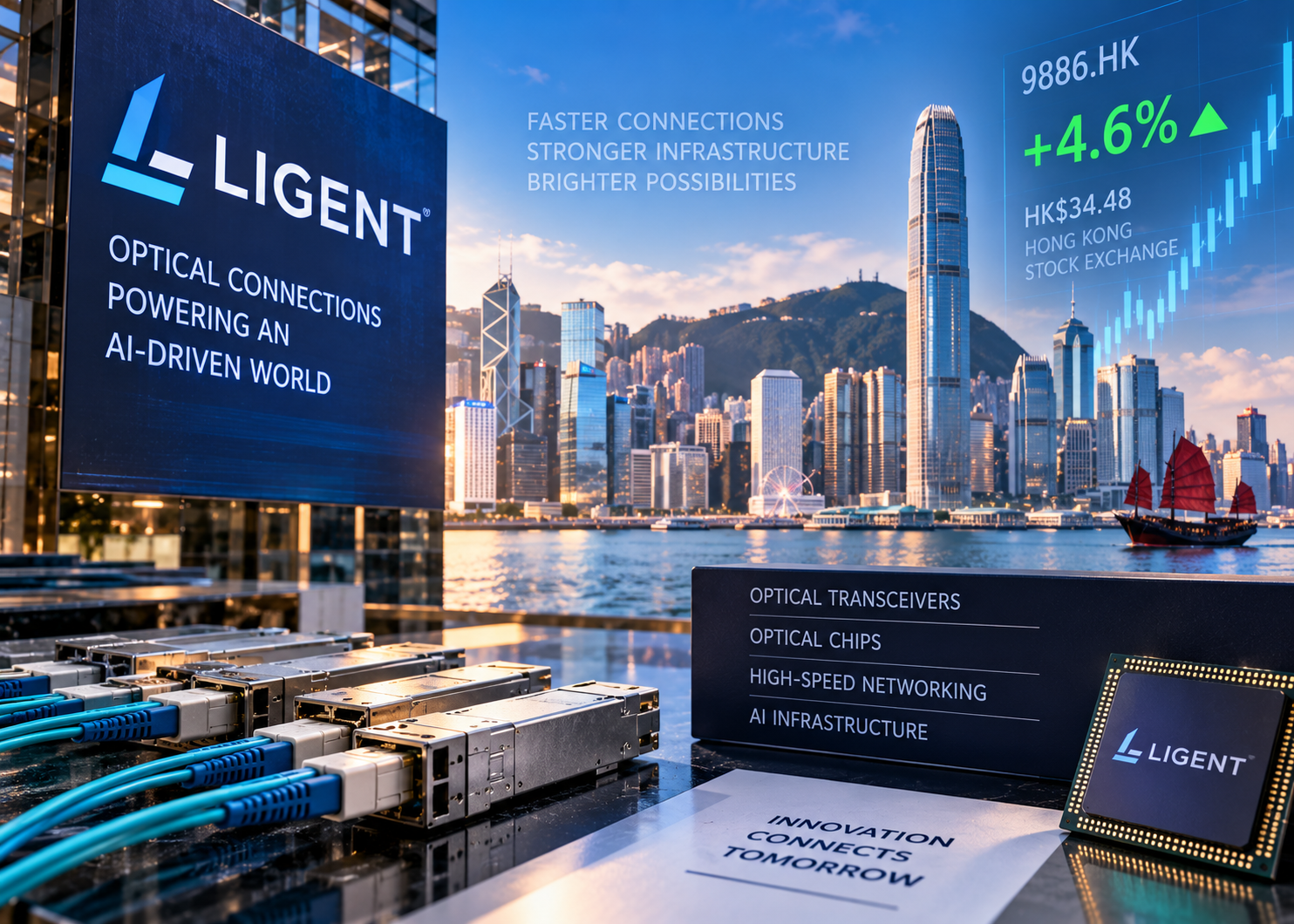
Ligent Technologies shares finished 4.6% higher in their Hong Kong trading debut after the Chinese optical-networking company raised HK$5.67 billion, approximately $723 million, amid strong investor interest in artificial-intelligence infrastructure.
The shares closed at HK$34.48, above their HK$32.96 offering price, after climbing as much as 19.2% to HK$39.30 earlier in the session.
Ligent produces optical transceivers, optical chips and network terminals.
Those technologies are becoming increasingly important to AI data centers because large computing clusters require extremely fast connections between servers, switches and other infrastructure. Optical systems allow enormous amounts of data to move rapidly through fiber networks.
Investor demand for the offering was substantial.
Ligent’s Hong Kong public offering was subscribed more than 35 times, while its international offering was subscribed approximately 4.7 times.
The company plans to direct about 52.9% of its net IPO proceeds toward research and development, primarily focusing on faster optical products and chips. Approximately 25.1% is expected to fund additional production capacity.
Ligent has also reported strong recent growth.
Revenue for the first half of 2026 increased 27.9% from a year earlier to 5.39 billion yuan, while net profit increased 29.7% to 661 million yuan.
The listing illustrates how investor interest surrounding artificial intelligence is expanding beyond the processors that initially dominated the AI investment cycle.
Data centers require networking equipment, optical connections, memory, power infrastructure and cooling systems in addition to computing chips. Companies supplying those components have therefore become another route for investors seeking exposure to continued AI infrastructure spending.
Ligent’s first-day performance provides an early indication of that demand, but the longer-term test will be operational.
Investors will be watching whether accelerating demand for high-speed optical networking translates into sustained revenue and earnings growth after the initial enthusiasm surrounding the IPO fades.