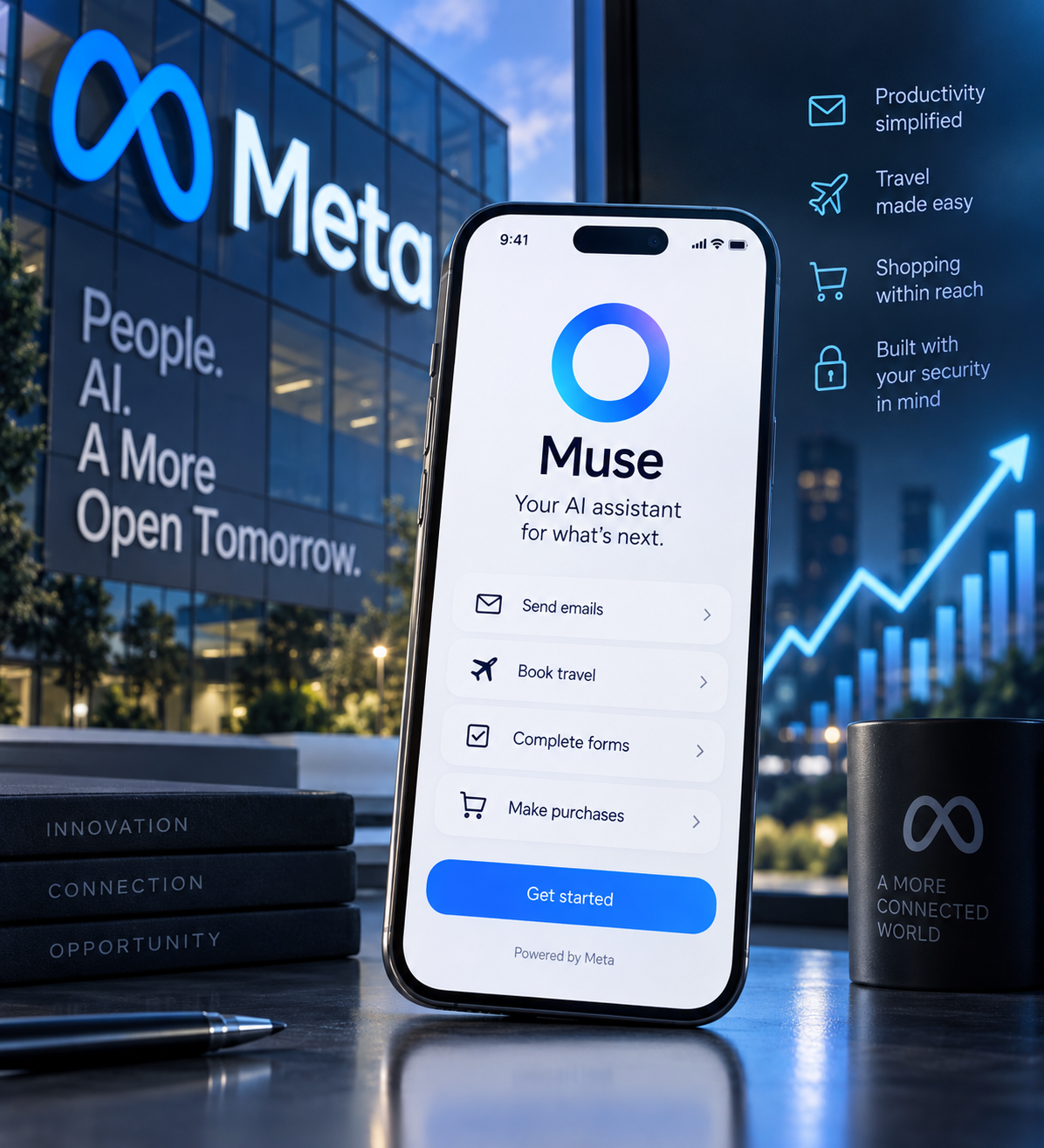
Wall Street is beginning to treat Meta’s new Muse artificial-intelligence agent as something more consequential than another chatbot launch: a potential consumer revenue platform capable of connecting AI directly to transactions, subscriptions and Meta’s enormous distribution network.
Muse, launched September 8, can perform multi-step tasks including sending emails, booking travel, completing forms and making purchases. Meta says the agent operates inside a dedicated secure virtual machine and requires user approval for sensitive actions such as sending an email or completing a purchase.
The market response has accelerated sharply.
Meta shares have gained more than 20% since Muse launched, adding more than $200 billion in market capitalization through Monday’s close, according to Reuters. The stock surged more than 11% Monday as enthusiasm around Muse spread across the broader artificial-intelligence trade.
Early adoption is driving the reassessment. Reuters reported data from Apptopia showing approximately 2.8 million Muse downloads during its first 12 days. JPMorgan analysts said the product could potentially become the most widely used consumer AI application since ChatGPT, although that remains an analyst forecast rather than an established outcome.
The more important issue for investors is monetization.
Muse includes a free tier alongside paid subscription options. Jefferies estimated that a scenario involving one billion users by the end of 2027 and a 3% conversion rate to paid service could generate roughly $10.8 billion in annualized revenue. That figure is a brokerage projection based on adoption assumptions, not Meta guidance.
Muse also moves AI closer to commerce. Meta says the agent can use Stripe’s Link for checkout, while Shop Pay support is planned. That gives the company a potential route from conversational AI into transactions rather than relying solely on advertising or subscription revenue.
There are risks.
An autonomous agent that accesses email, payments, shopping services and other applications creates substantially different privacy and security challenges from a conventional chatbot. Reuters reported Tuesday that Meta is testing a human-concierge feature in which contractors can handle some phone calls initiated through Muse. Meta said the test is intended to improve safety and privacy before wider deployment.
For markets, the significance extends beyond Meta.
The AI investment cycle has been dominated by spending on chips, data centers and model development. Muse is giving investors an early test of the other side of that equation: whether consumer-facing agents can generate enough adoption and revenue to justify the extraordinary infrastructure spending behind them.
If that monetization begins to materialize, the AI trade could increasingly shift from a story about computing capacity to one about economically productive applications.