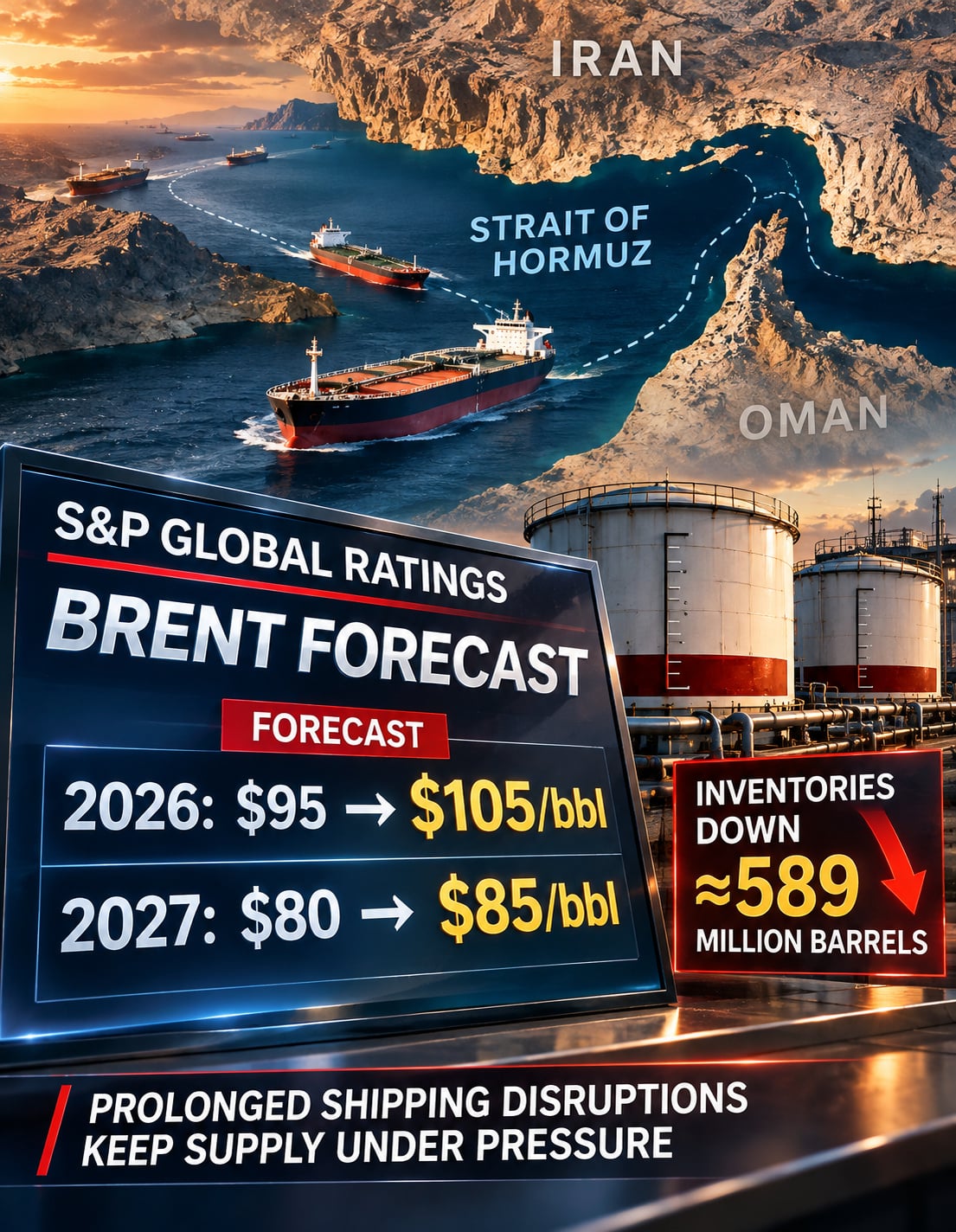
S&P Global Ratings has raised its oil-price assumptions, warning that prolonged disruptions around the Strait of Hormuz could keep global energy markets under pressure well into 2027.
The ratings agency now assumes Brent crude will average $105 per barrel for the remainder of 2026, up from its previous $95 assumption. Its 2027 Brent estimate increased to $85 from $80.
West Texas Intermediate assumptions were also raised to $95 per barrel for the remainder of 2026 and $80 for 2027.
The revisions reflect continued restrictions on Middle Eastern energy exports, uncertainty surrounding the conflict involving Iran and the depletion of inventories that have helped cushion supply disruptions.
S&P estimates that global crude oil and petroleum-product inventories have declined by approximately 589 million barrels since the conflict began.
That reduction leaves the market with less protection against additional supply interruptions.
Although shipments through the Strait of Hormuz have recovered from their lowest levels earlier this year, the ratings agency expects disruptions to continue through 2027 under its base-case assumptions.
The outlook contrasts with the recent decline in market prices. Brent traded above $98 on Friday following a sharp weekly retreat driven partly by expectations of reduced geopolitical tensions.
The distinction is important: S&P’s assumptions represent a forecast, not a guaranteed trading price.
Persistently elevated crude prices could increase transportation, manufacturing and consumer costs while complicating central banks’ efforts to control inflation.
Energy-importing economies would remain particularly exposed, while producers could benefit from higher realized prices if their export operations remain functional.
The next developments to watch are shipping volumes through Hormuz, diplomatic negotiations, commercial inventory levels and changes in refinery and tanker operations.
A sustained improvement in regional security could weaken the assumptions supporting higher prices. Further disruptions could reinforce them.