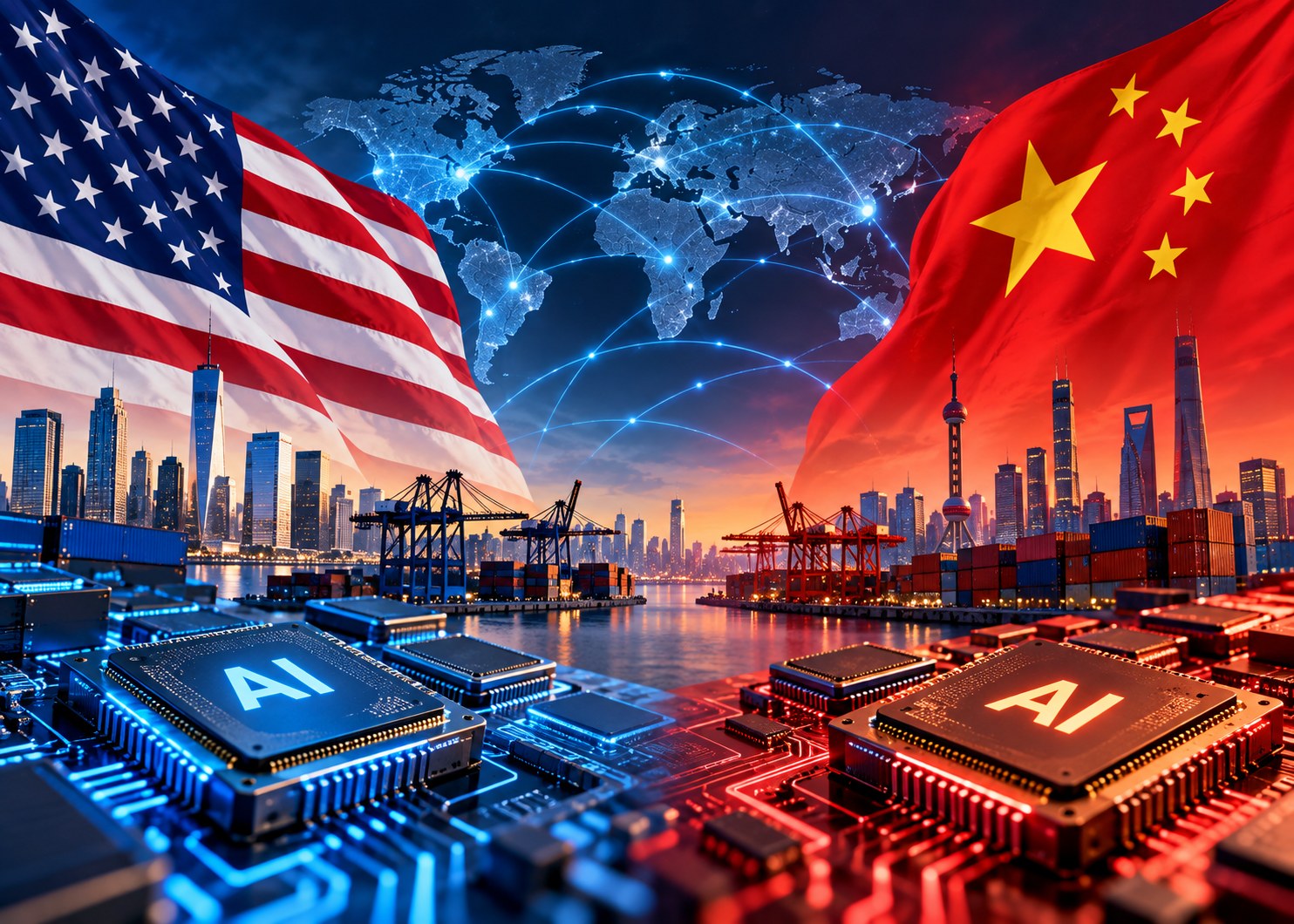
Competition between the United States and China over artificial intelligence is expanding beyond chips and individual companies into competing international technology ecosystems.
Governments around the world are increasingly being asked to navigate between a U.S.-aligned system emphasizing advanced semiconductors, trusted technology supply chains and security partnerships and a Chinese approach centered partly on lower-cost infrastructure and open artificial-intelligence models.
The emerging divide could influence where countries obtain processors, build data centers, source AI models and establish technical standards.
The United States is promoting cooperation through initiatives including Pax Silica, which focuses on semiconductor supply chains and technology partnerships.
China is developing its own international framework through the World AI Cooperation Organization while expanding AI infrastructure and financing relationships across developing economies.
Many countries are attempting to avoid choosing exclusively between the two.
Kazakhstan has engaged with initiatives associated with both powers while seeking foreign investment in data centers and artificial-intelligence infrastructure.
Indonesia is similarly pursuing technology relationships with both countries, while Singapore is considering participation in China’s cooperation initiative.
Saudi Arabia has combined Chinese AI models with U.S.-designed computing hardware.
Those strategies reflect a practical economic calculation.
Most countries lack the enormous capital, advanced semiconductor manufacturing and computing infrastructure required to independently develop frontier AI systems.
Access therefore depends heavily on technology and investment originating in the United States and China.
That dependence gives both countries increasing leverage.
Washington has tightened restrictions on access to advanced semiconductors and other strategic technologies while encouraging trusted technology partnerships.
Beijing has emphasized open-source AI and broader international access while arguing that U.S. export controls restrict technological development.
The resulting competition resembles a struggle over infrastructure as much as software.
Data centers, processors, cloud platforms, electricity, telecommunications networks and AI standards are increasingly becoming part of geopolitical alignment.
For markets, the fragmentation could reshape technology supply chains and capital spending.
Countries attempting to remain compatible with both ecosystems may face increasing pressure if U.S. and Chinese technical standards, security requirements or export controls diverge further.
The next phase of the AI competition may therefore be determined not only by which country develops the strongest models, but by which technology ecosystem attracts the largest international network of users, governments and infrastructure partners.