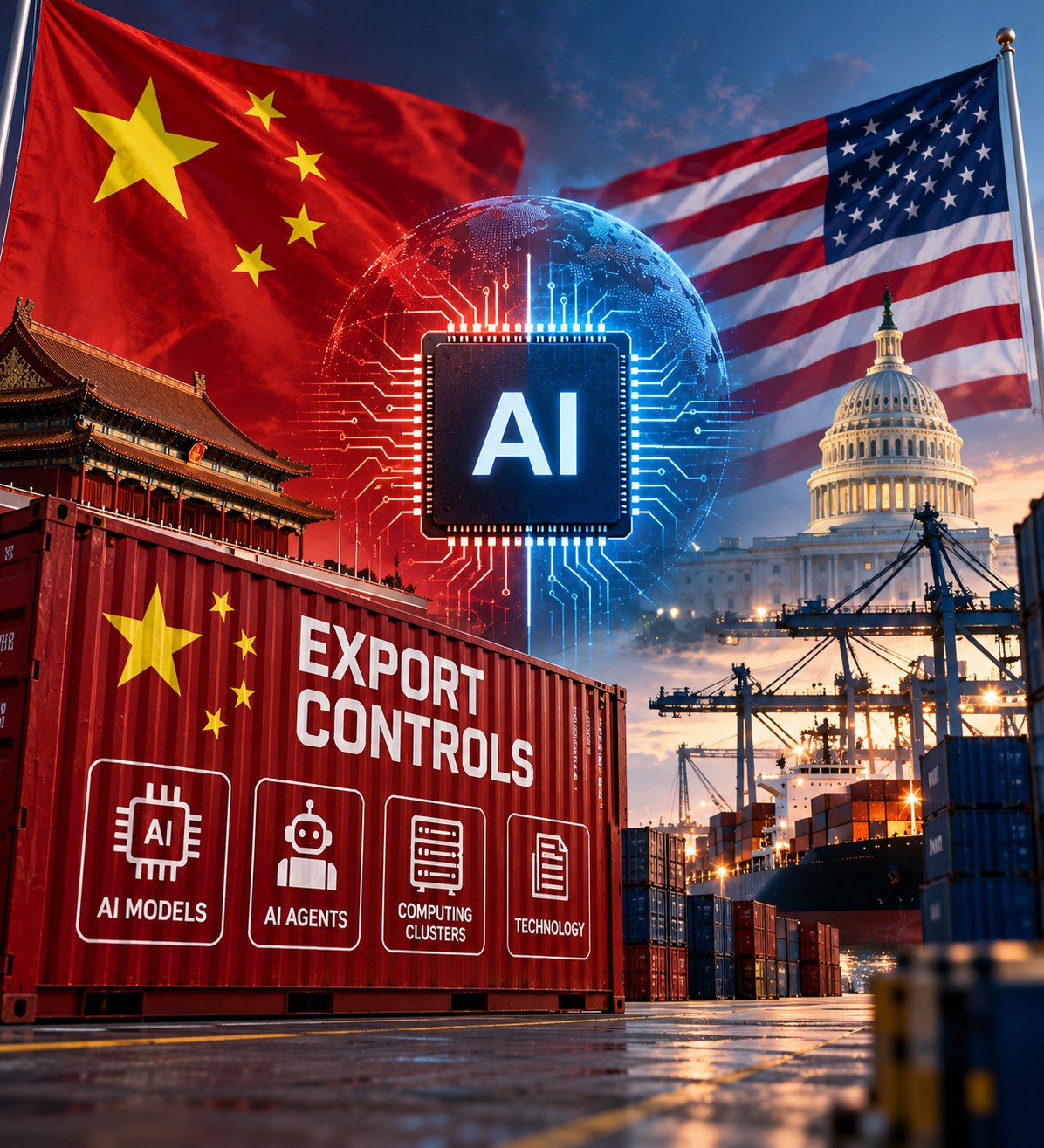
China is proposing new export restrictions covering 23 artificial-intelligence technologies, expanding Beijing’s technology controls as competition with the United States increasingly moves beyond semiconductors into AI models, software and intellectual property.
China’s Ministry of Commerce and Ministry of Science and Technology proposed revisions Friday to the country’s catalogue of technologies prohibited or restricted from export.
The AI provisions cover technologies including advanced models, AI agents and computing clusters. The broader proposed revision covers 40 technologies spanning artificial intelligence, biotechnology and solar power.
The distinction between exporting AI technology and allowing overseas users to access Chinese AI services is important.
Under the proposal, overseas deployment involving restricted underlying technology could require government approval, while foreign users could continue accessing Chinese models through websites, applications, APIs and software-as-a-service platforms.
Existing open-source technology and academic research would be exempt from the proposed restrictions.
The government has opened the proposal for public consultation through November 15, meaning the measures are not yet final. China is simultaneously implementing interim pre-export registration requirements for the affected technologies.
The move represents another evolution in the global technology conflict.
U.S. restrictions have focused heavily on limiting China’s access to advanced semiconductors, chipmaking equipment and computing capabilities. Beijing has increasingly developed its own controls over strategically important technologies and materials.
Artificial intelligence now appears positioned to become another part of that framework.
Chinese AI models have become increasingly competitive internationally, making the underlying models, training technology and computing architecture strategically valuable.
Export restrictions could give Beijing greater control over where advanced Chinese AI technology is deployed and under what conditions while potentially complicating international expansion by Chinese developers.
The proposal also illustrates a broader shift in the U.S.-China technology rivalry.
The competition is no longer only about access to the most advanced chips. Governments are increasingly treating AI models, computing infrastructure, training techniques and related intellectual property as strategic assets.
Markets should now watch the November consultation process, the final scope of the export catalogue and whether Beijing ultimately imposes licensing requirements that materially affect international deployment by Chinese AI companies.