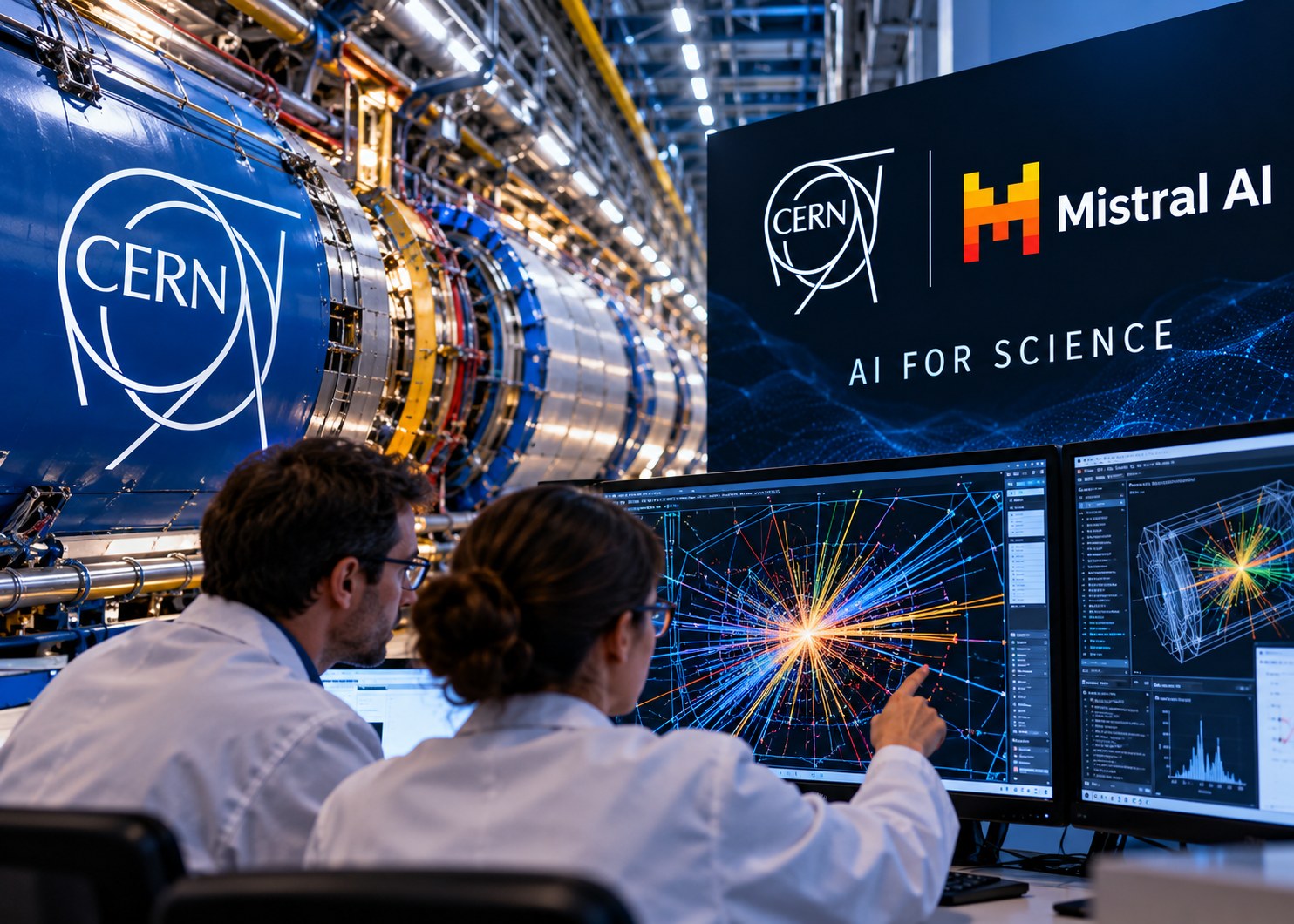
CERN and French artificial-intelligence company Mistral AI have established a strategic partnership aimed at developing a new generation of foundation models designed specifically for scientific research.
The initial project centers on a Large Physics Model called Flare, which CERN says is intended to become the first foundation model developed specifically for collider physics.
Instead of being trained primarily on text like conventional large language models, Flare will learn from billions of simulated particle collisions produced through high-energy physics research.
CERN already holds roughly one exabyte — about one million terabytes — of experimental data generated by the Large Hadron Collider. The number of particle collisions is expected to increase roughly tenfold when the upgraded High-Luminosity Large Hadron Collider begins operations around 2030.
Researchers currently rely on numerous specialized algorithms to reconstruct and identify particles produced during collisions. A sufficiently capable foundation model could eventually perform several of those functions within a more general AI architecture.
The project represents another expansion of artificial intelligence beyond consumer chatbots and corporate software.
Scientific organizations increasingly see foundation-model technology as a potential tool for analyzing datasets whose scale and complexity make conventional analysis difficult.
The partnership also carries strategic significance for Europe. Mistral has emerged as one of the continent’s most prominent AI developers as European governments and institutions seek greater technological independence from dominant U.S. and Chinese AI companies.
CERN and Mistral have not announced a development budget or completion date for Flare, making the initiative a research program rather than a finished product.
The next test will be whether foundation-model architectures can produce measurable improvements in particle reconstruction and scientific discovery — and whether techniques developed at CERN can eventually be applied to other scientific disciplines.