Wall Street recovered from an early technology-driven selloff Thursday as a sharp retreat in Treasury yields helped stabilize equities, although pressure remained concentrated in semiconductor and other artificial-intelligence-linked stocks.
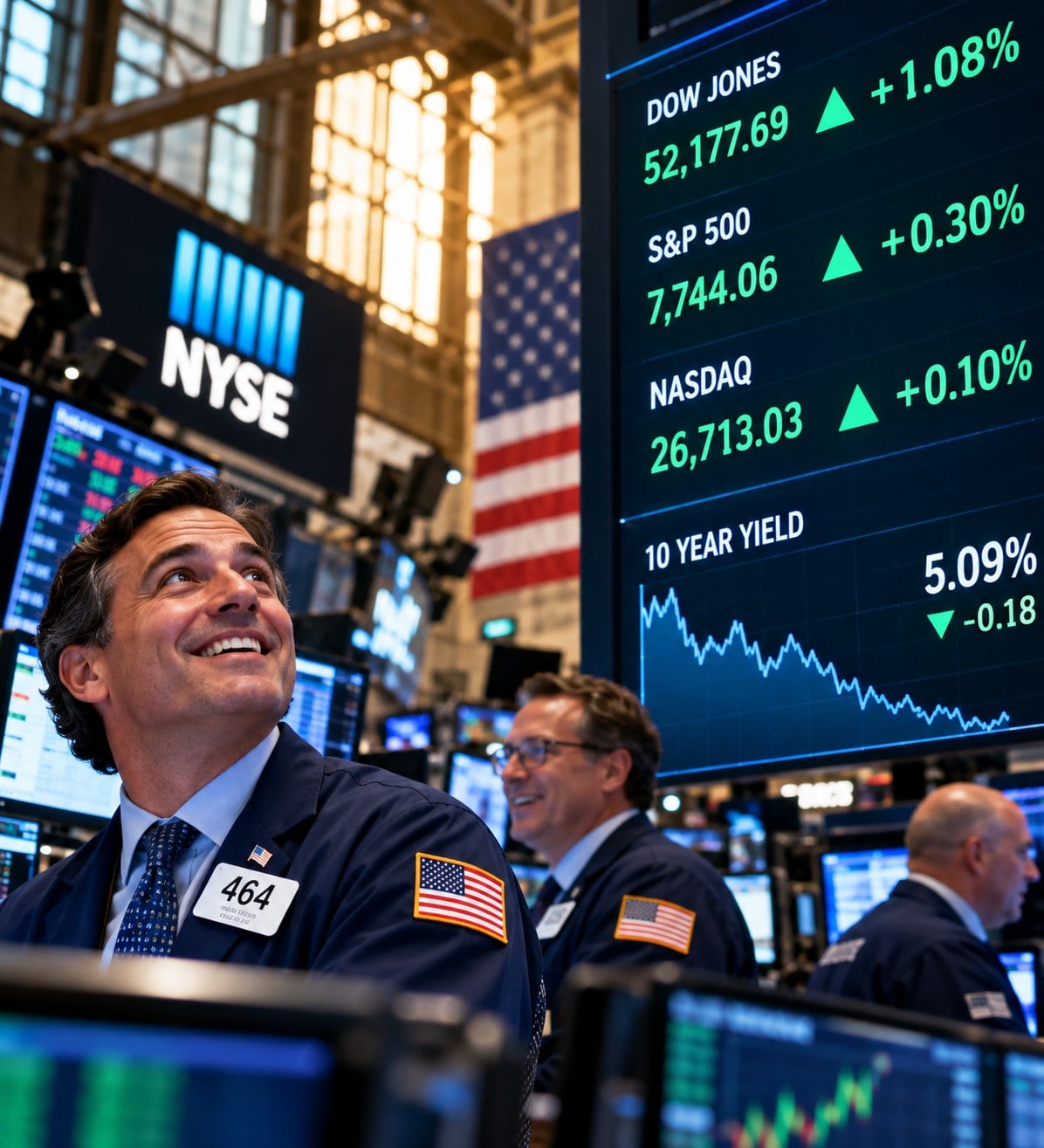
The Dow Jones Industrial Average rose 1.1% to 52,177.69, while the S&P 500 gained 0.3% to 7,744.06. The Nasdaq Composite recovered from earlier losses to finish 0.1% higher at 26,713.03.
The closing numbers concealed a significant change in market leadership.
Healthcare, materials and other less technology-dependent areas attracted buyers while semiconductor shares remained under pressure. The Philadelphia Semiconductor Index fell about 1.7%, extending a difficult stretch for chip stocks.
The shift follows several sessions of growing concern over the enormous amounts of debt and capital required to finance AI data centers, chips and computing infrastructure.
Those concerns have increasingly spread beyond equities into credit markets, forcing investors to reconsider whether projected AI revenue growth can justify the cost of financing the industry’s expansion.
Bond markets provided some relief Thursday.
The benchmark 10-year U.S. Treasury yield fell to roughly 5.09% as investors moved back into government debt. Lower long-term yields can ease valuation pressure on growth companies because future earnings are discounted at a lower rate.
The rebound did not eliminate the broader inflation problem. Investors remain focused on elevated inflation and what it could mean for Federal Reserve policy.
The session therefore looked less like a complete return to the AI trade than a rotation inside the U.S. equity market.
Investors were willing to buy stocks again, but increasingly favored companies with less dependence on expensive financing and aggressive future-growth assumptions.
The next test is whether large technology companies can demonstrate that extraordinary AI investment is translating into sufficiently strong revenue and cash flow. If they cannot, the rotation away from technology could become more durable rather than a temporary response to several difficult sessions.