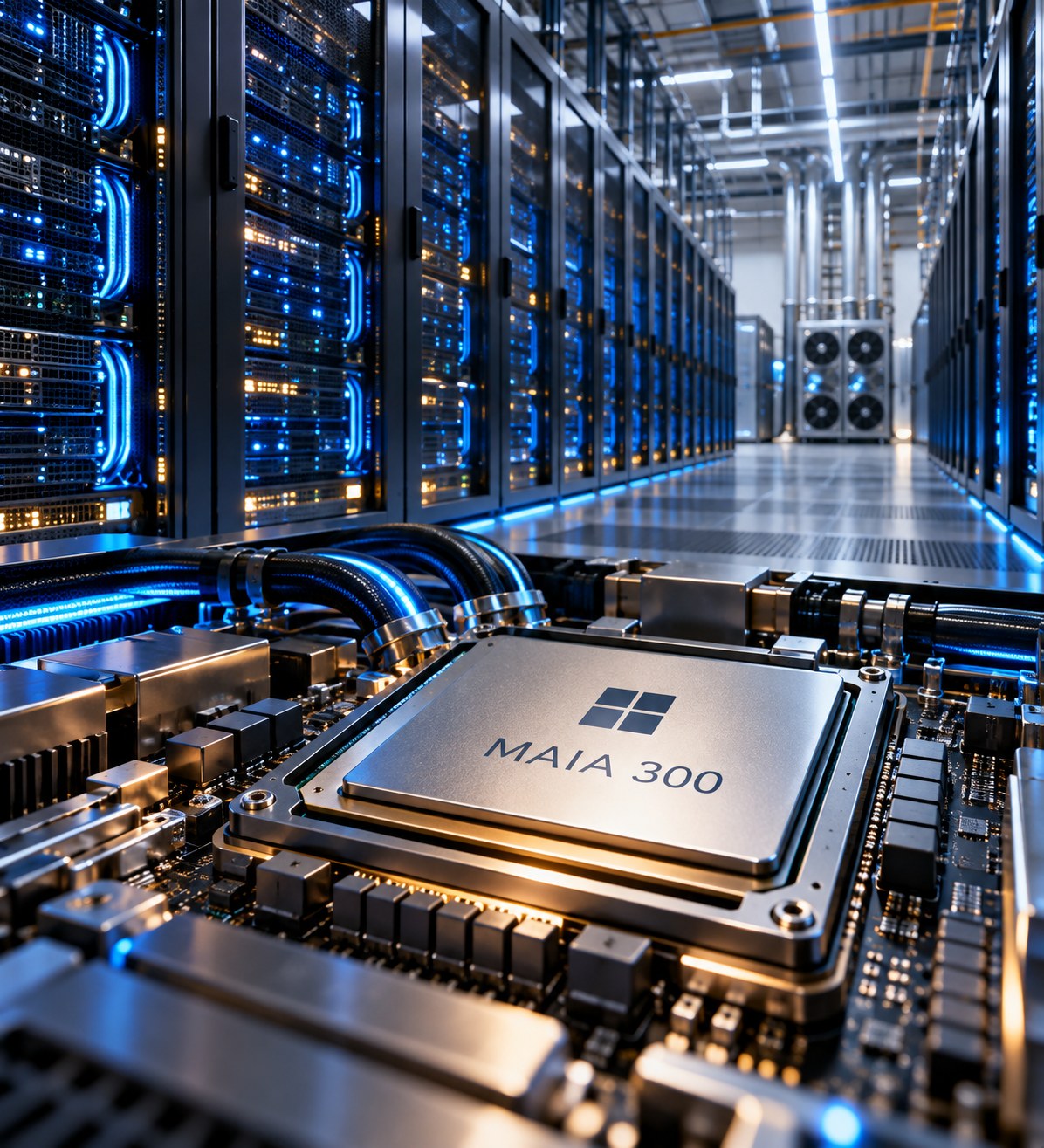
Microsoft has unveiled Maia 300, the third generation of its internally designed artificial-intelligence processor, and plans to expand the Azure Maia platform into multi-gigawatt deployments beginning in 2027.
The company says Maia 300 will become the primary AI-inference system supporting Microsoft products and services, marking a major expansion of its effort to control more of the hardware underlying its enormous AI infrastructure buildout.
Microsoft says Maia 300 is expected to deliver 40% more tokens per megawatt than leading GPU-based systems and as much as seven times the rack-level token throughput of Maia 200. Those figures are company performance claims rather than independently benchmarked results.
The economic significance extends beyond chip performance.
Microsoft has framed calendar-2026 capital expenditure at roughly $175 billion as it expands data centers, power capacity and AI infrastructure. Developing its own silicon gives the company another way to attack one of the largest costs in that expansion while reducing dependence on merchant processors.
Maia 200 is already running production workloads including Microsoft Copilot. Maia 300 is designed for more demanding inference workloads including long-context reasoning, conversational applications and sustained multi-step AI agents.
The strategy also intensifies competition across the AI semiconductor market. Hyperscalers increasingly want custom processors optimized around their own workloads, power constraints and software stacks rather than relying exclusively on general-purpose accelerator platforms.
For investors, the critical question is whether Microsoft’s enormous internal demand allows Maia to achieve sufficient scale and performance to materially alter the economics of AI inference.
The 2027 rollout will provide that test. If Microsoft can shift a meaningful share of its inference workloads onto internally designed hardware, the AI infrastructure race will increasingly be fought not only over access to computing capacity, but over who controls the processors, software and electricity economics underneath it.