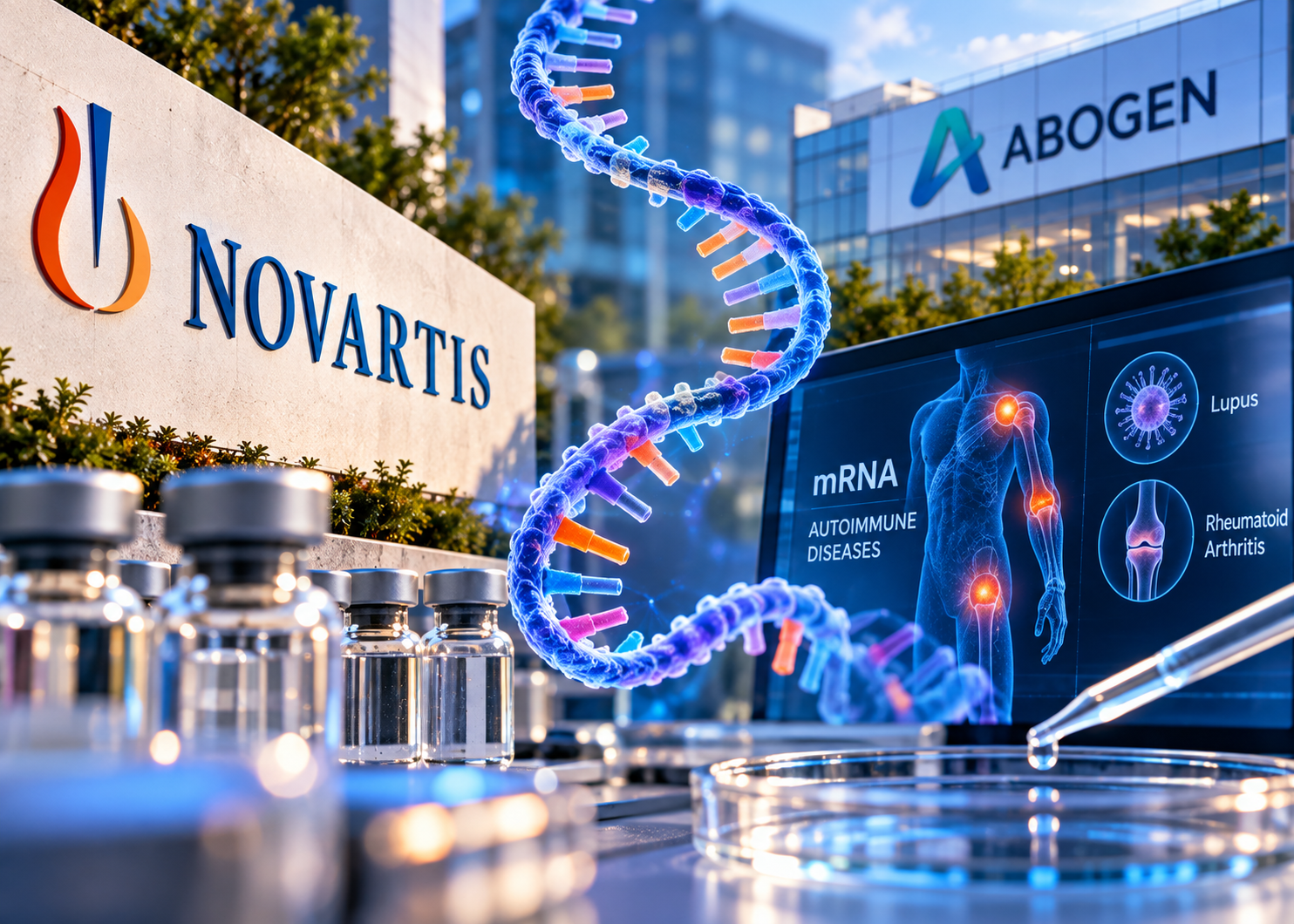
Novartis has agreed to a licensing partnership worth as much as $7.8 billion with Chinese biotechnology company Abogen, expanding the Swiss drugmaker’s exposure to messenger RNA therapies and adding another major cross-border pharmaceutical transaction involving Chinese drug development.
Under the agreement, Novartis will receive exclusive rights to Abogen’s experimental drug ABO2203 and options to license additional therapies built on the Chinese company’s RNA technology.
Abogen will receive $575 million upfront.
Another approximately $7.2 billion could be paid if the program reaches specified development and regulatory milestones.
ABO2203 is being developed for autoimmune diseases including lupus and rheumatoid arthritis.
The experimental treatment uses mRNA technology to instruct a patient’s own cells to produce a therapy designed to eliminate disease-causing B cells.
The agreement expands the commercial reach of mRNA technology beyond the infectious-disease vaccines that first brought the platform widespread attention.
Drugmakers are increasingly examining mRNA for cancer and autoimmune treatments.
The transaction also reflects growing international interest in China’s biotechnology industry.
Large pharmaceutical companies have increasingly licensed experimental medicines developed by Chinese companies as they search for new treatments and seek to replenish their development pipelines.
For Novartis, the deal comes at a sensitive time.
The company disclosed two late-stage clinical-trial failures in September that erased nearly $30 billion from its market value and increased investor scrutiny of its dealmaking strategy.
Novartis said its business-development approach has remained consistent and that Abogen’s RNA technology complements its existing autoimmune portfolio.
The agreement’s headline value should not be confused with an immediate $7.8 billion payment.
Only $575 million is due upfront. The remainder depends on future development and regulatory milestones that may or may not be achieved.
Investors will now focus on ABO2203’s clinical development, whether Novartis exercises its options on additional Abogen programs and whether mRNA therapies can establish a meaningful role in treating autoimmune disease.