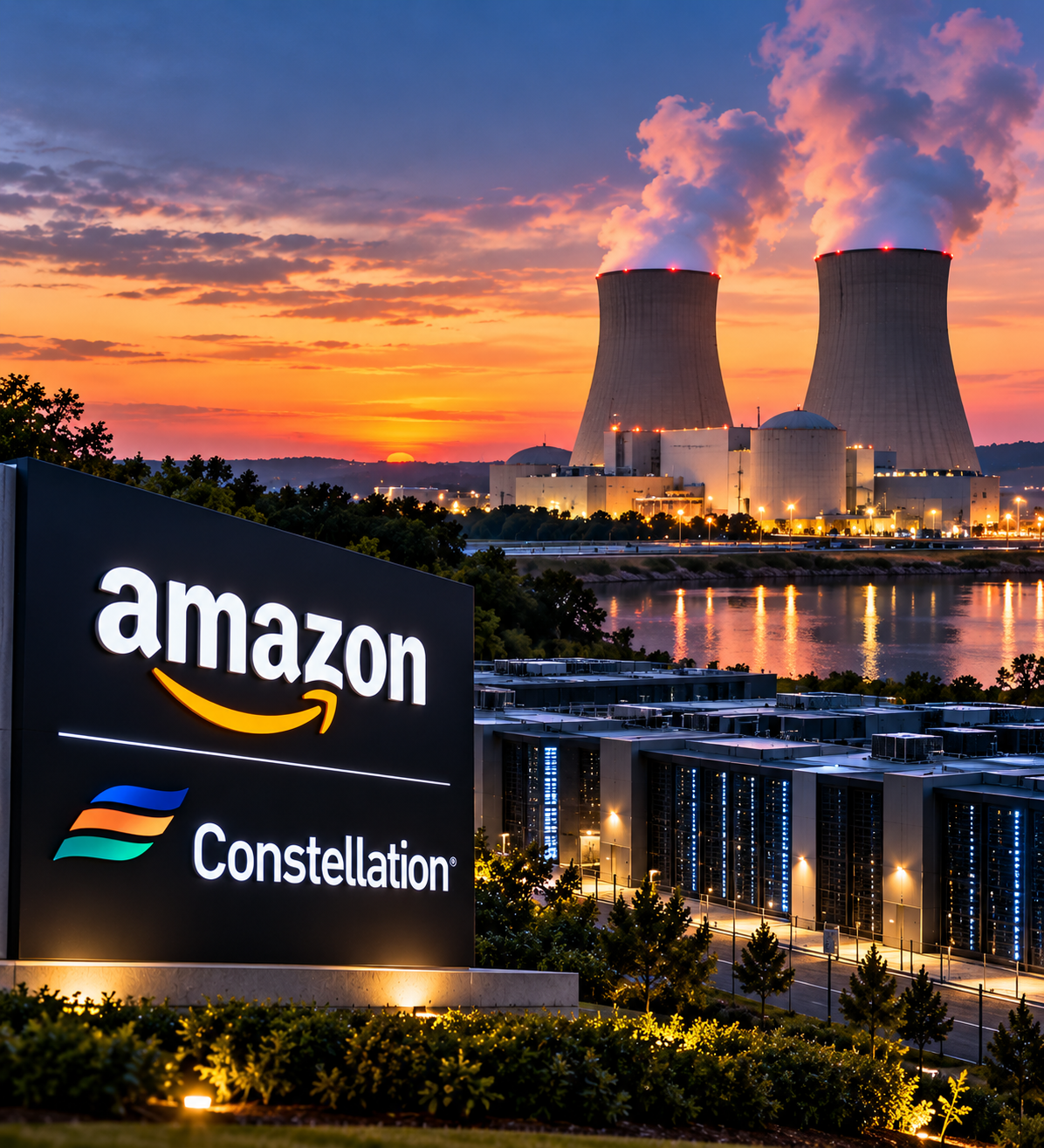
Amazon and Constellation Energy have signed a 20-year power purchase agreement supporting the expansion of Maryland’s Calvert Cliffs nuclear power plant, providing another major example of technology companies securing long-term electricity supplies for the artificial-intelligence infrastructure boom.
The agreement announced Wednesday links one of the world’s largest cloud-computing companies with an existing U.S. nuclear facility as electricity demand from AI data centers continues to rise.
Constellation operates the Calvert Cliffs nuclear plant in Maryland. Under the agreement, Amazon will purchase power associated with the facility over a 20-year period while supporting investments intended to increase the plant’s output.
The transaction reflects a fundamental constraint emerging across the AI industry.
Building advanced data centers requires more than GPUs and servers. Large AI facilities need enormous quantities of dependable electricity, often around the clock, and power availability is increasingly influencing where and how quickly new computing capacity can be deployed.
Nuclear power has consequently attracted growing interest from technology companies because existing reactors can provide large amounts of carbon-free baseload electricity without the intermittency associated with wind and solar generation.
For Amazon, securing long-duration electricity supply also provides greater visibility into one of the largest operating requirements associated with expanding AWS infrastructure.
For Constellation, agreements with technology companies can provide long-term commercial support for investments in existing nuclear assets.
The deal arrives as electricity markets across the United States face increasing pressure from data-center development.
PJM, the grid operator covering Maryland and parts of 12 other states and the District of Columbia, is simultaneously confronting a projected capacity shortage as AI and data-center electricity consumption expands.
Federal regulators on Wednesday ordered PJM to revise a proposed backstop procurement program intended to address an approximately 6,800-megawatt capacity shortfall for the 2028-2029 delivery year.
Together, the developments illustrate the scale of the challenge.
Technology companies are no longer competing only for semiconductor capacity, networking equipment and data-center real estate. They are increasingly competing for access to reliable electricity infrastructure capable of supporting AI computing for decades.
That competition is turning nuclear plants, utilities and power-generation assets into increasingly strategic components of the AI investment cycle.
The Amazon-Constellation agreement also reinforces a broader shift toward long-term contracting between technology companies and energy producers.
For markets, the question is whether existing nuclear facilities and other generation resources can expand quickly enough to meet accelerating data-center demand while avoiding sharply higher electricity costs for other customers.
Investors will now watch whether additional hyperscalers pursue similar long-duration agreements and whether the growing electricity requirements of artificial intelligence accelerate investment in nuclear generation, grid infrastructure and other dependable sources of power.