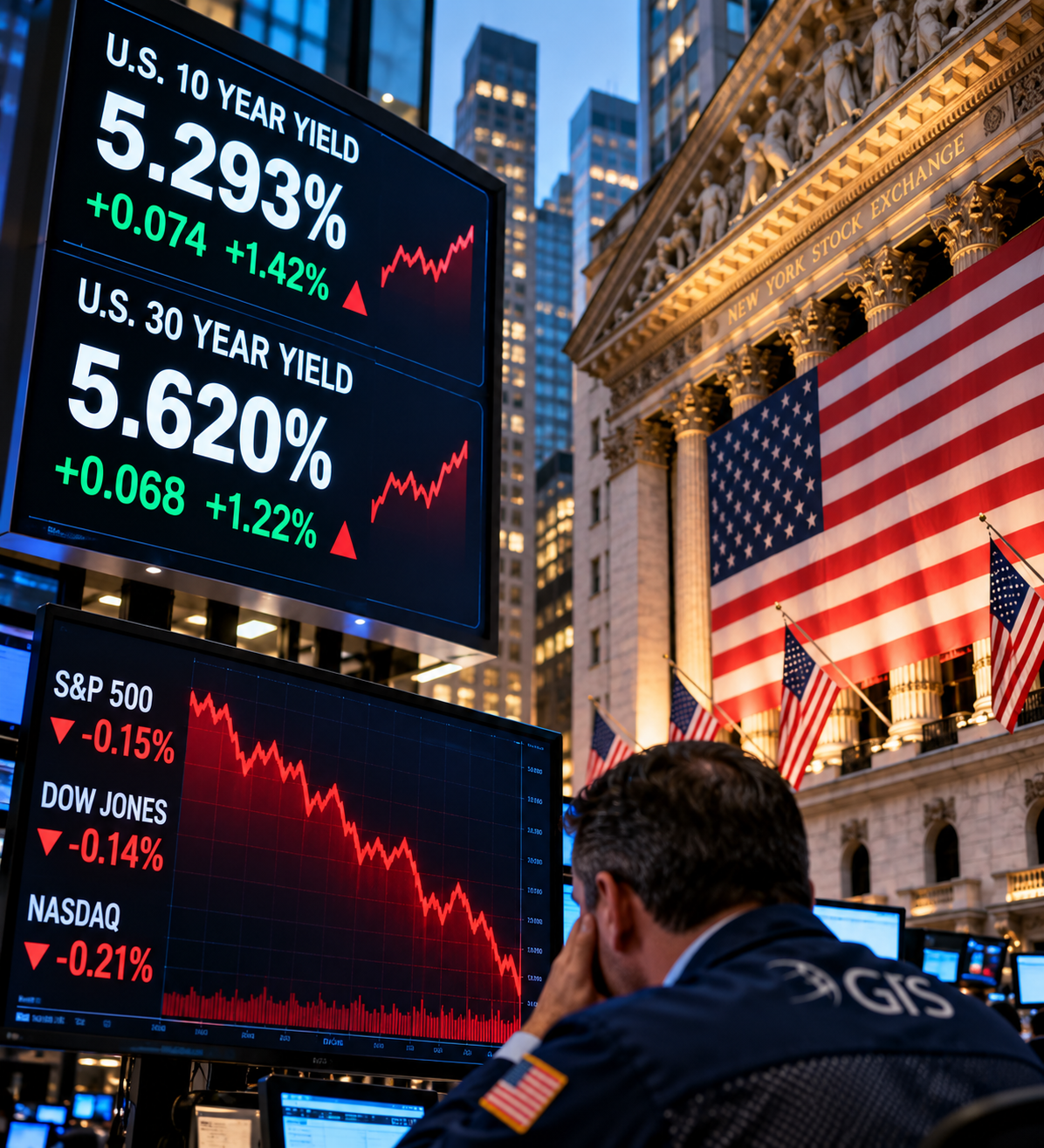
U.S. stocks finished modestly lower Tuesday as exceptionally high Treasury yields continued to restrain risk appetite, although a late shift in Federal Reserve expectations helped markets recover from deeper losses earlier in the session.
The S&P 500 slipped 0.15%, the Dow Jones Industrial Average declined 0.14%, and the Nasdaq Composite lost 0.21%. The relatively small declines masked another volatile session dominated by interest rates, oil prices and uncertainty about the Federal Reserve’s next move.
Treasuries remained the principal pressure point.
The 30-year Treasury yield reached 5.6206%, its highest level in roughly 24 years, while the benchmark 10-year yield climbed as high as 5.293%, a level last seen in 2007.
Those yields matter well beyond the bond market. Higher Treasury rates increase borrowing costs throughout the economy and raise the discount rate investors apply to future corporate earnings, creating particular pressure for richly valued growth and technology stocks.
The tone improved after New York Fed President John Williams said policymakers did not need to move urgently toward another rate increase. Williams said the central bank could evaluate additional economic information before deciding whether further tightening was necessary. He indicated that one additional increase this year could still be appropriate if the economy evolves as expected.
Markets reacted quickly. Expectations for an October Fed increase fell to roughly 51.5% from around 70% earlier in the session.
The shift helped equities recover from their earlier lows, but it did not eliminate the broader bond-market problem.
Economic data offered investors competing signals. U.S. job openings stood at 7.1 million in August, with hiring little changed at 5.2 million and total separations unchanged at 5.1 million.
Consumer sentiment was considerably weaker. The Conference Board’s Consumer Confidence Index dropped 6.7 points to 81.9 in September from 88.6 in August, while its Expectations Index fell for a third consecutive month to 63.6.
Energy provided some relief. Brent crude settled 2.6% lower at $102.59 a barrel while West Texas Intermediate fell 3.5% to $89.38 as signs of recovering Middle Eastern exports reduced immediate supply concerns.
The result is an unusually complicated setup heading into the final trading day of the quarter. Oil pressure is easing, parts of the labor market are cooling and Williams has pushed back against expectations for an immediate Fed move. Yet long-term Treasury yields remain near levels not seen in decades.
Markets now turn toward additional employment and inflation data for evidence about whether the rise in yields represents a lasting tightening of financial conditions or whether softer economic numbers can interrupt the bond selloff.