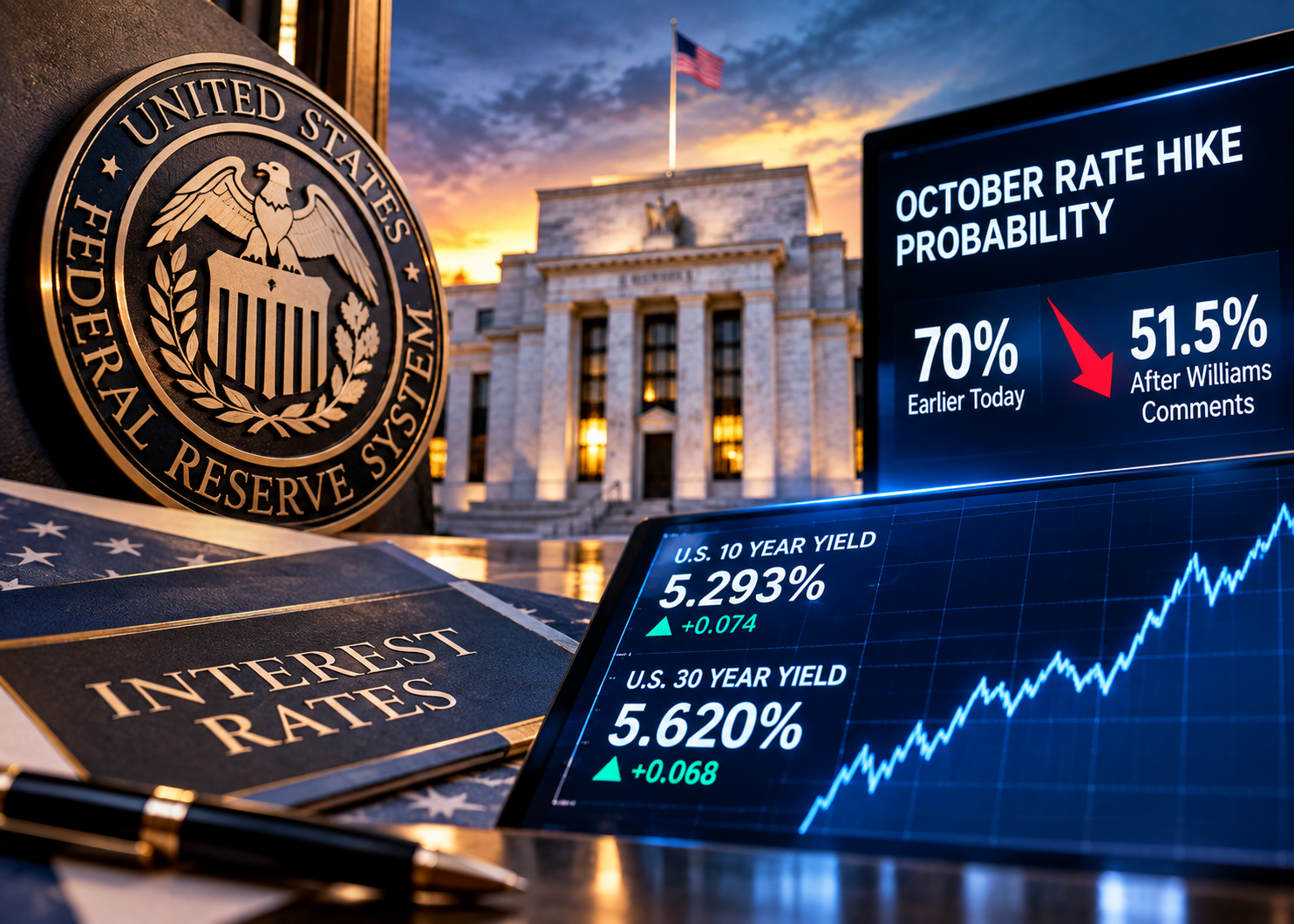
New York Federal Reserve President John Williams pushed back against expectations that another U.S. interest-rate increase must come immediately, saying policymakers have room to evaluate incoming economic data before deciding whether additional tightening is necessary.
Williams said Tuesday that he sees no urgency for the Federal Reserve’s next rate increase following this month’s quarter-point move, which placed the federal-funds target range at 3.75% to 4.00%.
His comments produced an immediate market response.
Traders reduced the implied probability of an October rate increase to roughly 51.5% from about 70% earlier Tuesday.
Williams nevertheless did not declare the tightening cycle finished.
He said another increase by year-end could be appropriate if economic conditions develop broadly as expected, while emphasizing that inflation must return sustainably toward the Fed’s 2% objective.
The remarks are particularly important because they arrived while Treasury yields were testing multi-decade highs.
The 10-year Treasury yield reached 5.293% Tuesday, its highest since 2007, while the 30-year touched 5.6206%, its highest in roughly 24 years. Those market rates themselves tighten financial conditions by increasing borrowing costs for households and companies.
Williams said higher long-term yields should not automatically be interpreted as evidence that inflation expectations are becoming unanchored.
He projected economic growth around 2.25% for 2026 and said inflation should continue moderating over the coming years, while acknowledging that recent energy and tariff pressures have complicated the outlook.
The Fed therefore faces a difficult balance.
Inflation remains above target and energy costs have added renewed price pressure, but consumer confidence is weakening and labor-market indicators are becoming less dynamic.
Tuesday’s JOLTS report showed 7.1 million job openings in August, while hires were little changed at 5.2 million.
For markets, Williams’ message reduces the assumption that another increase is automatic at the October meeting. It does not remove the possibility.
The next major employment and inflation reports will determine whether policymakers receive enough evidence to wait—or whether persistent price pressure forces another move before year-end.