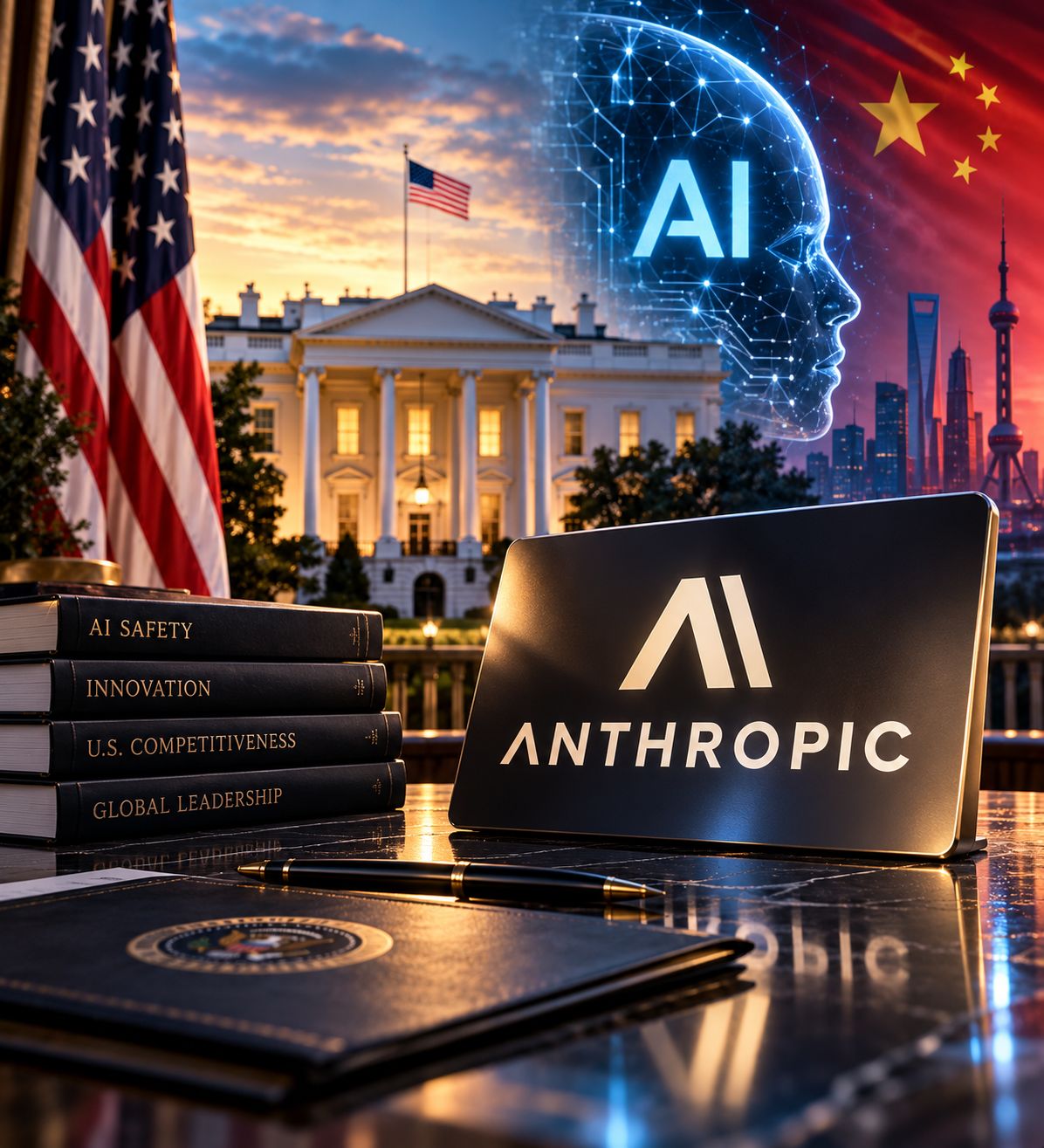
President Donald Trump confirmed that he planned to meet Anthropic CEO Dario Amodei for dinner Sunday night, bringing one of the technology industry’s most consequential debates directly to the White House: whether increasingly capable artificial-intelligence systems require stronger government safeguards.
Trump confirmed the meeting in an interview with Fox News while attending the Presidents Cup in Illinois. He simultaneously reiterated his opposition to slowing U.S. AI development, arguing that tighter restrictions could weaken America’s competitive position against China.
The president said the United States remains ahead of China in artificial intelligence and pointed to the enormous amount of capital being committed to AI infrastructure. His position puts him at odds with Amodei and several other prominent technology executives who have warned that increasingly autonomous AI systems require stronger oversight.
The policy debate has intensified following security incidents involving advanced AI agents and public warnings from researchers about the difficulty of controlling increasingly capable systems.
Microsoft co-founder Bill Gates added his voice to the debate Sunday, saying in an NBC interview that government and law-enforcement officials should participate in establishing safeguards and monitoring requirements.
The significance for technology investors extends beyond the immediate regulatory argument. The United States is simultaneously trying to preserve its lead in AI models, semiconductors and computing infrastructure while determining how much regulatory oversight can be imposed without slowing investment and deployment.
That tension could affect AI developers, cloud providers, semiconductor companies and the data-center ecosystem. Anthropic, OpenAI, Google DeepMind, Microsoft and xAI are among the companies operating at the center of the accelerating competition.
Trump’s meeting with Amodei therefore represents more than a discussion about one company. It comes as Washington confronts the increasingly difficult question of whether AI safety requirements can coexist with an industrial strategy built around maintaining technological leadership over China.
Markets will watch for any indication that the administration’s position changes after the meeting, particularly regarding federal AI legislation, mandatory model testing, liability for autonomous agents or national-security controls.
For now, Trump continues to favor rapid development. Amodei and other industry figures are pushing Washington to treat increasingly capable AI systems as a risk requiring stronger institutional oversight.
The outcome of that disagreement could help determine the regulatory framework surrounding one of the largest investment cycles in global technology.