
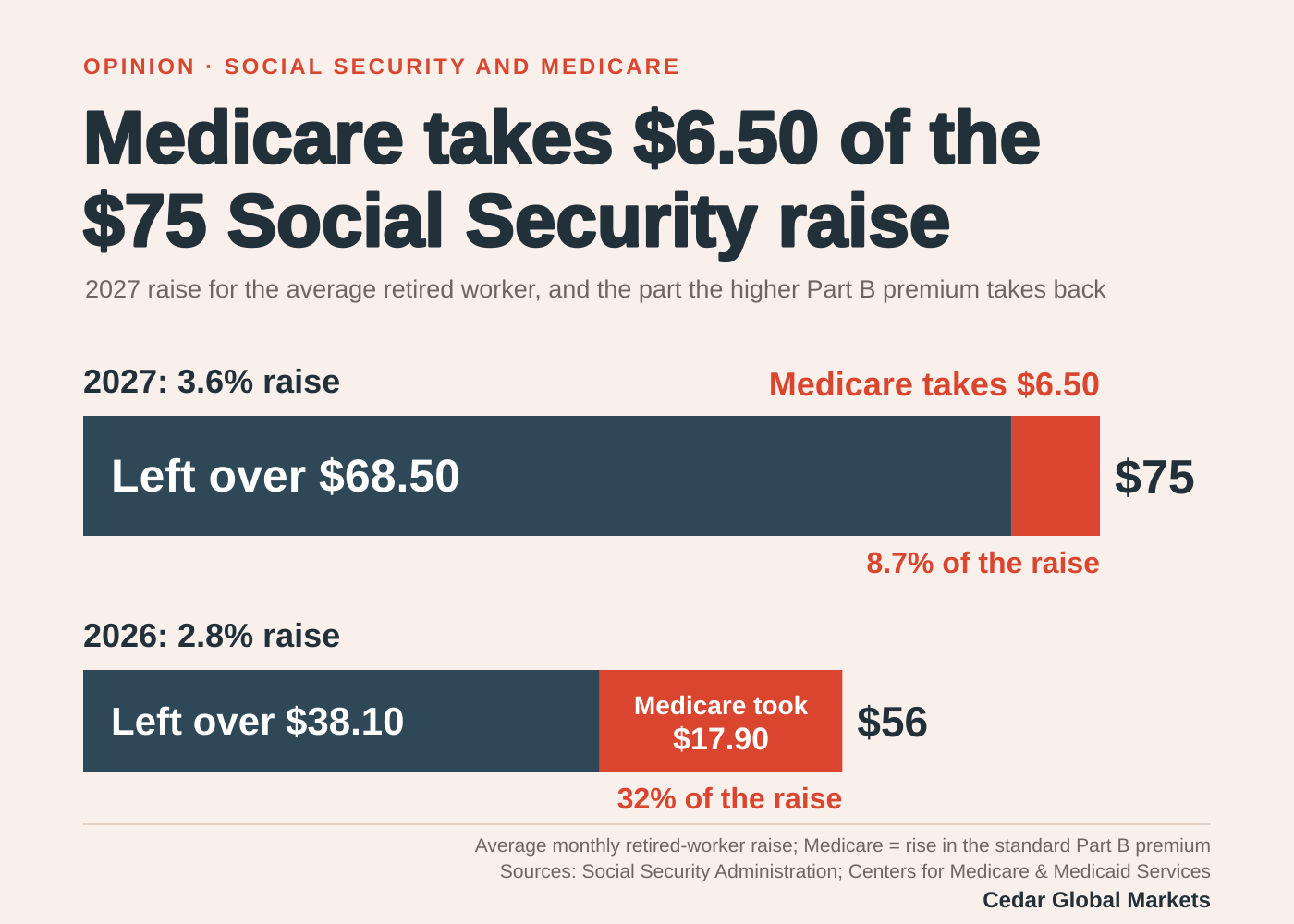
Retirees will get a bigger Social Security raise in January, and this time Medicare will not swallow much of it. The Social Security Administration set the 2027 cost-of-living adjustment at 3.6%, up from 2.8% this year. For the average retired worker, that means about $75 more a month, from $2,095 to $2,170, by the agency’s own estimate. The Centers for Medicare & Medicaid Services then set the standard Part B premium for 2027 at $209.40 a month, up $6.50 from $202.90.
Do the math the way it lands in a bank account. For people who collect Social Security, the Part B premium is usually taken out of the check before it arrives. Take $6.50 from a $75 raise and the average retiree keeps $68.50 a month of the raise, or $822 over the year, before any other changes such as taxes or drug-plan premiums. The higher premium takes back less than 9 cents of every dollar of the raise.
That is a real change from a year ago. The 2.8% adjustment for 2026 lifted the average retirement benefit by $56, from $2,015 to $2,071. The same January, the Part B premium jumped $17.90, from $185 to $202.90. Medicare took back about 32 cents of every dollar of that raise, nearly a third, and left the average retiree about $38 a month more in the check.
This year the premium is rising about 3.2%, a little slower than the 3.6% raise. CMS said the increase is mainly due to projected increases in health care spending. Couples come out ahead too. The agency estimates the average retired couple, both receiving benefits, goes from $3,238 to $3,355 a month, a gain of $117, while their two premiums together rise $13.
But the premium is not the whole bill. The Part B deductible, the amount people pay each year before Part B starts paying its share, rises to $292 from $283. Drug plans and supplemental policies set their own prices, and this math leaves them out. About 9% of people with Part B pay more than the standard premium because of their income, CMS says, with totals reaching $711.80 a month at the top.
There is also the question of what the raise is chasing. The adjustment follows an inflation index for urban wage earners and clerical workers, not one built around retirees. And the raise is bigger this time for a simple reason: prices rose faster. The index’s average for July through September was 3.6% higher than a year earlier. A raise that matches inflation keeps people even. It does not put them ahead, especially while grocery prices are showing signs of turning higher and this year’s Thanksgiving dinner cost more for the first time since 2022.
So the fair verdict is mostly good news, with limits. On the one line most retirees will check in January, Medicare is taking back $6.50 of an average $75, a far smaller bite than last year’s $17.90 of $56. The familiar worry that Medicare eats much of the raise does not hold this time, and it is worth saying so plainly.
What retirees should watch is whether this is a pause or a turn. Medicare premiums follow health care spending, while the raise follows prices at the store and the pump, and the two do not move together. One easier year does not undo a year when Medicare took nearly a third. Social Security says notices with new benefit amounts reach online accounts starting in late November and arrive by mail in December. The number that matters is not the raise. It is what is left after the premium.
…
That’s the story. … Thank you for listening to Cedar Global Markets. We’re supported by our partners, and you can learn more about the partner featured on this page. We’ll see you next time.