
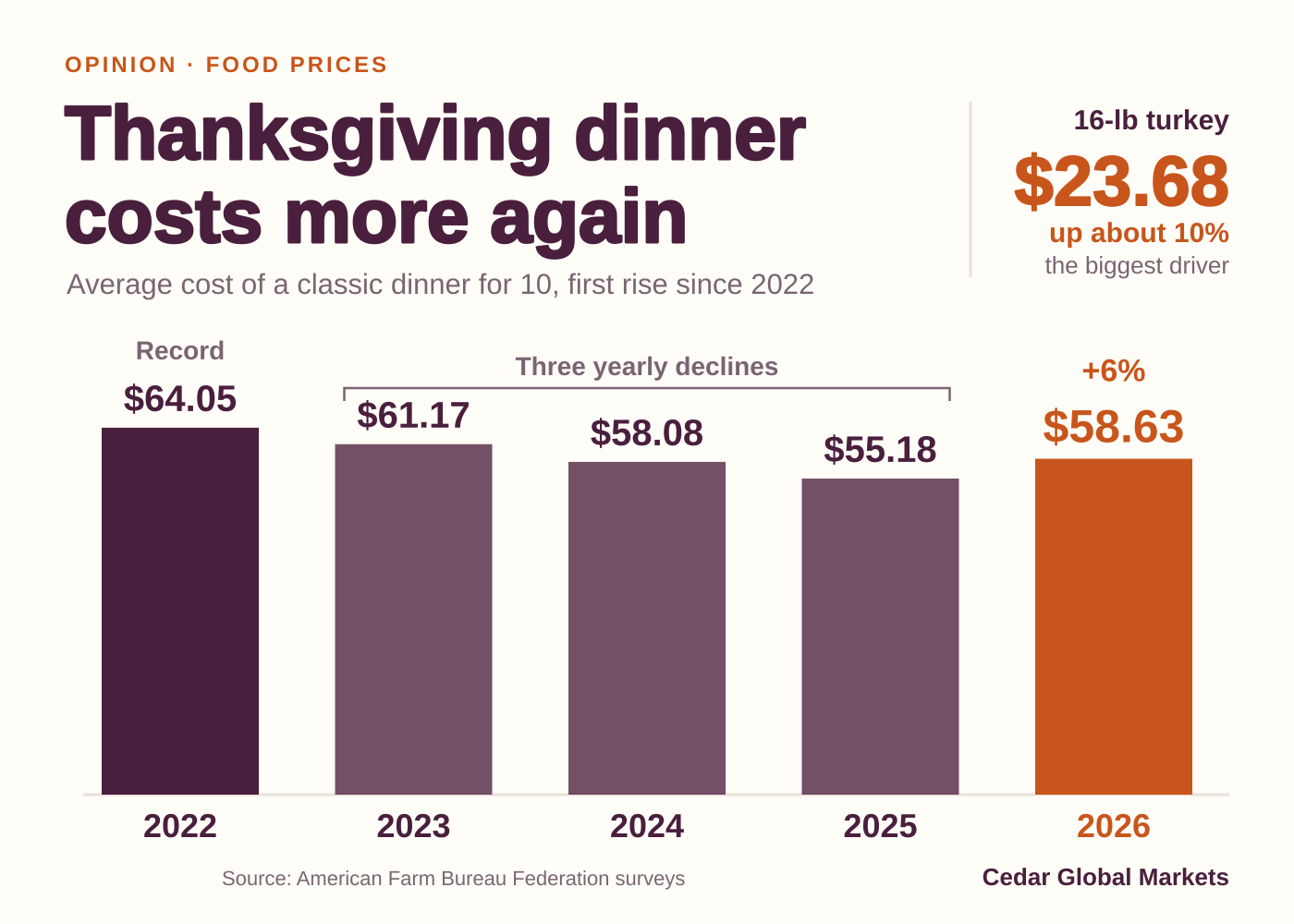
This year’s Thanksgiving dinner cost more than last year’s, the first increase since 2022. The American Farm Bureau Federation’s annual survey put the classic meal for 10 at $58.63, up about 6% from $55.18 in 2025, or roughly $5.86 a person. That is a few extra dollars on a holiday table. It is also a sign that the long run of relief at the grocery store may be over.
Look at the path. The same dinner hit a record $64.05 in 2022, then fell three years in a row: to $61.17 in 2023, $58.08 in 2024 and $55.18 in 2025. Food inflation seemed to have cooled, and the Thanksgiving table agreed. This year it changed direction. The meal still costs more than 8% less than the 2022 peak, the Farm Bureau said, but a price that is falling and a price that is rising feel very different at the checkout.
Turkey did most of the damage. The survey’s 16-pound bird averaged $23.68, about 10% more than a year earlier. The Farm Bureau blamed strong demand and tight inventories, and its deputy chief economist, Faith Parum, pointed to a turkey flock that is still recovering from years of disease. An industry analyst told the Associated Press that demand has been rising as more Americans look for lean protein and as U.S. turkey exports grow.
It would be easy to blame the farmer. The numbers say otherwise. Citing the Agriculture Department’s Food Dollar Series, the Farm Bureau says less than 6 cents of every dollar spent on food goes back to the farm. On the farm side, it lists record diesel costs, elevated fertilizer prices and higher labor expenses. Fuel runs through the processing and trucking of nearly everything in the basket, and drivers are still paying more for gasoline than a year ago. Costs like these rarely fall quickly.
The wider grocery bill points the same way. The Labor Department said its index of prices for food at home rose 0.4% in October alone, one more sign that the long calm in grocery prices may be ending.
Not everything went up. Several items in the survey got slightly cheaper, including the tray of celery and carrots, frozen pie crusts and heavy whipping cream. Where people live matters too. The Northeast paid the most, at $61.57 for 10, followed by the West at $58.74 and the Midwest at $56.89. The South paid the least, at $54.33.
Shoppers also had some help from stores. The Farm Bureau’s volunteer shoppers found turkey for as low as 69 cents a pound, and the AP reported that some stores price Thanksgiving staples lower to draw people in. Aldi told the AP that its version of the Farm Bureau’s menu for 10 cost $39. Deals like those are real, but they are built for one holiday. They do little for the grocery runs of the other 51 weeks.
So keep the size of this in proportion. A rise of $3.45 on a dinner for 10 is not a crisis, and many families may barely notice it. The direction is what deserves attention. When the turkey, the fuel and the farm wages all cost more at once, the bill reaches the table, and it arrives just as the Thanksgiving shopping weekend begins. Anyone who talks about food inflation as a solved problem should look at what Americans paid for this one meal.
…
That’s the story. … Thank you for listening to Cedar Global Markets. We’re supported by our partners, and you can learn more about the partner featured on this page. We’ll see you next time.