
On Wednesday, the Federal Reserve released the minutes of its Oct. 27-28 meeting, and the message was plain. “Almost all participants judged” that raising interest rates again “would likely be appropriate.” A couple of officials said an increase of more than a quarter point could be weighed at the next meeting, on Dec. 8-9, if inflation data were unfavorable.
For many Americans, that will not show up first in a stock portfolio or a mortgage. It will show up on a credit card statement.
Most credit cards charge a variable rate that is tied to the prime rate, and the prime rate moves with the Fed. Right now it is 7%, three points above the top of the Fed’s target range of 3.75% to 4%. When the Fed raises its rate, the prime rate follows, and so do the rates on those cards.
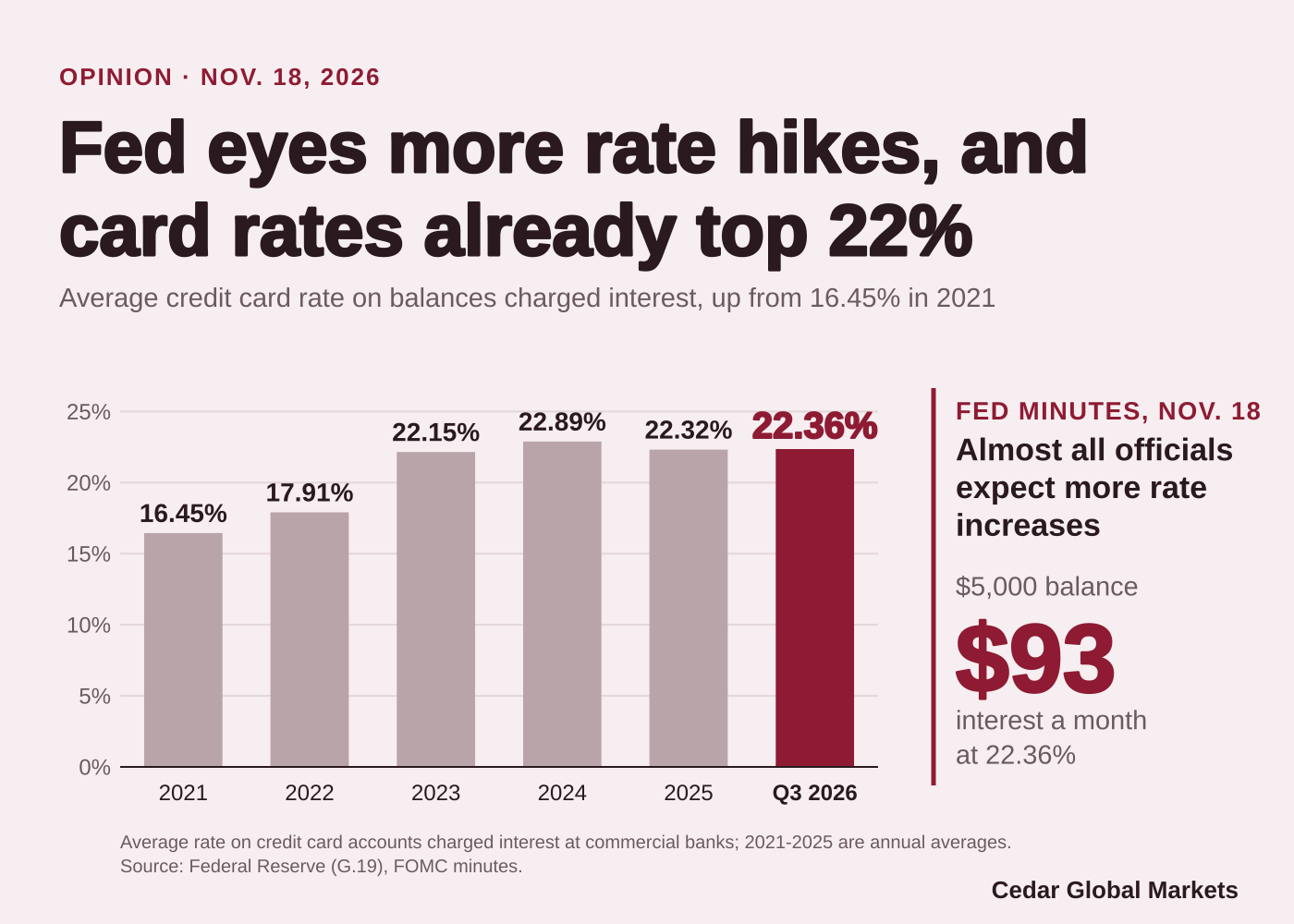
The starting point is already steep. In the third quarter of 2026, the average rate on credit card accounts that were charged interest was 22.36%, according to the Fed’s own data. In 2021 it was 16.45%. Americans owed $1.37 trillion in revolving credit, most of it on cards, at the end of September.
Here is what that means in dollars. At 22.36%, a $5,000 balance costs about $93 in interest a month. A quarter-point increase adds about $1 a month to that. A half-point adds about $2.
That sounds small, and on its own it is. But that is the point. Each increase lands on top of a rate that has already climbed about six percentage points since 2021. Card rates have stayed above 22% for three years.
The Fed knows who feels it. A few officials noted that “higher prices of necessities were straining the budgets of lower- and middle-income households.” The minutes also say that while household credit was sound on balance, credit card delinquencies “stayed elevated relative to pre-pandemic norms.”
None of this means the Fed is wrong to fight inflation. Rising prices are a tax of their own, and they fall hardest on the same families. The Fed’s staff estimated that inflation by the Fed’s preferred measure rose to 3.6% in September, well above its 2% goal.
But the cost of the fight is not shared evenly. Households with savings can earn more as rates rise. Households carrying a card balance pay more, every month, with no say in the matter.
Washington will spend the next three weeks debating the Fed’s rate. For millions of families, the rate that matters is the one printed on their statement. It is worth knowing that number before Dec. 9.
…
That’s the story. … Thank you for listening to Cedar Global Markets. We’re supported by our partners, and you can learn more about the partner featured on this page. We’ll see you next time.