Most Americans never think about how their money moves. They tap a card, a paycheck lands, a bill gets paid. On Tuesday, Federal Reserve Governor Christopher Waller described how that plumbing is starting to change, and savers should pay attention before the change reaches their checking accounts.
Speaking at The Clearing House’s annual conference in New York, Waller said stocks, bonds and commodities are being “tokenized,” or turned into digital tokens that trade on blockchain networks, which run around the clock. To pay for them, firms are building tokenized money: stablecoins, and what Waller called tokenized deposits, “digital transformations of the digits in your checking account.”
The selling point is speed. Waller gave the example of an investor buying a tokenized stock on a Saturday, when many traditional systems are closed, with the payment and the stock changing hands at the same moment. He noted that stablecoins are starting to be used behind the scenes to settle obligations among participants in card networks.
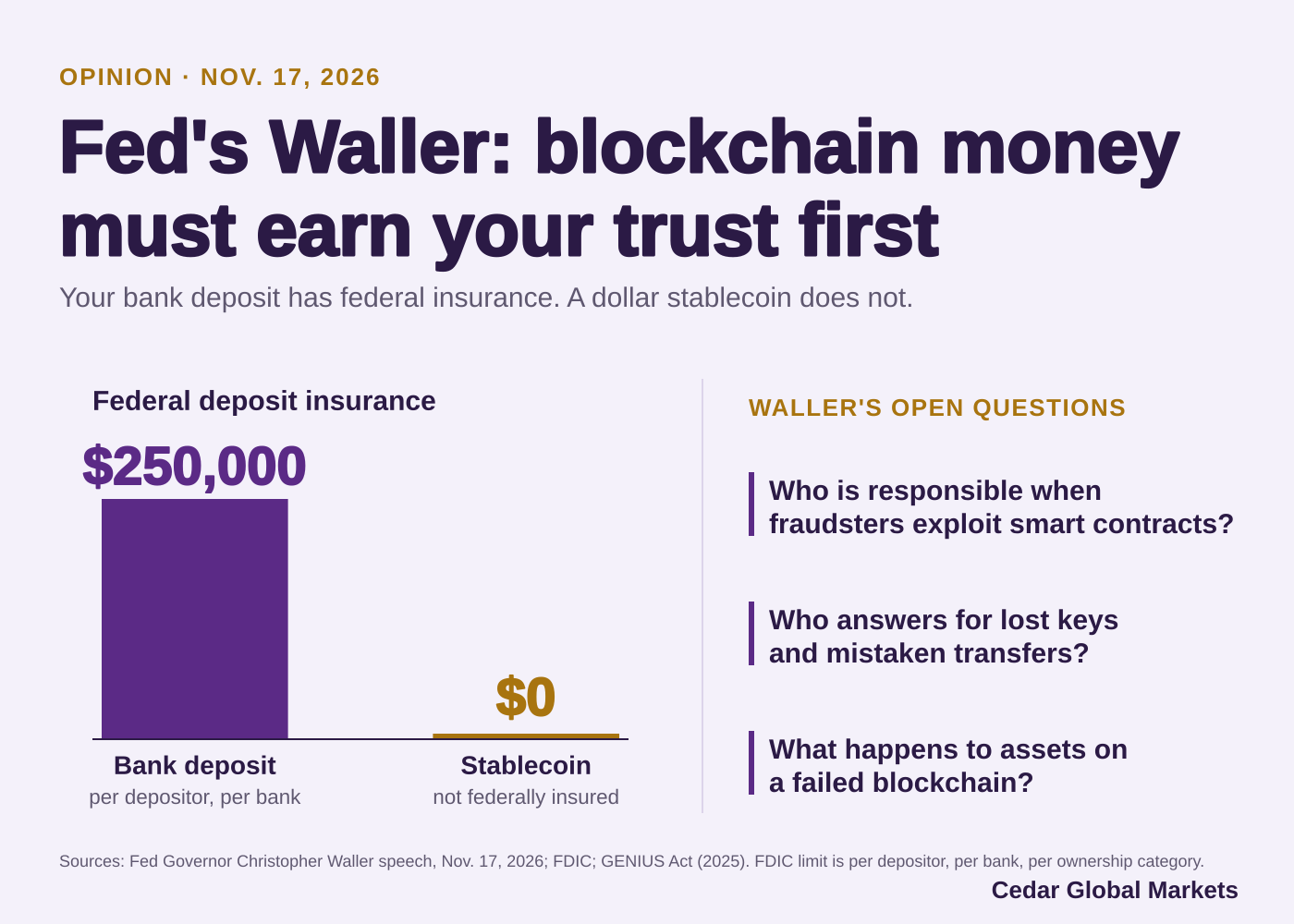
But the most useful part of the speech for ordinary savers was a list of questions he said still need answers. Who bears responsibility when fraudsters take advantage of the automatic execution of smart contracts? Who answers for compromised or lost keys, transfers sent by mistake and pricing errors? What happens to assets stranded on failed blockchains? He pointed to recent events around Binance as an example of the problems that can arise.
Those are not technical details. They are the protections that make today’s bank account safe to use. Deposits at an FDIC-insured bank are covered up to $250,000 per depositor, per bank, for each ownership category. If your debit card is lost or stolen and you report it within two business days of discovering the loss or theft, federal rules generally cap your loss at $50. Stablecoins are different: the GENIUS Act, the federal stablecoin law passed in 2025, says they are not covered by federal deposit insurance and bars issuers from marketing them as insured. Waller noted that stablecoins and tokenized deposits differ in how they are regulated.
Waller, who calls himself a firm believer in the free market, said the market will determine which solutions deserve broader business and consumer trust, and that trust “is hard to win and easy to lose.” He also said that while central bank money need not be used in every transaction, its presence “at the foundation of the system is essential.”
That is the right test for anyone offered a new way to hold dollars. Faster is nice. Before moving money onto a new platform, ask the questions Waller raised, such as who is responsible for a theft or a transfer sent by mistake, and also ask whether the dollars are insured. If the answers are vague, the ordinary checking account is still doing its job.
…
That’s the story. … Thank you for listening to Cedar Global Markets. We’re supported by our partners, and you can learn more about the partner featured on this page. We’ll see you next time.