Federal Reserve Chair Kevin Warsh said Monday that the Fed is preparing for a wide range of outcomes from advanced artificial intelligence, from broadly shared productivity gains to job losses or a letdown that hits stock valuations and the economy.
Opening the Fed’s Productivity and Jobs Task Force Conference at the Federal Reserve Bank of San Francisco at noon Eastern time, Warsh said the widespread adoption of what he calls “super intelligence” will have a significant impact on the economy, “with important implications for monetary policy down the road.” He said the Fed’s role is “neither advocacy nor opposition.”
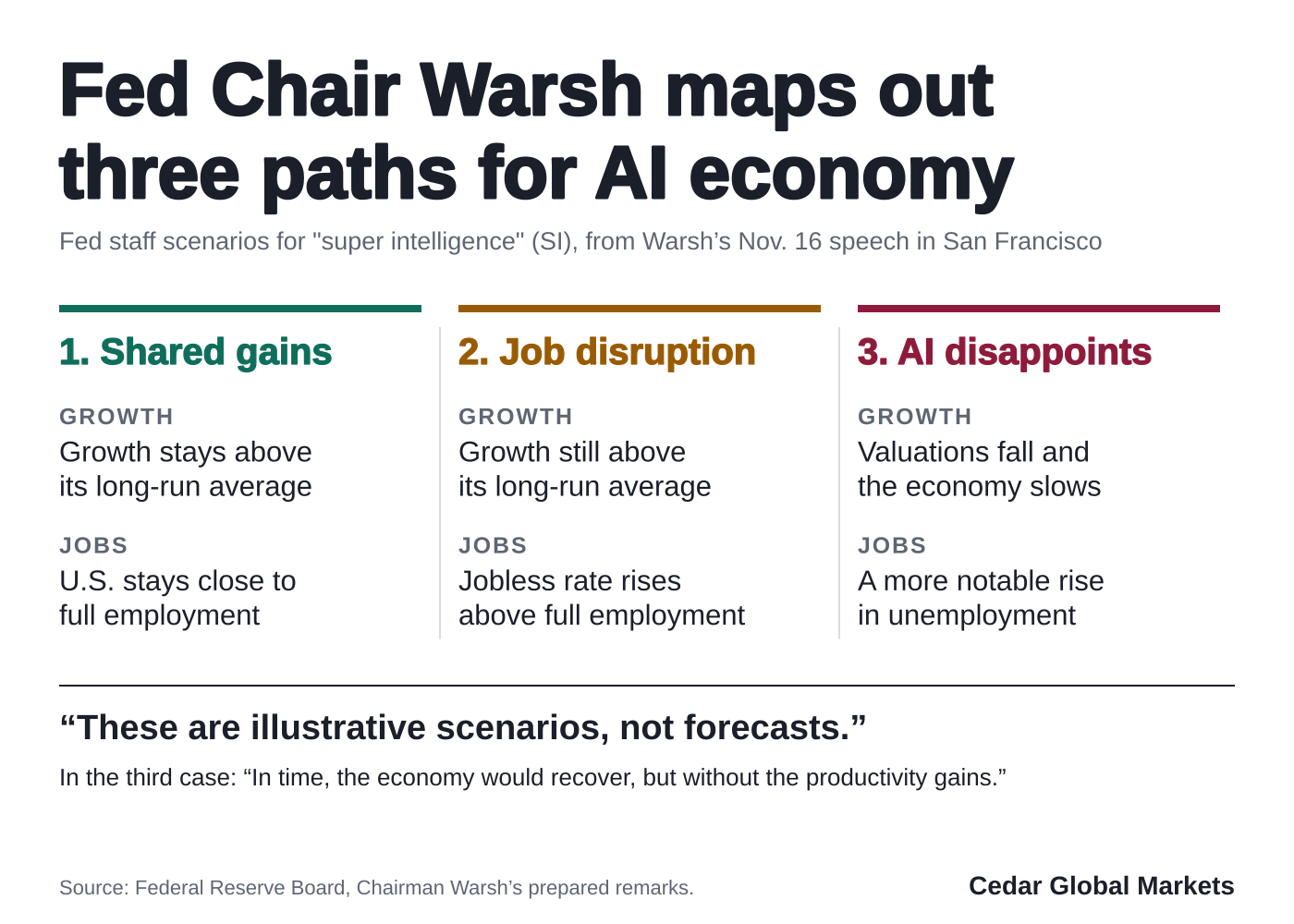
Warsh said the Fed Board’s staff has begun to model several outcomes, which he stressed are “illustrative scenarios, not forecasts.” In the best case, productivity rises, gains are shared broadly between workers and the owners of capital, economic growth stays above its long-run average and the U.S. stays close to full employment. In a second case, growth is still above average, but automation displaces jobs and pushes the unemployment rate above levels consistent with full employment.
In a third case, AI disappoints: after heavy investment and stock market gains, expected returns turn down, equity valuations fall and the economy slows, with a more notable rise in unemployment. “In time, the economy would recover, but without the productivity gains,” Warsh said.
Warsh said productivity growth has been reasonably strong in recent quarters but has not yet broken out “definitively and structurally to the upside.” He did not discuss the path of interest rates. The task force’s three leaders include investor Marc Andreessen, and the conference was set to close with a fireside chat including Warsh and Andreessen. His remarks came as U.S. stocks fell sharply, led by chipmakers, a day before Nvidia reports quarterly results.
…
That’s the story. … Thank you for listening to Cedar Global Markets. We’re supported by our partners, and you can learn more about the partner featured on this page. We’ll see you next time.