
If you carry a balance on a credit card, the Federal Reserve’s next meeting matters to you more than it does to most people. Traders now see an interest rate increase at the Fed’s Dec. 8-9 meeting as all but certain, according to CME Group’s FedWatch tool as reported by CNBC on Thursday. When the Fed raises rates, credit card bills are among the first places households feel it.
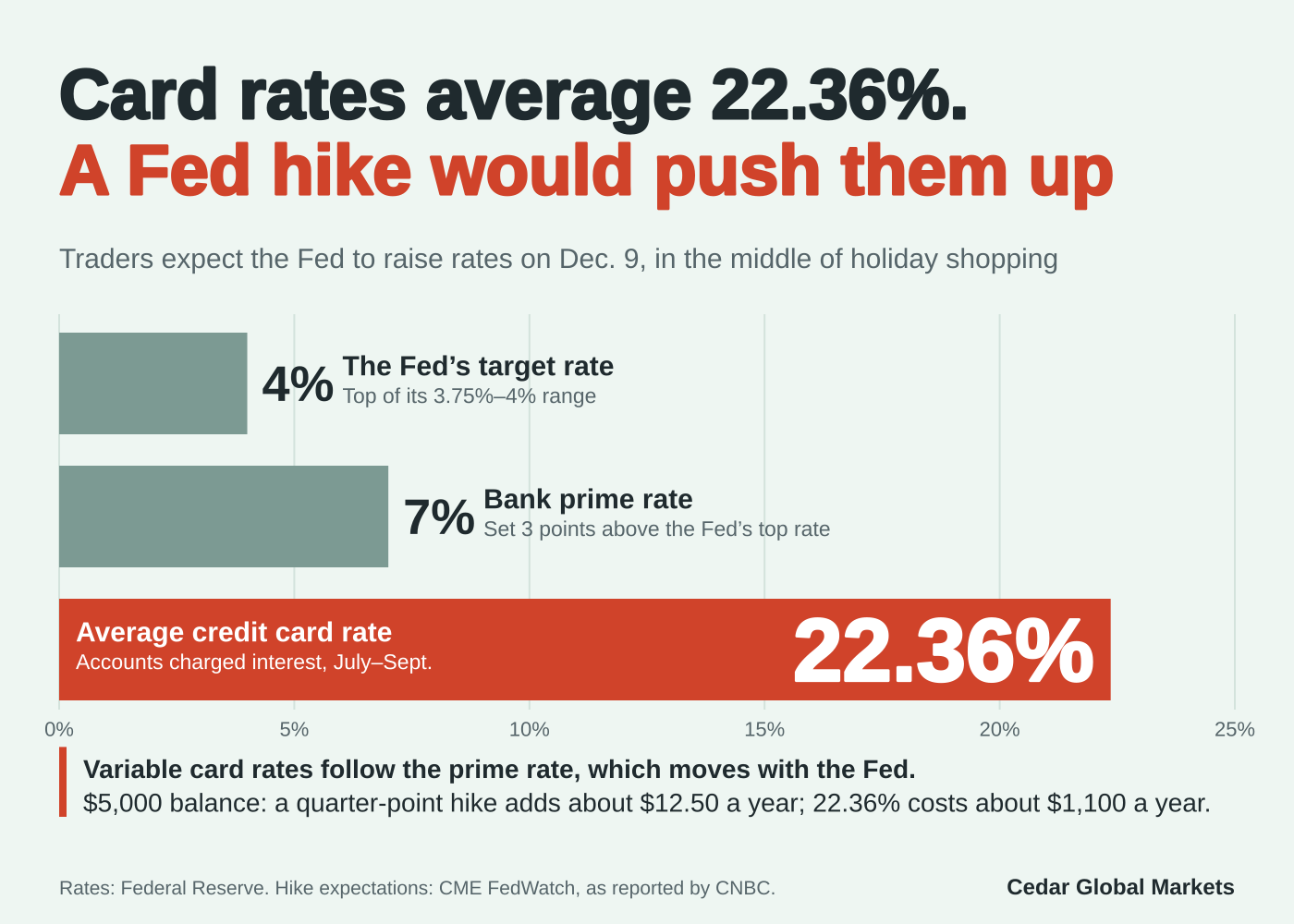
Here is how it works. Most credit cards have a variable rate tied to an index, usually the prime rate. The Consumer Financial Protection Bureau explains that a variable rate “changes with the index interest rate, such as the prime rate published in the Wall Street Journal.” By long-standing convention, banks set the prime rate 3 percentage points above the top of the Fed’s target range. Today the Fed’s range is 3.75% to 4%, and the prime rate is 7%. If the Fed raises its rate a quarter point, prime rises with it, and so do variable card rates.
Card rates are already steep. The average rate at banks on credit card accounts that were charged interest was 22.36% in the third quarter, according to preliminary Fed data released Nov. 6. That is close to the 22.83% of a year earlier and up from 21.52% in the first quarter. Americans’ revolving credit, the category that includes credit card balances, stood at $1.37 trillion in September.
On its own, a quarter-point hike is small. On a $5,000 balance carried for a year, it adds roughly $12.50 in interest. The bigger cost is the rate already in place: at 22.36%, the same $5,000 costs roughly $1,100 in interest over a year if the balance stays there. A hike makes an expensive debt a little more expensive, at the worst time of year.
The timing is what makes this one sting. The Fed would decide on Dec. 9, in the middle of holiday shopping. Variable card rates usually reset within a billing cycle or two after the prime rate moves, so a holiday balance carried into the new year would likely be charged at the higher rate.
The Fed raised rates in September and is expected to raise them again to bring down inflation, and that is its job. But households should not wait to see what it does. The useful steps are simple: pay down the card with the highest rate first, avoid adding new holiday balances you cannot clear in January, and call your card issuer to ask for a lower rate. A promotional balance-transfer offer can help, but read the transfer fee and the date the promotional rate ends.
The smaller your balance when a higher rate kicks in, the less a rate hike can take from you.
…
That’s the story. … Thank you for listening to Cedar Global Markets. We’re supported by our partners, and you can learn more about the partner featured on this page. We’ll see you next time.