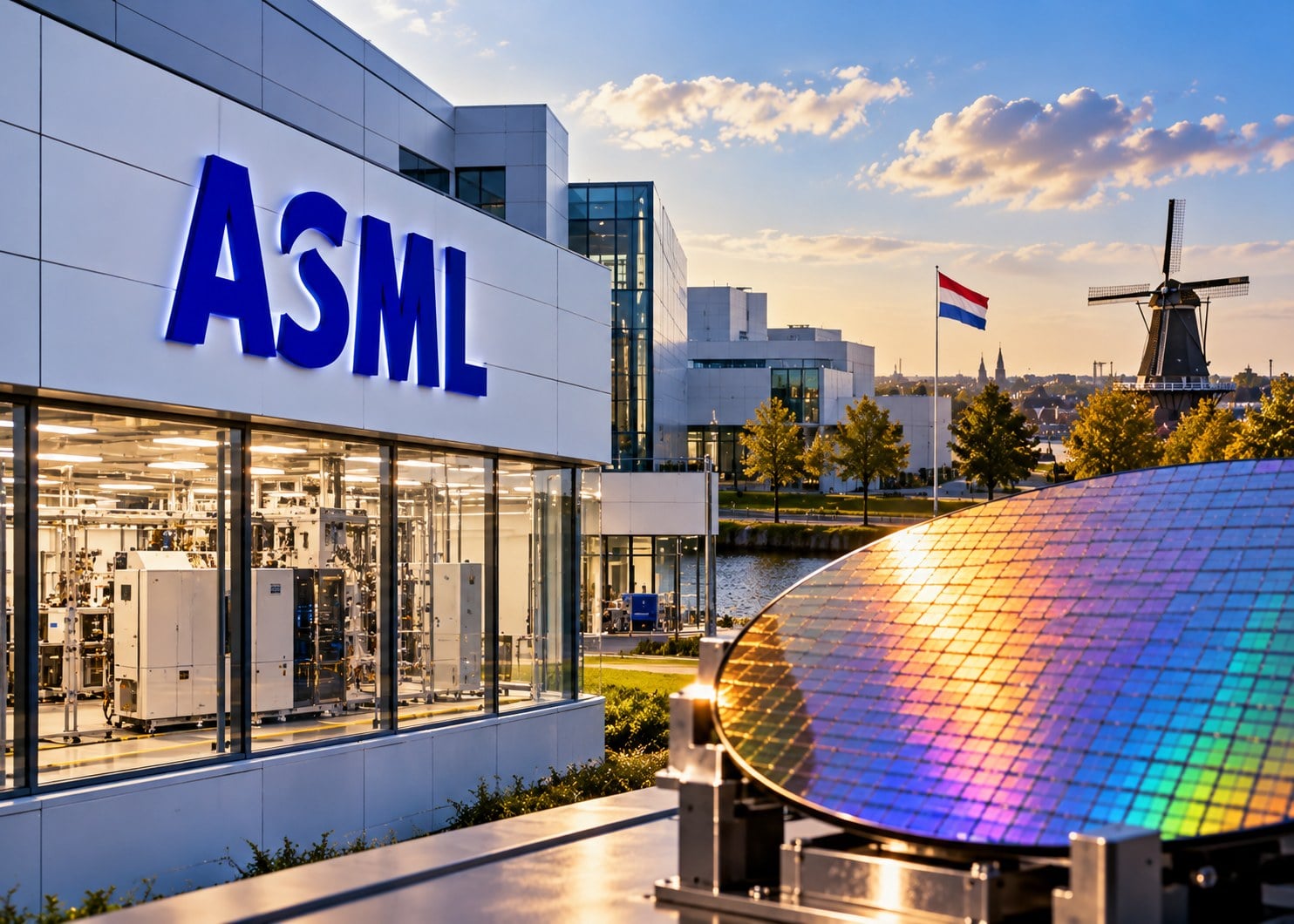
ASML could directly account for as much as 1.6% of the Dutch economy in 2026, according to ING economists, illustrating how the global artificial-intelligence investment boom is increasingly shaping the economic structure of the Netherlands.
ING estimates ASML’s direct contribution has risen from approximately 1.3% in 2025 and just 0.1% in 1995.
The expansion reflects ASML’s unique position in the semiconductor supply chain.
The Dutch company supplies the advanced lithography systems required to manufacture leading-edge processors, making its equipment critical to the AI chip investment cycle.
AI-related demand has helped make ASML Europe’s most valuable listed company, with a market capitalization around €547 billion at the time of ING’s assessment.
The Netherlands therefore occupies an unusual position within Europe.
While policymakers have repeatedly warned that Europe is losing ground to the United States and Asia in high-growth technology industries, ASML has given the Dutch economy direct exposure to one of the most capital-intensive parts of the global semiconductor expansion.
The benefit also creates concentration risk.
ING compared the situation with Finland’s historical dependence on Nokia, whose contribution to the Finnish economy fell dramatically after the company lost ground during the smartphone transition.
ASML faces a different market structure, but risks remain.
Export restrictions involving China, geopolitical pressure on semiconductor supply chains, dependence on specialized foreign components and shortages of skilled labor could all affect future expansion.
ASML is also increasing production capacity and expanding around Eindhoven, requiring additional workers and infrastructure.
The economic significance is therefore becoming broader than the company’s earnings or share price.
For the Netherlands, ASML increasingly influences investment, employment, suppliers, exports and economic growth.
The next question is whether that technology advantage can continue expanding without making Dutch growth excessively dependent on the fortunes of a single globally exposed company.