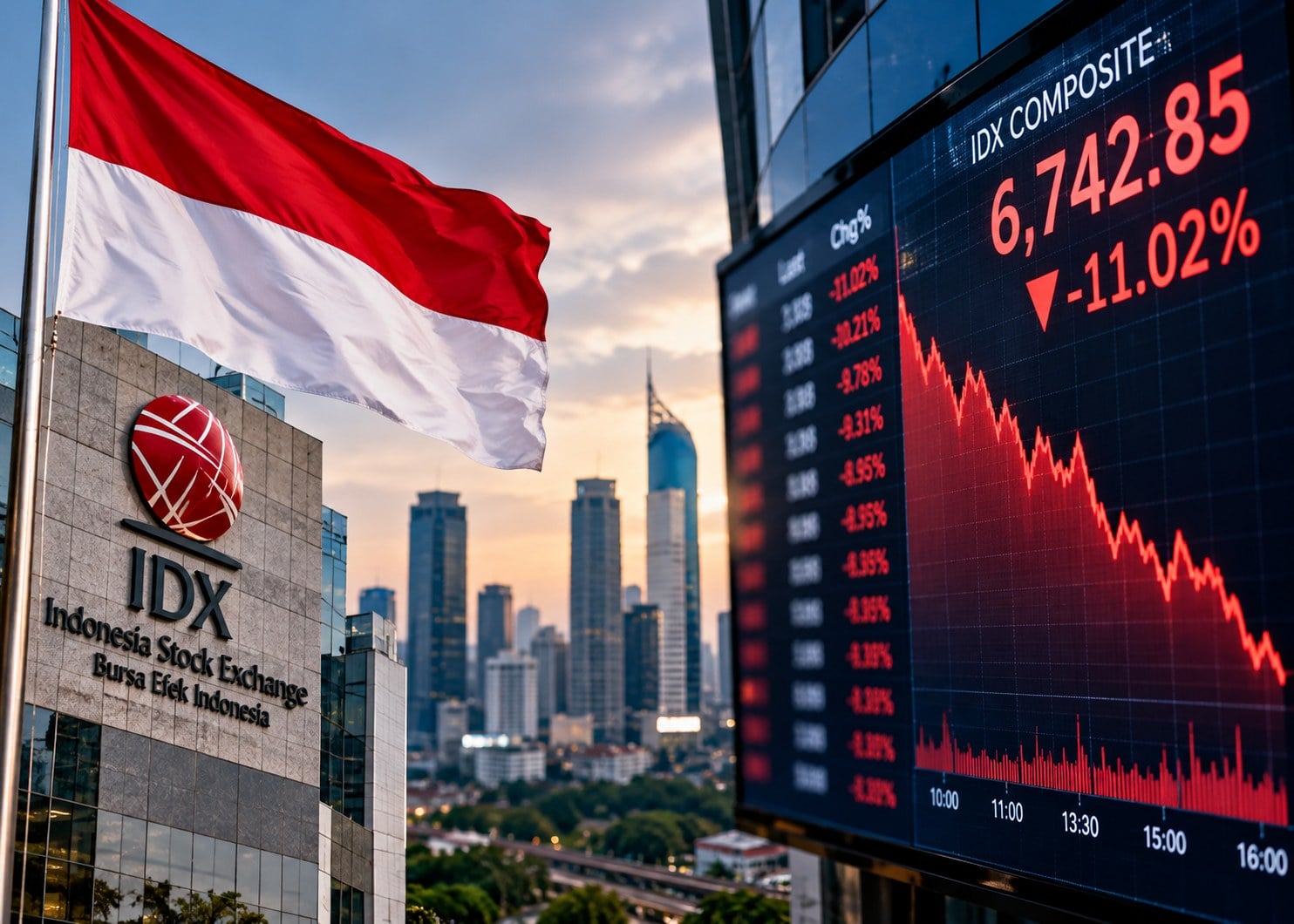
Indonesia’s stock market suffered its steepest one-day decline since 1998 after MSCI warned that the country could lose its emerging-market classification, raising the possibility of significant foreign capital outflows.
Indonesia’s benchmark stock index plunged roughly 11% Friday to a six-year low after MSCI concluded that the market no longer met the standards required for emerging-market status. The Indonesian rupiah fell about 0.6% to 18,070 per U.S. dollar, its weakest level since late July.
MSCI is considering moving Indonesia to standalone-market status and removing Indonesian securities from indexes followed by global investment funds.
The threat is significant because MSCI benchmarks influence how trillions of dollars in institutional capital are allocated around the world.
Funds that track emerging-market indexes mechanically hold securities according to benchmark weights. Removing a country can therefore force index-tracking funds to sell affected stocks regardless of individual company fundamentals.
The potential downgrade follows concerns over market accessibility, transparency and investability.
Indonesia was already among the world’s weakest-performing major equity markets this year before Friday’s decline.
A move to standalone status would place the country outside MSCI’s main developed, emerging and frontier-market classifications, potentially reducing its visibility and accessibility to international investors.
The consequences could extend beyond equities.
Large portfolio outflows could place additional pressure on the rupiah and raise financing costs for Indonesian companies and the government.
The immediate question is whether Indonesian authorities and market regulators can address MSCI’s concerns before a final decision is implemented.
For global investors, Friday’s collapse demonstrates how changes in benchmark classification can rapidly become real capital-flow events rather than merely technical index decisions.